
By Gerardo Arbaiza and Emily Green
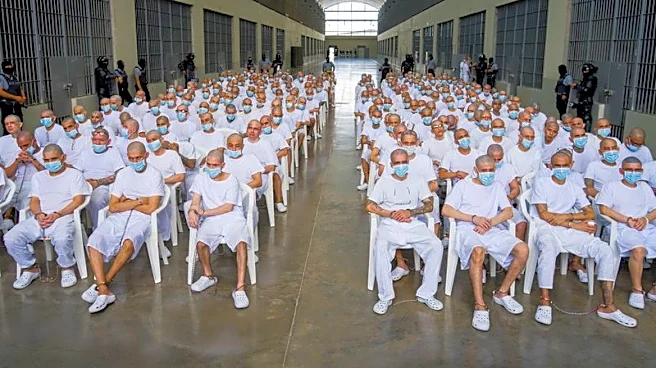
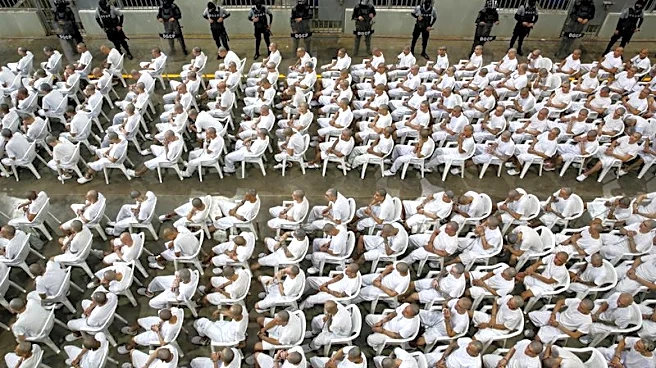
SAN SALVADOR, April 23 (Reuters) - From inside a Salvadoran mega prison, more than one hundred alleged gang members sit in rows, wrists cuffed and ankles shackled, to
watch court proceedings on a large screen that will decide the fate of all of them.
Reuters witnessed the scene on Thursday as the court oversaw the trial of 486 suspected gang members in the largest mass trial yet under President Nayib Bukele's crackdown on gang violence.
Since April 2022, Bukele has used state-of-emergency powers to suspend constitutional rights and detain over 91,000 people, primarily those suspected of being members of the MS-13 and Barrio 18 gangs. His New Ideas party also passed a law that made El Salvador Latin America's only country to allow mass trials.
Bukele, who has been in office since 2019, is publicizing the current trial and has granted Reuters access to the prison.
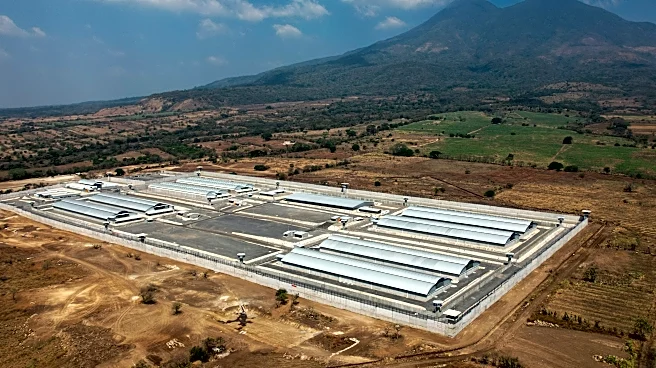
The defendants are being held across five prisons including the maximum-security CECOT opened in 2023 that has become a symbol of Bukele's zero-tolerance crackdown.
The prisoners at CECOT dress in all-white uniforms and have their heads shaved, some revealing tattoos linked to MS-13. Heavily armed guards stand watch.
Prosecutors have accused the alleged gang members of more than 47,000 crimes committed between 2012 and 2022, including extortion, arms trafficking and homicide.
But the defendants in the mass trial are only accused of gang membership and would be sentenced based on affiliation, said Ana Maria Mendez, director for Central America of the Washington Office on Latin America. Like all criminal court proceedings in El Salvador, the trial is closed to the public.
"There is no way to see and verify that the information the prosecutors present is true. Secrecy is now the norm in El Salvador," Mendez said.
Considering the number of detainees and length of pre-trial detention, mass trials are likely to become commonplace in El Salvador, she said.
"Mass trials are just formalities," said Salvadoran criminal defense lawyer Roxana Cardona. "They violate the right to defense, which allows lawyers to sit down with their accused clients and build a defense strategy. In mass trials, that is completely lost."
A Bukele spokesperson and representative for the attorney general's office did not respond to texted requests for comment outside of regular office hours.
Bukele has defended mass trials as necessary for the war on gangs, who once ruled swathes of the country. His tough-on-crime policies has won him broad support from Salvadorians, making him one of Latin America's most popular leaders.
The Inter-American Commission on Human Rights on Tuesday reiterated concern over rights violations during El Salvador's state of emergency and called for an end to its use to fight crime.
The government has credited the gang crackdown under emergency powers for pushing the homicide rate down last year to 1.3 per 100,000 people compared to 7.8 in 2022.
(Reporting by Emily Green and Gerardo Arbaiza; Editing by Christopher Cushing)