





By Gertrude Chavez-Dreyfuss
NEW YORK, April 14 (Reuters) - Bond investors are doubling down on so-called "curve steepener" trades that are bullish on short-dated U.S. Treasuries but bearish on the long end, reflecting expectations that the Federal Reserve will eventually resume cutting interest rates.
In a steepener, yields on longer-dated Treasuries rise relative to short-term maturities, as investors demand greater compensation for holding debt exposed to longer‑term risks such as inflation and mounting
U.S. fiscal deficits.
That stance has persisted even amid uncertainty over the war in the Middle East, with investors saying a curve steepener remains a viable trade whether the conflict de‑escalates or worsens. That points to growing concern among investors about the U.S. fiscal picture, which until recently appeared to be somewhat on the mend.
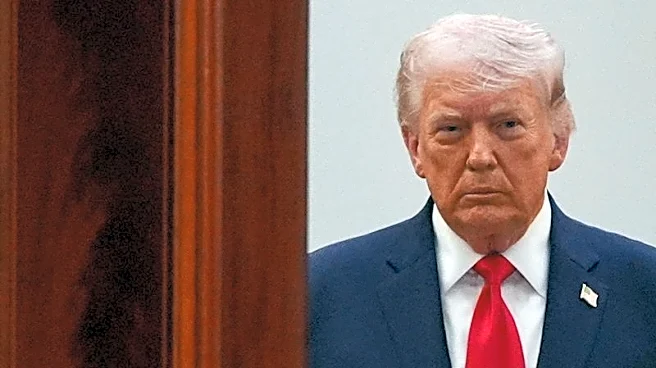
On Sunday, President Donald Trump said the U.S. Navy would begin blockading the Strait of Hormuz after marathon talks with Iran failed to secure an agreement to end the war. It's a move that could upend what had already been a fragile two‑week ceasefire.
But bond market players may have already factored in the worst outcome from the war and are moving past it. The latest reading on the MOVE index, a measure of rate volatility, showed a decline to a five-week low of 72.15, after hitting a roughly one-year peak of 115.02 in late March.
The rate options market is also signaling calmer conditions ahead, with analysts pointing to short volatility positioning across the curve. The move reflects expectations of reduced turbulence in interest rate swaps - instruments used to hedge interest rate risk and exposure to Treasuries.
"We're heading through a rocky period, but unless we go back into a full-scale war, which is not our central view, we think ultimately this will die away slowly but surely," said Padhraic Garvey, head of global rates and debt strategy at ING in New York.
"The back end of the curve has issues with inflation expectations and on the front end, we're not expecting the Fed to react by hiking rates," he said, adding that a curve steepener makes sense.
The latest steepening strategy also reflects a view that the Iran conflict will not evolve into a sustained inflation crisis that will compel the Federal Reserve to raise interest rates. Instead, downside risks to growth that result from weakening demand caused by higher oil prices, including cracks in the labor market, will skew policy toward more rate cuts at some point.
Front‑end rates will therefore remain anchored by easing expectations, or a no-rate-hike outlook. Long-end yields, on the other hand, will continue to push higher with the persistent rise in prices including the prospect of elevated issuance of Treasuries arising from high fiscal deficits that need to be funded.
"As yield curves are normalizing, you will see the probability of cuts go higher," said Vishal Khanduja, head of the broad markets fixed income team at Morgan Stanley Investment Management in Boston.
"We do think that we'll come back to one or two cuts this year after the war and that's because of the labor market. There is underlying weakness in the labor market that will become a lot more apparent as you go through the quarters."
PRICING OUT RATE CUTS
But for now, rate cuts have been effectively priced out.
On Monday, U.S. rate futures were factoring in 6 basis points of cuts in 2026, according to LSEG estimates, compared with roughly 55 bps before the war began in late February. By late July next year, futures imply about 15 bps of rate declines.
That repricing has left investors more focused on inflation risks further out the curve, where longer‑dated Treasuries remain vulnerable. Fuel prices are likely to keep rising for months even after the Hormuz Strait reopens and the U.S. Energy Information Administration predicted last week that benchmark Brent crude prices will average $96 a barrel this year.
Aside from inflation, the long end could also be undermined by heavy government debt issuance and broader fiscal pressure resulting from the war. The Pentagon is seeking more than $200 billion in supplemental funding from Congress for the Iran war, which is on top of the roughly $900 billion defense bill already signed for fiscal year 2026.
In that environment, Morgan Stanley's Khanduja believes the U.S. Treasury 5/30 yield curve has the most room to steepen. On Monday, the spread between five-year note yields and those on 30-year bonds was 96.9 bps. It was at 114 bps before the war, before falling to 82 bps in the midst of the conflict.
That view is shared by other strategists, who argued that the steepening case holds even under more adverse scenarios. Even if the war in the Middle East intensifies, the trade remains attractive, said Guneet Dhingra, head of U.S. rates strategy at BNP Paribas.
"If escalation continues, the focus is going to turn toward: where is the funding for this...going to come from? It's not just one-time funding, but also the persistent increase in the U.S. defense budget," Dhingra pointed out.
"In an escalation scenario where growth concerns offset inflation fears, front-end yields do not rise, while the long end starts to rise because deficit concerns start to build."
(Reporting by Gertrude Chavez-Dreyfuss; Editing by Colin Barr and Andrea Ricci )