


By Niket Nishant and Gregor Stuart Hunter
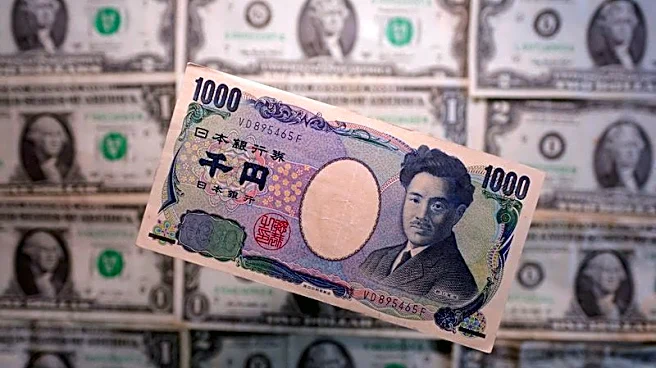
Aug 17 (Reuters) - The dollar fell to its lowest level in more than two months on Monday as traders trimmed U.S. rate hike bets against the backdrop of a run of softer economic data, leaving the euro at two-month highs and the battered yen on stronger ground for now.
The yen strengthened 0.13% to around 159.15 per dollar, brushing aside weaker-than-expected Japanese economic growth data. Japanese and U.S. authorities intervened in currency markets in late July
to stem the yen's weakness.
The dollar index, which measures the dollar's value against a basket of other major currencies, trimmed some losses after falling to its lowest since early June. The euro hit a two-month high at around $1.1614, last up 0.18% on the day.
JACKSON HOLE SYMPOSIUM
The repricing comes as markets prepare for the Federal Reserve's Jackson Hole symposium next week, where investors will look for clues on policymakers' interpretation of the latest economic data.
Joint efforts by the U.S. and Japan to stem the slide in yen have also set up a delicate backdrop for currency markets and the focus has shifted to whether the Bank of Japan will raise rates soon.
"Intervention changed the path. It didn't eliminate the interest-rate incentive supporting the carry trade," Matthew Tuttle, CEO of Tuttle Capital Management, said.
Carry trades refer to the practice of borrowing cheaply in a currency with low interest rates, such as the yen, to chase higher returns elsewhere.
Japan's economy grew at a slower-than-expected pace in April to June, due to lacklustre household spending and business investment that analysts say mainly reflected one-off factors.
RATE PUZZLE KEEPS MARKETS ON EDGE
The yen's fortunes also hinge on the U.S. rates outlook.
Last week's data showing a surprise drop in retail sales and benign inflation have led markets to conclude that the urgency for further hikes has been diminished.
Traders expect just a 30.6% chance of a rate increase at the Fed's September meeting, compared with 52.2% a week ago, according to the CME FedWatch tool.
Still, "there were enough quirks in the data to keep the market on guard for a potential rate hike before the end of the year", Thomas Simons, chief U.S. economist at Jefferies, said.
Markets may remain sensitive to incoming data, commentary at Jackson Hole and developments in the Middle East. Lack of fresh guidance from the Fed has also left investors manoeuvring in an increasingly murky rate environment.
"Ask 10 people about their outlook on Fed policy rates, and you'll probably get 20 answers back," Simons added.
Against the Chinese yuan, the dollar was 0.07% lower at 6.7398 in offshore trade, hovering at its weakest since 2023.
China's industrial output growth slowed while retail sales grew less than expected in July, data on Monday showed.
Meanwhile, the stalemate in the Middle East continued, with Iran calling on the U.S. to accept defeat while President Donald Trump told Americans to prepare for continued high fuel prices.
Brent crude was 0.62% higher on the day at $89.07 per barrel.
(Reporting by Niket Nishant in Bengaluru and Gregor Stuart Hunter in Singapore; Editing by Stephen Coates, Kate Mayberry, Dhara Ranasinghe and Andrew Heavens)