






By David Lawder
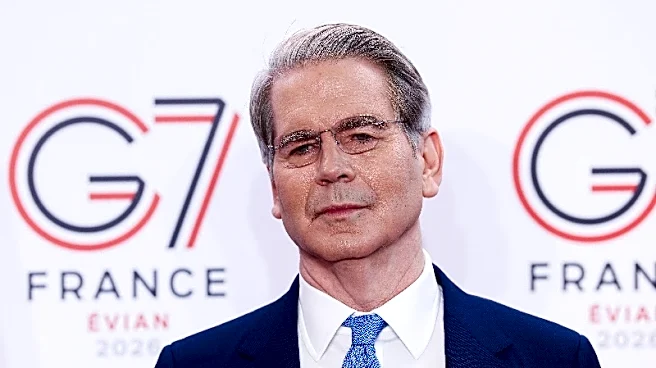
PARIS, May 19 (Reuters) - U.S. Treasury Secretary Scott Bessent on Tuesday called on allies to more forcefully disrupt Iran's financing networks and said the Treasury would scrub its sanctions list of outdated designations to make it easier for financial institutions to root out the most sophisticated terrorist financing schemes.
In remarks prepared for delivery at an anti-terrorism financing conference after G7 finance leaders met in Paris, Bessent said that participants needed to
"stand with us in full measure" against Iran.
"That will require, for example, our European partners to join the United States in taking action against Iran by designating its financiers, unmasking its shell and front companies, shuttering its bank branches, and dismantling its proxies," Bessent said. "It will require those of you in the Middle East and Asia to root out Iran's shadow banking networks."
As the Trump administration tries to pressure Tehran to reopen the Strait of Hormuz to unlock vital oil flows disrupted by the U.S.-Israeli attacks on Iran, the U.S. Treasury has stepped up its sanctions efforts through a program dubbed "Economic Fury." It aims to disrupt Iran's shadow banking networks, and has frozen nearly half a billion dollars worth of cryptocurrency linked to Iran's regime.
To make this more effective, the Treasury will modernize its sanctions architecture because "our adversaries adapt and innovate" by creating new shell companies.
Most U.S. Treasury sanctions are imposed on individuals, companies and other entities that are added to its Specially Designated Nationals List, which contains tens of thousands of designees that are cut off from the dollar-based financial system and see assets frozen. Anyone that transacts with designated entities risks being sanctioned themselves.
"To sharpen national security outcomes, Treasury is tailoring our sanctions program for the 21st century. We are reviewing outdated and obsolete designations to help financial institutions focus on the most sophisticated terrorist financing and sanctions evasion schemes," Bessent said.
He said the most effective sanctions are aggressive and targeted, and those left in place too long could create unintended consequences.
"Sanctions are meant to change behavior, not to punish populations," Bessent said. "Sanctions left in place for years with no visible and tangible changes in behavior can have generational impacts that are nearly impossible to predict."
He said the Treasury's approach would "maintain agility to maximize effectiveness" and cited examples of easing sanctions on Syria and Venezuela after regime changes as examples of how the Trump administration intends to adjust sanctions.
(Reporting by David Lawder; Editing by Chizu Nomiyama)