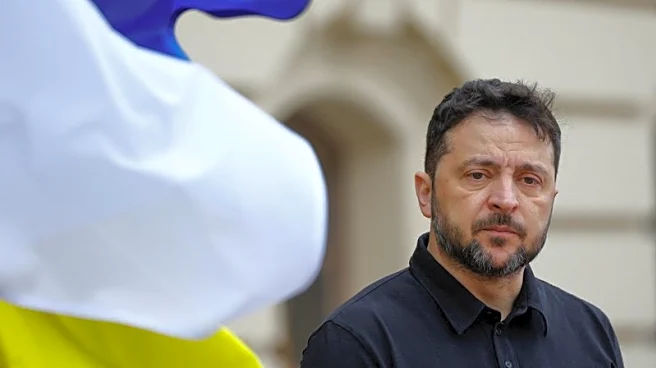

Dec 22 (Reuters) - Ukrainian President Volodymyr Zelenskiy said on Monday that negotiations conducted with the United States and European nations aimed at ending the nearly four-year war with Russia were
"very close to a real result."
Ukrainian negotiators led by senior official Rustem Umerov, along with representatives from Europe, have held a series of meetings with U.S. envoys, including in recent days in Florida.
Russian negotiator Kirill Dmitriev, President Vladimir Putin's investment envoy, has also been holding separate talks with U.S. officials in Florida.
Officials in both Ukraine and Russia said their teams were returning home on Monday to report on the outcome of the discussions.
"It all looks quite worthy ... And here it is important that this is the work of both us (Ukraine) and the United States of America. This suggests that we are very close to a real result," Zelenskiy told a gathering devoted to Ukrainian diplomats.
U.S. 20-POINT PLAN ON THE TABLE
Zelenskiy said the negotiators had been working on a 20-point plan, put forward by U.S. envoys, which has been under discussion for weeks after an initial draft was criticised by Ukrainians and Europeans as being too slanted towards Russia.
"Not everything is ideal with this, but the plan is there," he said.
Also under discussion were security guarantees Ukraine has been seeking to guard against any future Russian military action once the fighting stops, as well as a plan for Ukraine's economic recovery.
"The basic block of all the documents is ready. It's basic," Zelenskiy said. "There are some matters for which we are not prepared. And I am certain that there are matters for which the Russians are not prepared."
The U.S. team has been led by President Donald Trump's envoy, Steve Witkoff, and his son-in-law, Jared Kushner.
Speaking later in his nightly video address, Zelenskiy said the key issue was to determine whether the United States was able to "get a response from Russia, real readiness on the part of that country to focus on something other than aggression."
He said continued pressure on the Kremlin was vital to reduce Moscow's capacity to wage war.
"Lowering the price of Russian oil, strong global sanctions and continued other forms of pressure are what can persuade even a stubborn person," he said.
"This year, much has already been done to reduce the money available to Russia's war machine."
(Reporting by Ron Popeski and Oleksandr KozhukharEditing by Rod Nickel)