
By Diego Oré
MEXICO CITY, Jan 23 (Reuters) - The Mexican government is reviewing whether to keep sending oil to Cuba amid growing fears within President Claudia Sheinbaum's administration that Mexico could
face reprisals from the United States over the policy, which is a vital lifeline for the Communist-run Caribbean island, according to three sources familiar with the discussions.
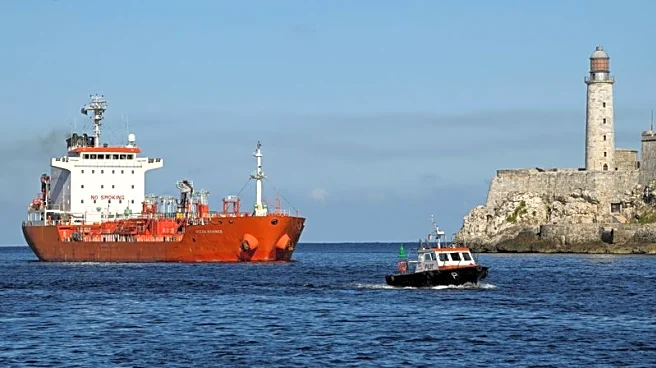
A U.S. blockade of oil tankers in Venezuela in December and the dramatic capture of President Nicolas Maduro this month have halted Venezuelan oil shipments to Cuba, leaving Mexico as the single-largest supplier to the island that suffers from energy shortages and mass blackouts.
Mexico's pivotal role in sending oil to Cuba has also put the U.S.' southern neighbor in Washington's crosshairs. President Donald Trump has stressed Cuba is "ready to fall" and said in a January 11 Truth Social post: "THERE WILL BE NO MORE OIL OR MONEY GOING TO CUBA - ZERO!"
Publicly, Sheinbaum has said Mexico will continue oil shipments to Cuba, saying they are based on longterm contracts and considered international aid. But the senior Mexican government sources said the policy is under internal review as anxiety grows within Sheinbaum's cabinet that the shipments could antagonize Trump.
Mexico is trying to negotiate a review of the USMCA North American trade pact, while also persuading Washington it is doing enough to combat drug cartels and that U.S. military action against the groups on Mexican territory is neither welcome nor needed.
The government review of Cuban oil shipments has not been previously reported, and the sources requested anonymity to discuss the sensitive matter. It remains unclear what ultimate decision the Mexican government might take, with sources saying a complete halt, a reduction, and a continuation in full are all still on the table.
The Mexican presidency told Reuters the country "has always been in solidarity with the people of Cuba" and added that shipping oil to Cuba and a separate agreement to pay for the services of Cuban doctors "are sovereign decisions." The Cuban government did not respond to a request for comment.
A White House official said: “As the President stated, Cuba is now failing on its own volition ... there will be no more oil or money going to Cuba from Venezuela, and he strongly suggests Cuba makes a deal before it is too late.”
LAND ATTACKS ON CARTELS
In recent weeks, Trump has ratcheted up pressure on Mexico, saying the country is run by the cartels and that ground attacks against them could be imminent. Sheinbaum has repeatedly stressed that any unilateral U.S. military action in Mexican territory would be a grave breach of the country's sovereignty.
"There is a growing fear that the United States could take unilateral action on our territory," one of the sources added.
During a phone call last week, Trump questioned Sheinbaum about crude and fuel shipments to Cuba and the presence of thousands of Cuban doctors in Mexico, two of the sources said. Sheinbaum responded that the shipments are "humanitarian aid" and that the doctors deal "is in full compliance" with Mexican law, the sources familiar with the call said. They added Trump did not directly urge Mexico to halt the oil deliveries.
The three sources said officials in Sheinbaum's government are also increasingly concerned about a growing presence of U.S. Navy drones over the Gulf of Mexico since December. Local media have reported, using flight-tracking data, that at least three U.S. Northrop Grumman MQ-4C Triton drones have conducted a dozen flights over the Bay of Campeche, roughly following the route taken by tankers carrying Mexican fuel to Cuba.
These same reconnaissance aircraft were spotted off the Venezuelan coast in December, days before the U.S. attack on the South American country.
Sheinbaum has spearheaded an offensive against the notorious Sinaloa Cartel and approved three unprecedented mass transfers of nearly 100 drug kingpins to the United States.
These measures have been praised by high-ranking U.S. officials, but Sheinbaum has repeatedly stated that unilateral U.S. action on Mexican soil represents a red line.
"Very little of the crude oil produced in Mexico is sent to Cuba, but it is a form of solidarity in a situation of hardship and difficulty," Sheinbaum said on Wednesday. "That doesn't have to disappear," she added.
CUBA'S MEXICAN OIL LIFELINE
Trump's pressure campaign against Cuba dates back to his first term when he reversed much of the historic rapprochement orchestrated by former Democratic President Barack Obama, and has only increased since the Republican returned to office a year ago.
Secretary of State Marco Rubio, a Cuban American, has been a driving force behind Trump's Venezuela policy, which he and other U.S. officials also see as potentially weakening Maduro's Cuban allies. But the constraints on Trump's approach to Cuba are more daunting, given Havana's regional and international support, the entrenched nature of Cuba's leadership and security forces, and the ability the country has shown to withstand decades under a tough U.S. economic embargo.
The largest island in the Caribbean relies heavily on fuel imports of refined products to meet its demand for electricity generation, gasoline, and aviation fuel. U.S. sanctions and a deep economic crisis have prevented the Communist government from purchasing enough fuel for years, forcing it to depend on a small group of allies.
Within Sheinbaum's government, the three sources said, there is a belief that Washington's strategy of cutting off Cuba's oil could push the country into an unprecedented humanitarian disaster, triggering mass migration to Mexico. For this reason, they added, some in the government are pushing to maintain some fuel supplies to the island.
With Venezuelan supplies to Cuba stopped, it appears unlikely that other oil producers would step in to make up the shortfall, given the U.S. focus and heavy military presence in the region. The U.S. has seized tankers that had been involved in the Venezuelan oil trade, vessels in the shadow fleet that supply crude from countries under U.S. sanctions, including Iran and Russia.
Between January and September last year, Mexico shipped 17,200 barrels per day of crude oil and 2,000 bpd of refined petroleum products to Cuba worth approximately $400 million, according to information reported by Mexican state oil company Pemex to the U.S. Securities and Exchange Commission.
(Reporting by Diego Oré; Additional reporting by Adriana Barrera in Mexico City and Dave Sherwood in Havana; Editing by Ana Isabel Martínez, Stephen Eisenhammer, Rod Nickel)