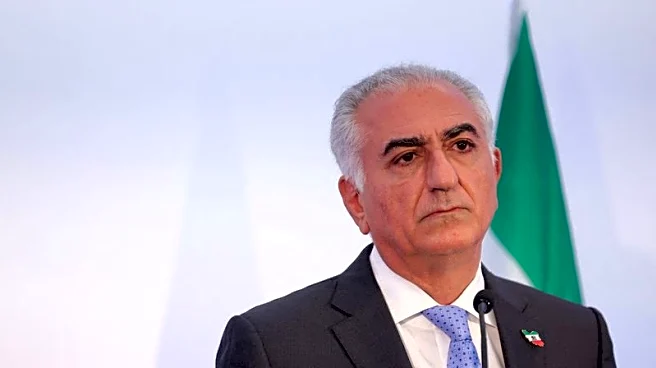

Jan 11 (Reuters) - In a nation where opposition to almost half a century of clerical rule has long been fragmented, the son of the last shah of Iran has become a prominent voice spurring on protesters
staging the biggest anti-government demonstrations in years.
Reza Pahlavi, 65, has sought to speak as a national leader despite living outside Iran since before his father was toppled in the 1979 Islamic Revolution.
In messages sent from his home in the United States, he has repeatedly praised Iranians demanding change and, like those who ended his father's rule, calling for an end to repression.
"We will completely bring the Islamic Republic and its worn-out, fragile apparatus of repression to its knees," he said in one of his most recent messages, in a video posted on X.
HOW MUCH SUPPORT DOES PAHLAVI HAVE IN IRAN?
How much public support Pahlavi now commands in Iran, where he has not set foot for decades, is difficult to gauge.
Some protesters have voiced support for him in verified videos circulating on social media, with some chants of "Long live the shah", suggesting his messages may be galvanising some people.
Many others simply call for sweeping political change, with slogans such as "Down with the dictator", a reference to Supreme Leader Ayatollah Ali Khamenei, who under Iran's system of clerical rule has the final say in all state matters.
Others shout slogans demanding action to fix an economy hammered by years of international sanctions and pummelled by a 12-day war in June, when Israel and then the U.S. launched airstrikes on Iran.
The dire economy was the catalyst for the latest protests.
"Everything Reza Pahlavi learned about ruling a country came from his own father who failed for a reason. We had Pahlavis, now it is time for a democratic country," said Azadeh, 27, in a message from northern Iran.
Pahlavi has frequently called for change, particularly during bouts of unrest, including mass demonstrations in 2009 over a contested election and nationwide protests in 2022 over the death of Mahsa Amini, a young woman who died while in detention for allegedly violating Islamic dress codes.
In those protests, there were few obvious signs of momentum in support for a man who the exiled royal court in 1980 declared shah after his father's death from cancer in a Cairo hospital.
PAHLAVI SAYS HE IS READY TO LEAD A TRANSITION
Unlike in the 1979 revolution, there is no single voice driving the opposition.
Five decades ago, Ayatollah Ruhollah Khomeini became the voice of revolutionary fervour, spurring on demonstrators - even those who wanted a secular system to prevail in Iran. Khomeini's recorded speeches smuggled in on cassette tapes from his exile abroad stoked opposition to Pahlavi's father.
In his messages over the past two weeks, which have been blocked as the government has shut down the internet, Pahlavi has told Iranians he is ready to lead a transition.
He has long said he would let the people decide on who should rule them, but he has been clear that he wants an end to theocratic rule.
"There is only one way to achieve peace: a secular, democratic Iran. I am here today to submit myself to my compatriots to lead them down this road to peace and a democratic transition," he said in a speech posted on X on June 23, shortly before the end of last year's 12-day war.
SUPPORT AMONG DIASPORA
Born in 1960, Pahlavi was declared crown prince in 1967 at his father's coronation in Tehran. Images show him sitting beside his father's jewel-encrusted throne in a child's version of the shah's uniform, peaked cap on his lap and gold brocades on his small shoulders.
The monarchy's lavish style at that time helped fuel discontent when Iranians compared it to their own hardships, with surging inflation and a big wealth divide as the shah's bid to modernise the oil-powered economy left many people behind.
Iranians also sought an end to repression by the shah and his feared security apparatus, SAVAK.
Pahlavi left Iran before his father was forced out, heading to the United States to train as a fighter pilot. He later wrote that he offered to serve in the war with Iraq in the 1980s when the young theocratic Iranian state came under attack, but that his offer was turned down.
He studied political science at university.
From exile, Pahlavi, who is married with three children, has garnered support in the diaspora, including Iranians in the U.S., with his criticism of Iran's rulers and calls for change.
In 2023, he visited Israel, a close ally of Iran in his father's day and an implacable foe of the Islamic Republic now, and met Prime Minister Benjamin Netanyahu and other officials.
He supported the Israeli and U.S. strikes in June that mainly hit Iran's nuclear facilities, but said more action was needed to support Iran's people. Israel and Western states accuse Iran of seeking nuclear weapons, which Iran denies.
But he has gained little traction in winning personal support from Western governments abroad - neither in Washington, a close ally of Iran in the shah's time, nor in European capitals, which have long been critical of the Islamic Republic and its nuclear programme.
As the latest protests have unfolded, U.S. President Donald Trump has said he would support Iranians if security forces fire on them, but also said on Friday he was "not sure that it would be appropriate" to meet Pahlavi.
(Writing by Edmund Blair;Editing by Timothy Heritage)