
By Claire Fu
SINGAPORE, Aug 26 (Reuters) - The European Union is finding support on an opponent's turf ahead of trade talks with Beijing, as Chinese workers vent on social media about excessive overtime
that critics say gives exporters an unfair advantage.
Europe, which last year ran a trade deficit with China of roughly $1 billion a day, has given Beijing until October to address growing imbalances that it says are hollowing out domestic industries and causing mass layoffs.
A key EU complaint is China's weak domestic demand, caused in part by sluggish wages and insufficient labour protection, which is depressing imports - including from Europe - and is forcing Chinese producers to seek overseas markets.
Amid those tensions, one of Brussels' older tools to tackle the issue is drawing greater attention on China's heavily censored internet. The EU Forced Labour Regulation, adopted in 2024 and taking effect in December 2027, bans goods produced with imposed or involuntary work, including excessive overtime.
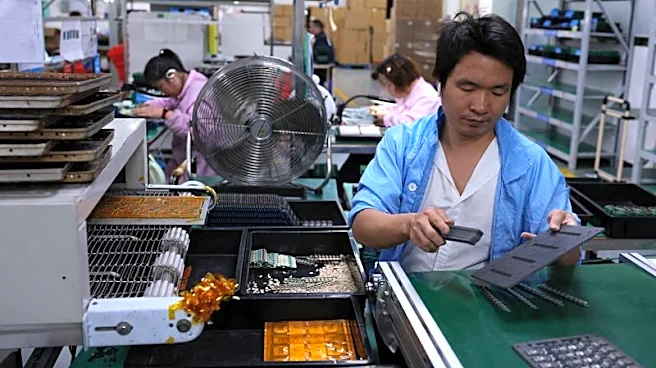
The regulation strikes a chord with many Chinese workers, who have long complained about the "996 culture" of 12-hour shifts, six days per week.
"I think the EU is right to sanction forced labour. Who agrees and who disagrees?" read a recent post on RedNote, China's Instagram-like platform, drawing almost 3,000 likes before being removed.
Users in the comments section expressed support for sanctions and shared information on filing complaints with EU authorities.
Analysts say the online interest in the topic reflects growing concerns over a weakening labour market and mounting pressure from employers grappling with deflationary price wars fuelled by overcapacity and competition in export markets.
"Some workers have found that while a company may not be particularly concerned about an individual domestic overtime dispute, it may be far more concerned about losing access to Western markets," said Mingwei Liu, director at the Centre for Global Work and Employment at Rutgers University.
China's human resources ministry and the cyberspace administration, which oversees online content, did not respond to requests for comment.
INTERESTS OF CHINESE EXPORTERS AND WORKERS DIVERGE
On Douyin, China's version of TikTok, videos tagged "EU reporting website" and "EU reporting procedures" received more than 200,000 views. One video explaining the formal complaints process received 5,442 likes and 714 shares.
Xiao Qiang, founder of the U.S.-based China Digital Times, which tracks Chinese censorship, said other platforms appear to be limiting the audience reach of such posts.
Nevertheless, Xiao said the topic's emergence in spite of that shows many Chinese people do not view exporters' interests as synonymous with national interest.
"History won't remember its view count, but this was the first time someone connected domestic labour grievances directly to foreign law enforcement mechanisms," he said.
An EU Commission source said its departments have received informal allegations of labour violations, including excessive overtime, but had not seen a noticeable increase in complaints recently.
Some social media users also suggested complaining to Washington.
In July, the U.S. imposed tariffs of up to 12.5% on goods from 60 trading partners, including the EU and China, citing failures to screen or curb forced labour.
A U.S. Customs and Border Protection spokesperson declined to discuss any complaints, citing confidentiality, but said evidence of "extreme, systemic unpaid overtime" could trigger supply-chain investigations.
CHINA STRUGGLES TO ENFORCE WORKER PROTECTIONS
Chinese people work more than 48 hours a week on average, versus the legal cap of 44, official figures show, suggesting poor worker rights enforcement.
Last year, some Chinese companies, including appliance maker Midea, announced mandatory clock-off times.
In an article in March, Lu Ming, a member of the Chinese People's Political Consultative Conference (CPPCC), the country's top political advisory body, called for stronger labour protections, warning of a backlash from trade partners.
"Other countries may view the price competitiveness of Chinese products as being derived from excessively intensive work and a poor quality of life," Lu was cited by the CPPCC website as saying.
"This not only affects China's image, but could also lead to substantive trade barriers."
(Reporting by Claire Fu; Editing by Marius Zaharia and Thomas Derpinghaus)