








By Scott DiSavino
NEW YORK, July 21 (Reuters) - Oil prices climbed about 2% on Tuesday to a five-week high, on worries that energy supply disruptions could worsen in the Middle East due to more attacks between the U.S. and Iran and a threatened naval blockade of Saudi Arabia by Yemen's Houthis.
Brent futures rose $1.79, or 2.0%, to settle at $91.01 a barrel, while U.S. West Texas Intermediate crude gained $1.68, or 2.0%, to settle at $84.91.
That was the highest close for Brent since June 10 and for WTI
since June 11. It also kept Brent in technically overbought territory for a seventh straight day for the first time since June 2025.
"The rally is not necessarily about lost barrels today, but rather the market assigning a higher probability that logistics remain unstable through the week, especially if Saudi exports to Asia or Red Sea transit face additional disruption," analysts at consulting firm Gelber & Associates said in a note.
Two oil tankers carrying Saudi crude to Asia reversed course in the Red Sea on Tuesday after threats from the Iran-aligned Houthis. U.S. forces bombed targets in the south and west of Iran overnight; Tehran targeted U.S. sites in Bahrain, Kuwait and Jordan and at least one tanker was hit in the Strait of Hormuz.
The Houthis announced a naval blockade on Saudi Arabia on Monday, expanding the conflict and raising the threat to global energy supplies and trade beyond the Gulf.
The two tankers, which loaded Saudi crude bound for China and India this week, made U-turns and were headed toward the Suez, shipping data on LSEG showed. However, sources said Saudi Arabia's Red Sea port of Yanbu was operating normally.
Crude oil exports from Saudi Arabia fell for a third straight month in May to a record low, data from the Joint Organizations Data Initiative showed on Tuesday.
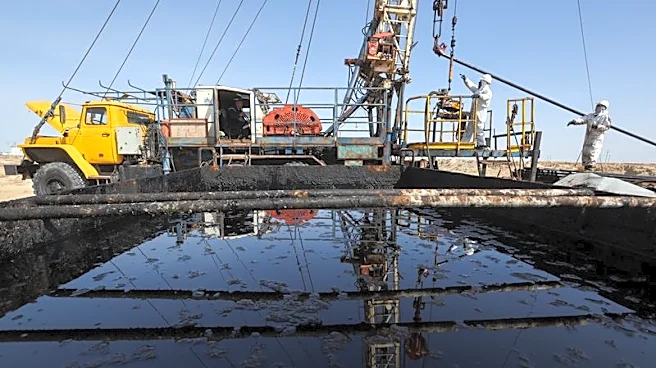
As Russia's war with Ukraine expands beyond Ukraine's borders, the Caspian Pipeline Consortium (CPC) has stopped receiving oil from Kazakhstan after suspending loadings on Monday due to attacks on oil tankers at its Black Sea terminal, three industry sources said.
Russia has accused Ukraine of targeting CPC tankers. Ukraine has not commented on the attacks.
U.S. OIL INVENTORIES
The oil market awaited weekly storage reports from the American Petroleum Institute trade group later on Tuesday and the U.S. Energy Information Administration on Wednesday.
Analysts estimated energy firms pulled 0.5 million barrels of crude from storage during the week ended July 17.
If correct, that would be the second week of declines in a row and compares with a decrease of 3.2 million barrels in the same week last year and an average decline of 1.2 million barrels over the past five years (2021 to 2025). [EIA/S] [API/S]
(Reporting by Scott DiSavino in New York, Stephanie Kelly in London, Anushree Mukherjee, Ishaan Arora in Bengaluru and Emily Chow in Singapore;Editing by David Goodman, Emelia Sithole-Matarise, David Gregorio, Rod Nickel)