






By Brad Brooks, David Hood-Nuño and Nathan Layne
COMMERCE CITY, Colorado, June 25 (Reuters) - Gerardo Verdugo voted for Donald Trump in 2024 hoping for an economic revival.
Instead, the president’s tariffs drove up the cost of the imported sweets he sells at his Mexican candy shop in Commerce City, outside of Denver. Scenes of masked immigration agents rounding up his fellow Latinos deepened his disillusion.
But that doesn’t mean he’s ready to vote Democrat. "I'm just kind of in the middle right now,”
said Verdugo, 24, letting out a deep sigh.
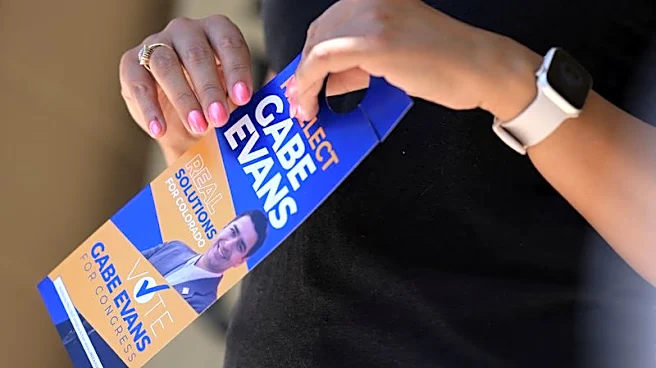
Colorado's 8th Congressional District, where 40% of the population identifies as Latino, has always been competitive. A Democrat won here in 2022, Republican Gabe Evans took the seat in 2024 -- and it’s a toss-up again in 2026.
In November's midterm elections, Evans will take on the winner of Tuesday's Democratic primary between Manny Rutinel, a Dominican-American state legislator, and Shannon Bird, a former state legislator.
Latinos are one of the swingiest demographics in the American electorate, polls show, their political allegiances tending to shift in rhythm with economic ebbs and flows. They were a key part of Trump’s winning coalition in the last election, and will be pivotal again this year as Democrats try to retake the House of Representatives.
The president’s approval rating among Latinos who backed him in 2024 has fallen by more than a quarter, according to a Pew survey in April. Overall, only 27% of Latino voters approve of Trump’s performance, down from 36% at the start of his second term, Reuters/Ipsos found this month.
But that erosion in support has not yet corresponded with a Democratic surge.
A bipartisan poll of 3,000 Latino voters in May by BSP Research and Shaw & Company on behalf of UnidosUS found that one in five remain undecided heading into the midterms, with "both parties underperform[ing] 2024 support levels." Voters’ top four issues were tied to the economy.
"If they can help my cost of living … I'm open to hearing about it," said Gabriel Sanchez, a BSP pollster, describing the prevailing attitude.
That sentiment dominated conversations with more than 50 voters, organizers and strategists across Colorado’s 8th. Many residents are tired of Trump, but they're just as tired of politics as usual. And they’re still waiting for candidates to earn their vote.
Each party has its challenges, analysts said. Republicans are tied to an unpopular president and have yet to muster the grassroots energy that helped Trump make gains with Latinos; Democrats have the early edge on outreach but are struggling to convince voters they can bring down costs.
REPUBLICAN STRATEGY
The National Republican Congressional Committee views Colorado's 8th as one of more than a dozen House races nationwide where Latino voters could be decisive, according to a person familiar with party strategy.
To appeal to them, Republicans plan to highlight Trump’s “Big Beautiful Bill,” which cut taxes on tips, while giving candidates room to distance themselves from the president on immigration policy, the person said.
Evans, the grandson of a Mexican immigrant, is a co-sponsor of the DIGNIDAD Act, a bipartisan reform bill combining border security with legal status for some immigrants in the country illegally. He’s also leaning on his working-class roots to connect with struggling Latinos.
But Denise Galvez Turros, a co-founder of Latinas for Trump, a group instrumental in mobilizing support for the president in 2024, said voter enthusiasm hasn’t translated to the midterms. Her group was formed to elect Trump, she said, not to boost his fellow Republicans.
The Latina voters she rallied in 2024 "don't care about what's going on so much in the Republican Party,” she said, guessing many may stay home in November.
On the ground here, outreach has largely fallen on conservative groups like the LIBRE Initiative, which has canvassed thousands of doors in the district since January to rally support for Evans.
Angel Merlos, LIBRE’s strategic director for Colorado, said the people he's speaking with have "large concerns" about Trump and are "kind of on the fence."
Republican candidates should be talking more about tax cuts, he said, but also their willingness to work across the aisle in Washington.
Was the party doing enough to retain its majorities in Congress? "We can always do better," he said.
'IMMENSE OPPORTUNITY'
Stacy Suniga, who founded the nonpartisan Latino Coalition of Weld County in 2020, hopes Democrats can retake the 8th but is blunt about the party’s shortcomings.
“You have Trump here with broken promises ... and you have Democrats over here who want to keep doing things the way that it's always been done,” she said, urging candidates to embrace bolder, more progressive economic proposals.
At a debate earlier this month, both Rutinel and Bird focused on affordability and Trump's cuts to Medicaid, consistent with national messaging.
The Democratic Congressional Campaign Committee launched an eight-figure nationwide advertising campaign targeting Latino and rural voters in November -- months earlier than in previous cycles -- faulting Republicans for Trump's tariffs, cuts to food assistance and rising gas prices.
Democratic-aligned organizations are also ramping up their efforts.
Mi Familia Vota has been knocking on doors in Fort Lupton, north of Commerce City. Voto Latino is testing affordability messages in 20 battleground states and is partnering with Latino organizations at the University of Northern Colorado for a registration push in August.
"It's just an immense opportunity to flip that district," said Beatriz Lopez, Voto Latino's executive director.
Voters like Olivia Dominguez, 61, who owns a beauty salon in Fort Lupton, should be a natural target for Democrats. Her salon’s rent recently shot up by 50%; nearly every beauty product she uses is more pricey.
But the Biden years also featured high gas prices and persistent inflation, she and many other voters said. What they're looking for now are concrete plans to improve their lives.
Dominguez says she'll cast her ballot for "whoever has some kind of sense in their brain about the economy."
(Reporting by Brad Brooks in Colorado, Nathan Layne in New York and David Hood-Nuño in Washington; Editing by Jesse Mesner-Hage and Alistair Bell)