








By Rocky Swift and Makiko Yamazaki
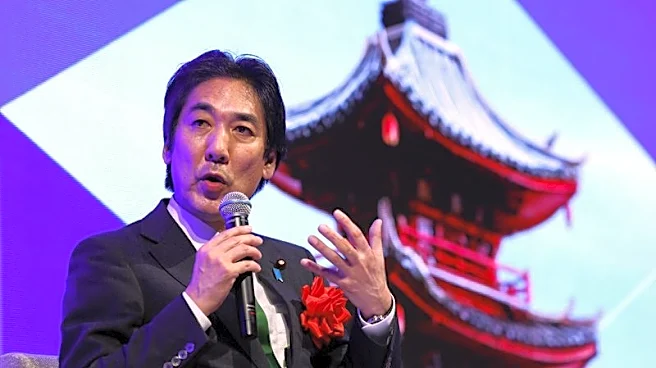
TOKYO, Oct 15 (Reuters) - Japanese Economy Minister Minoru Kiuchi said monetary policy should be left to the Bank of Japan, reiterating the government's stance on respecting the central bank's independence, as markets assess the outlook for further interest rate hikes.
"Generally speaking, the government understands that the BOJ is entrusted with conducting monetary policy to achieve the 2% inflation target," Kiuchi said at a Reuters NEXT Newsmaker event hosted by
LSEG in Tokyo on Thursday.
"It is important that monetary policy adjustments are left to the BOJ's judgment," said Kiuchi, who is often viewed by markets as a reflationist, a reputation stemming from his past caution over rate hikes and his ties to a pro-stimulus group of lawmakers.
He also disputed the reflationist label, saying that Japan is no longer in a situation where reflationary policies would be adopted and that Prime Minister Sanae Takaichi's government has never pursued such policies.
He said Japan is "transitioning towards a new, growth-oriented economy" and global investors should judge the country on its current situation rather than on perceptions shaped by decades of deflation.
"The Japanese economy is no longer the same economy it was during the long years of deflation. I would encourage you to assess Japan on the basis of this changing reality," he said. "I believe now is the time to invest in Japan."
Kiuchi also emphasised fiscal sustainability alongside growth, seeking to reassure investors wary of rising public spending under Takaichi's administration.
"Some may hear the words 'proactive public finances' and assume that they simply mean relaxation of fiscal discipline - that is not what we are pursuing," he said.
Instead, he argued that strategic investments would boost Japan's growth potential, leading to higher wages, incomes and tax revenue while preserving fiscal sustainability.
The government has rolled out a growth strategy targeting more than 370 trillion yen ($2.34 trillion) in public and private investment by fiscal 2040 in areas including semiconductors, artificial intelligence, quantum technologies and content industries.
($1 = 157.8400 yen)
(Reporting by Rocky Swift and Makiko Yamazaki; Editing by Jamie Freed and Hugh Lawson)