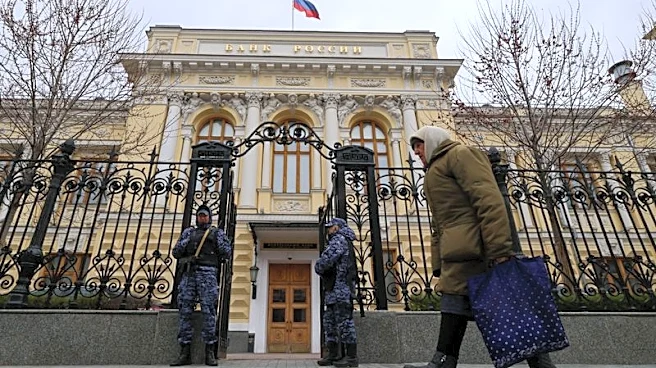








PARIS/BERLIN, July 6 (Reuters) - Russia risks an "explosive" banking crisis because lenders are shouldering much of the burden of the country's war economy, a European state intelligence report seen by Reuters has warned, as the European Union readies a raft of new sanctions.
The two-page document, which was prepared in recent weeks to inform European officials about the state of Russia's banks, outlines their vulnerability to further Western curbs.
While Russia's banks have mostly weathered the sanctions
imposed since Moscow's 2022 full-scale invasion of Ukraine, the June report says deteriorating loans and growing household indebtedness create an "explosive" risk, just as the EU prepares a 21st package of sanctions it hopes to finalise in July, targeting banks and cryptocurrency networks.
The Russian central bank declined to comment on the assessment, although it has recently played down the risks of a major banking crisis.
With the cost of a four-year war with Ukraine draining state coffers, Russia has increasingly leant on banks to support companies and borrowers. The report says this has lumbered banks with risks, as the economy teeters.
The Economy Ministry cut its gross domestic product growth forecast to 0.4% in 2026 from 1.3% previously and to 1.4% in 2027 from 2.8%.
The intelligence report, titled "Note on the probability of a banking crisis in Russia in 2026", said banks have been pushed to give subsidised loans to defence companies, homebuyers and others. It noted that state-backed credit programmes, loan restructurings and government support masked the banks' vulnerability.
"The situation creates the illusion of a dynamic economy that, in reality, conceals an explosive situation which an economic shock, such as an ambitious package of sanctions against banks ... could trigger," said the report.
Lending to defence firms, regional state-backed projects and homeowners has increased the amount of loans that may never be repaid, the authors said.
The report estimates that 10% of corporate loans are doubtful, a sharp increase from 2024, while some major banks reported retail non-performing loan ratios as high as 15% in 2025.
It also says that more than 500,000 Russians declared bankruptcy in 2025, up almost a third from the previous year, while state programmes encouraged more than 13 million Russians to take out at least three loans simultaneously.
Russian central bank Deputy Governor Filipp Gabunia said last month that "vulnerabilities in the financial sector are not critical," stressing that banks' capital cushion was at the highest level in three years, while corporate bad loans had, at 4%, not changed during the last year and a half.
"Russia's economy is stagnating but the dominance of the state and defence spending means there is no immediate financial crisis to hand," said Chris Weafer, a Russia expert at consultancy Macro Advisory.
"Asia ignores sanctions. So the idea that a fresh round will tip Russia into crisis is wishful thinking," he said, adding that defence spending was keeping unemployment low and wages high.
RUSSIA HAS PROVEN RESILIENT, DESPITE SANCTIONS
The European Union has imposed sweeping sanctions on Russia in an attempt to choke bank profits and international money movements, oil and gas sales and the defence sector.
Russia has struggled but proven largely resilient, while Europe has often had difficulty enforcing sanctions, with no central authority to do so.
Compounding Europe's difficulties, the United States, under President Donald Trump, has loosened some sanctions, earlier granting temporary permission to sell Russian oil, although that waiver expired in mid-June.
European diplomats are now discussing targeting banks and cryptocurrency networks as well as drone production, oil traders and refiners.
This would add scores of individuals and entities to the sanctions list, including nearly 90 banks, bringing the number of blackballed lenders to more than 100 — over half of the country's internationally connected banks.
SBERBANK EXECUTIVE — EVERYONE USED TO SANCTIONS
Russian President Vladimir Putin recently said Russia would press ahead with its battlefield aim of fully capturing four Ukrainian regions, despite the sanctions, rejecting what he said was a new proposal by Ukraine to rein in hostilities.
Putin also said Russia was expecting a resumption of U.S.-led diplomatic efforts to end the war, once the "hot phase" of the U.S.-Israeli conflict with Iran was resolved.
There are signs of increasing pressure. Russia's second-largest lender VTB plans to boost reserves, its first deputy CEO told Reuters on Friday, to shield itself against higher fuel prices and possible loan losses.
The amount of cash being held outside banks has grown by more than 17% year-on-year to over 19 trillion roubles ($243 billion) so far this year, according to central bank data.
That has put pressure on banks which rely on deposits to fund lending.
"All major banks are already under sanctions ... and when they were introduced in 2022, there was stress," Taras Skvortsov, chief financial officer of Russia's largest bank, Sberbank, told Reuters.
"By 2026, everyone has become so used to it. Many clients of the sanctioned banks do not even know about sanctions."
(Writing by John O'Donnell; editing by Elisa Martinuzzi, Elaine Hardcastle and Sharon Singleton)