
By Alexander Dziadosz
BEIRUT, April 30 (Reuters) - In a parking lot strewn with rubbish near Beirut's Mediterranean coast, Hassan Yahya has taped a cardboard sign to a traffic signal pole beside the tarp
tent that now serves as his home.
"Kfar Kila welcomes you," read the lines scrawled in thin pen.
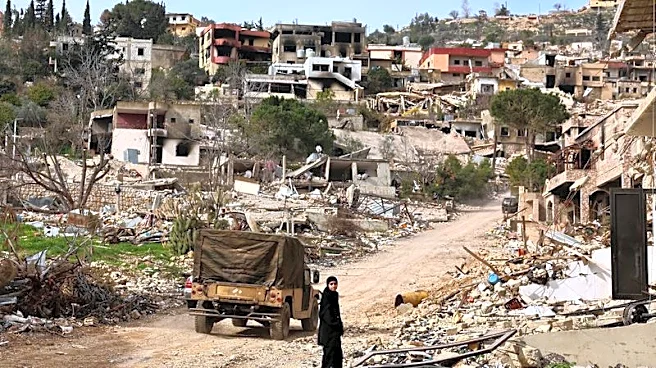
The flimsy board recalls a signpost that once stood dozens of miles away at the entrance of the centuries-old village of that name. Kfar Kila is one of about a dozen villages along Lebanon’s southern border that have been progressively flattened by waves of Israeli bombardment over the past two and a half years.
Now, as Israeli forces move in with controlled detonations and bulldozers, the villages are being effectively erased, vibrant communities reduced to lifeless moonscapes.
Like tens of thousands of other southerners, Yahya has watched his ancestral lands transformed into a "buffer zone" that Israel is clearing to secure its border.
In Lebanon, villages occupy a profound psychological and cultural space: centres of gravity where families converge from across the country and world, maintaining roots by investing in homes and forging communal ties to the rhythm of weddings, holidays and olive harvests.
Practically everyone knows their family's village – "day'a" in the local dialect – even if they left generations ago. The sudden disappearance of these settlements has cut hundreds of thousands adrift.
"It's like fish, if they leave the water, they die," said 58-year-old Yahya, squatting on a plastic chair in his tent as a generator thrummed behind him. "We can't leave. We die."
Israeli forces say Kfar Kila and other levelled villages are havens for Hezbollah, the political and military movement they have fought since the Hamas-led attacks on southern Israel of October 7, 2023, hurled the region into conflict.
The Israeli military told Reuters that Kfar Kila had been designated a "flagship village of Hezbollah" and had hosted "extensive terrorist infrastructure", including in homes and schools. It said Israeli forces had seized more than 90 truck-loads worth of weapons there in 2024 and more this year, adding that the military strived to mitigate harm to civilians. Reuters was unable to independently verify their assertions.
The latest round of fighting, which broke out early last month when Hezbollah fired rockets at Israel in solidarity with its attacked ally Iran, has forced 1.2 million Lebanese people from their homes, about a fifth of the population.
To reconstruct life in one of Lebanon's vanished villages, Reuters spoke to five former residents of Kfar Kila now scattered across the country and used satellite images, social media posts, and photos and videos shared by them and others to see what has become of their communities.
Some of the earliest mentions of Kfar Kila appear in the 10th-century travelogues of the Arab geographer Al-Maqdisi and later in the records of Ottoman tax collectors and colonial-era British surveyors.
Before war erupted in 2023, about 5,500 people lived there, according to Kfar Kila mayor Hassan Sheet. Farming dominated life, the climate supporting crops from wheat and grapes to watermelons, tobacco, tomatoes, parsley, fava beans and olives.
The village prized its olive oil, sold nationwide and drawing buyers from as far as Beirut, he added.
Daily life revolved around bakeries, restaurants and cafes where residents gathered to play cards and trade gossip and jokes. During weddings, the community would come together for a week of feasting funded by gifts to the groom. On the day of Ashura, commemorating the death of the Prophet Mohammad's grandson Imam Hussein, crowds thronged in the village centre, climbing onto rooftops to watch men in medieval dress reenact the Battle of Karbala, where Hussein was killed 1,300 years ago.
'IT ALL WENT UP IN SMOKE'
Much of the two decades preceding the October 7 attacks saw relative prosperity for Kfar Kila, Sheet said. Schools and clinics opened, literacy rose, roads to the city of Nabatieh and other nearby hubs expanded horizons. Expats sent money home from Europe, the Gulf and Africa.
Yahya's brother’s children, who lived in Sweden, built a house beside the Fatima Gate, a historic border crossing which became a local attraction as restaurants sprang up near a replica of Jerusalem's Dome of the Rock and a graffiti-covered wall built by Israel along the frontier. Yahya himself built a three-storey house of cement and stone in the village, and installed an oven in the basement to serve pastries to friends.
Within days of the attacks, though, Hezbollah launched a "war of support" for Hamas, firing missiles into Israel. The Israeli border town of Metula was particularly heavily hit, with hundreds of homes damaged or destroyed, according to Israeli media outlets.
Israel responded with a ferocious air and ground campaign, concentrated heavily in the south. By January 2024, Kfar Kila was nearly empty, Sheet said.
In the months that followed, Israel said it destroyed dozens of underground structures and hundreds of Hezbollah weapons found in the village.
Hezbollah officials have repeatedly condemned the village demolitions and denied the group places military infrastructure in areas where civilians live. Its media office didn't immediately respond to a request for comment on the demolitions and the Israeli military's statement about Kfar Kila.
Before the war, Hezbollah made no secret of its plans to invade northern Israel, even inviting reporters to observe its fighters simulate such an attack, and described its tunnel network as extensive. At least one of four tunnels found by Israel in 2018 ran from Kfar Kila under the border and up to Metula.
Soon after the conflict broke out, Yahya went north from Kfar Kila before ending up in Beirut. His neighbour and childhood friend, Kheder Hammoud, settled near the Syrian border. Grocery store owner Jameel Fawwaz, whose shop and home were destroyed, fled first to the southern town of Habbouch and later to a school in the coastal city of Sidon that sheltered hundreds of people who had lost their homes.
"It all went up in smoke," Fawwaz said, sitting by a wall at the school bearing dozens of paper signs put on display by displaced residents to remember the names of villages hit by the war, including Kfar Kila.
IRAN WAR BRINGS FRESH PAIN
A ceasefire in November 2024 prompted some residents to return. But by then nearly 85% of buildings in Kfar Kila had been destroyed, Sheet said. Among them was the newly built home of Yahya's extended family, completed just before the war.
A few residents, including Hammoud, set up prefabricated homes near the ruins, hoping to rebuild. In February this year, Prime Minister Nawaf Salam visited Kfar Kila and promised impatient residents that reconstruction would start soon.
Instead, war returned within a month. This time, Israeli forces used controlled demolitions and bulldozers.
In one video, verified by Reuters and first posted on social media in late March, an earthmover can be seen moving on the western outskirts of the village. Reuters could not confirm who was operating the machine.
By late April, Israeli forces had destroyed over 90% of homes in Kfar Kila, an Israeli military official told Reuters, requesting anonymity to discuss security matters.
With little hope of returning soon, many former Kfar Kila residents now rely on sporadic calls to maintain ties. When someone dies, Yahya said, "We just pick up the phone. That's it." Marriages, if they happen at all, often take place without fanfare, Sheet said.
Though Israel says the buffer zone is temporary, many Lebanese fear it will become permanent. The Golan Heights, captured from Syria in the 1967 Middle East war, was annexed in 1981. The West Bank, captured from Jordan in the same war, is now home to hundreds of thousands of Israeli settlers.
One day this month, Hammoud drove his battered sedan from the northern mountains to the Beirut parking lot to visit Yahya.
They paced together, Hammoud leaning on his late mother's walking stick, one of the few items salvaged from his home, and recalling the days of their youth.
"Everything in the old village has meaning and significance for us – the historic houses, our family's homes, the homes of our ancestors," he said. "These things are impossible to bring back."
Sheet, the mayor, echoed this as he sat in his uncle’s home in a village in the country’s central mountains, where he’d taken refuge.
"There's a spiritual connection, psychological connection, a connection with your roots – a very strong one. This is fundamental for Kfar Kila," he said. "It'll take time, for sure, but when we get back, we'll rebuild."
He paused.
"This isn't just talk," he said. "We're going back."
(Reporting by Alexander Dziadosz; Additional reporting by Maayan Lubell, Pesha Magid, Eleanor Whalley, Pola Grzanka, Catherine Cartier, Aaron McNicholas, María Paula Laguna and Marine Delrue; Editing by Pravin Char)