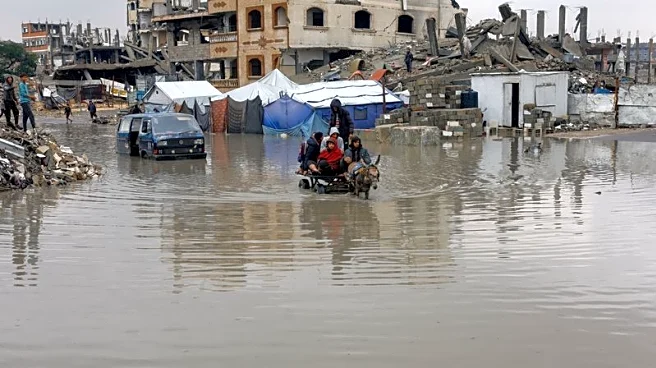

GAZA, Dec 15 (Reuters) - Authorities in Gaza warned on Monday that more war-damaged buildings may collapse because of heavy rain in the devastated Palestinian enclave and said the weather was making it hard
to recover bodies still under the rubble.
Two buildings collapsed in Gaza on Friday, killing at least 12 people according to local health authorities, amid a storm that has also washed away and flooded tents, and led to deaths from exposure.
Israel and Hamas agreed to a ceasefire in October after two years of intense bombardment and military operations, but humanitarian agencies say there is still very little aid getting into Gaza, where nearly the entire population is homeless.
Gaza Civil Defence spokesman Mahmoud Basal called on the international community to provide mobile homes and caravans for displaced Palestinians rather than tents.
"If people are not protected today we will witness more victims, more killing of people, children, women, entire families inside these buildings," he said.
Mohammad Nassar and his family were living in a six-storey building that was badly damaged by Israeli strikes earlier in the war, and then collapsed on Friday.
His family had struggled to find alternative accommodation and had been flooded out while living in a tent during a previous bout of bad weather. Nassar went out to buy some necessities on Friday and returned to a scene of carnage with rescue workers struggling to pull bodies from the rubble.
"I saw my son's hand sticking out from under the ground. It was the scene that affected me the most. My son under the ground and we are unable to get him out," Nassar said. His son, 15, died, as did a daughter, aged 18.
Gaza authorities are meanwhile still digging to recover around 9,000 bodies they estimate remain buried in rubble from Israeli bombing during the war, but they lack the machinery needed to expedite the work, spokesman Ismail al-Thawabta said.
On Monday, rescue workers retrieved the remains of around 20 people from a multi-storey building bombed in December 2023 where around 60 people, including 30 children, were believed to be sheltering.
(Reporting by Dawoud Abu Alkas, Nidal al-Mughrabi, Bassam Masoud and Raghed Waked; writing by Angus McDowall; editing by Mark Heinrich)