





By Siddharth Cavale
NEW YORK, Aug 27 (Reuters) - Brent crude prices settled up by 2.1% on Thursday, snapping a three-session losing streak, after a Wall Street Journal report said U.S. President Donald Trump is not interested in returning to terms of a memorandum of understanding reached with Iran in June.
Citing people familiar with the matter, the report said the Trump administration has repeatedly told mediators it has no interest in reviving the June agreement, complicating a flurry of diplomatic
efforts this week to restart talks.
Brent crude futures finished up $1.86, or 2.1% at $89.70 a barrel. U.S. West Texas Intermediate crude futures settled up $1.30, or 1.6% at $83.53.
Both benchmarks rebounded as investors scaled back expectations of a diplomatic breakthrough that could boost oil flows from the Middle East.
A lack of progress in talks, combined with continually restricted flows, could have prompted an adjustment of market views, UBS analyst Giovanni Staunovo said.
Earlier on Thursday, Washington confirmed it was not in talks with Iran despite diplomatic efforts by other countries to re-engage the two sides.
"We don't want to speak to them. We're not looking to meet or anything," Trump told reporters later in the Oval Office, saying the U.S. was focused on punishing Tehran economically and would penalize countries that do business with the Islamic Republic.
On Monday, the U.S. announced what it called the "toughest sanctions in history" on Iran. Treasury Secretary Scott Bessent suggested the measures would lessen the need for new major military operations.
Ebrahim Azizi, head of the Iranian parliament's national security committee, said the sanctions were an "inhumane and hostile act" that had nevertheless lost their effectiveness.
Qatar's prime minister visited Tehran on Thursday in a bid to relaunch diplomatic talks to end the U.S.-Israeli war with Iran, on the eve of its six-month anniversary.
Iran's top security official Mohsen Rezaei warned that Tehran would target U.S. military and economic interests if Washington started any "mischief" during the talks with Qatari officials.
PROLONGED UNCERTAINTY
"At the heart of the dispute remains Iran's nuclear programme and that is unlikely to be resolved quickly ... Iran also understands the importance of its geographical position and the leverage that the Strait of Hormuz provides, so the risk of prolonged uncertainty remains," said Priyanka Sachdeva, head of market insights at Phillip Nova.
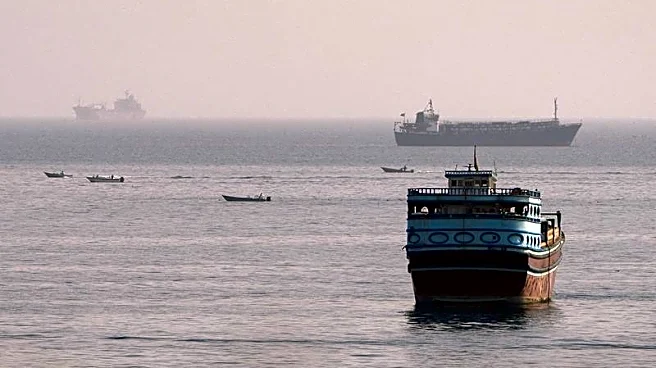
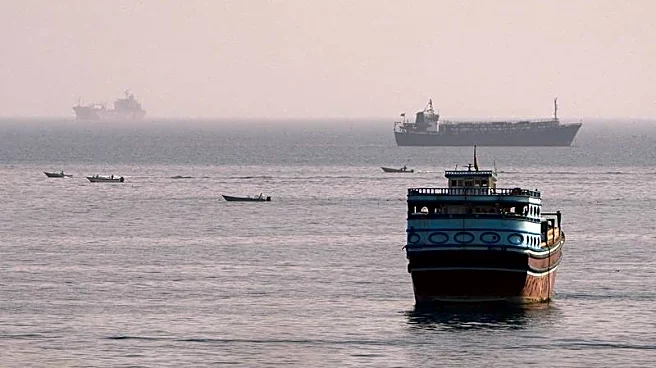
The Strait of Hormuz handled about one-fifth of global daily oil and liquefied natural gas supplies before the conflict began in late February.
Flows through the strait improved slightly on Wednesday, with 10 commodity vessels transiting the waterway, up from recent lows but still below the 10-day average of 15, according to Kpler data. Vessels exiting the strait included a medium-range fuel tanker, a bitumen tanker and a bulk carrier.
State-owned Kuwait Integrated Petroleum Industries Co had restarted all three crude units at its 615,000 barrel-per-day Al-Zour oil refinery at 60% capacity as of August 19, consultancy IIR said. The refinery had come under attack by Iranian drones in May.
Elsewhere, geopolitical tensions escalated after Russia warned it could strike British military targets inside and outside Ukraine in response to Ukrainian attacks on Russian territory using British-supplied long-range cruise missiles.
Trump, however, said Russian President Vladimir Putin will not attack a North Atlantic Treaty Organization (NATO) country, and he downplayed media reports that CIA Director John Ratcliffe this week had warned Russian officials against such an attack. Britain is one of the founding members of NATO.
(Reporting by Siddharth Cavale and Laila Kearney in New York, Robert Harvey in London, Emily Chow in Singapore and Anushree Mukherjee in Bengaluru. Editing by Thomas Derpinghaus, Conor Humphries, Mark Potter, Louise Heavens and David Gregorio)