





By Gopal Sharma, Saurabh Sharma, Sahana Bajracharya and Liz Lee
KATHMANDU, Aug 29 (Reuters) - Nepal resumed search and rescue work on Saturday after a brief weather-related suspension as authorities searched for nearly 3,000 missing people following a devastating flood that killed hundreds and tore through a region bordering Tibet.
The impoverished Himalayan nation of 30 million people called for specialist foreign assistance and its finance minister told Reuters it would also need about $4 billion
to $5 billion to rebuild after the disaster.
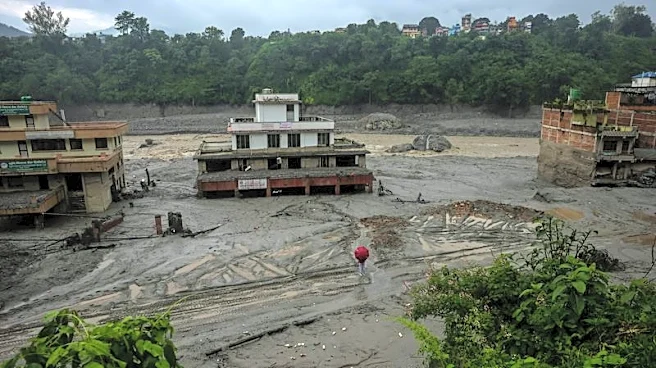
Triggered by a glacier collapse, a torrent of rock, ice, mud and debris hurtled through mountain river systems on Wednesday, killing at least 669 people in Nepal and seven in China's Tibet and sweeping away buildings, bridges and power stations.
Nearly 3,000 people remain missing, including about 2,426 in Nepal and 554 in Tibet's Gyirong County, among them at least 540 foreign nationals, many of them Hindu pilgrims from India.
DECOMPOSED, UNRECOGNISABLE BODIES TO BE BURIED
Search and rescue operations were temporarily halted because of rain and fog but resumed later in the afternoon, a police officer in hard-hit Rasuwa district said.
"Helicopters are flying and the operation resumed following some improvement in weather," he said, on condition of anonymity as he is not authorised to speak to the media.
Authorities had also suspended rescue work on Friday when a lake, formed across the Nepal-China border after the flood, began overflowing into Nepal's Lhende Khola and Trishuli rivers.
By Saturday, the risk had eased and parts of the lake bed were visible, Chinese authorities and state broadcaster CCTV said. Satellite images suggested water was slowly draining from the lake, gradually reducing its size, CCTV reported.
The lake is one of two upstream of the flood zone being monitored by Nepal. Flood risks will persist until both have fully drained, an official warned.
Three days after the disaster, authorities said some bodies being recovered had decomposed beyond recognition. They would be buried after legal formalities because of health risks and a fear of disease outbreaks.
"DNA samples will be collected, and the bodies will be buried in an open space," the Chitwan district administration said in a notice.
FAMILIES SEARCH FOR THE MISSING
In Kathmandu, families of missing people gathered outside Maharajgunj Medical Campus, where some bodies had been taken. Many tried to identify relatives from photographs of the bodies displayed on gates and boundary walls.
In Malaysia, families of 91 citizens listed as "uncontactable" across Tibet and Nepal also waited for news.
Manivannan Rethinam, a representative for some of them, urged the foreign ministry to establish a communication channel for faster updates, saying the lack of information was "profoundly painful" for relatives awaiting news.
Malaysia's foreign ministry said search and rescue and verification efforts were continuing.
For survivors, the ordeal is far from over as they face the task of rebuilding their lives.
Saraswati Ghale, 43, said her home was destroyed in the flood. She recalled scrambling uphill as the water struck, shaking the ground "like there was an earthquake".
"I don’t have anything (left) ... I am saved but who knows how things will pan out," she said.
Nepal's Finance Minister Swarnim Wagle told Reuters the government's initial estimate was that rebuilding would cost between $4 billion and $5 billion.
"This is just an estimate. Loss and damage is being assessed," he said.
TECHNICAL AID HEADS TO NEPAL
Nepal's Foreign Minister Shisir Khanal said the country did not need help with search and rescue but required specialist assistance to rescue people trapped in tunnels, restore transport and communication lines where bridges had been destroyed, identify bodies, conduct DNA testing and store bodies for longer periods.
"We have already made requests for such specialised services and technical assistance in areas where we don't have enough expertise and technical know-how," he told Reuters late on Friday.
A team of Indian tunnel experts arrived in Nepal on Saturday, he said, while China's Xinhua news agency reported Beijing had dispatched five tunnel experts to support rescue efforts, with four more due to join them.
India has already sent three flights carrying 60 tons of relief supplies, including blankets, medicines, and food.
It has also offered disaster-response personnel, prefabricated bridges and technical teams to help restore connectivity, the foreign ministry said.
Chinese authorities are also racing to trace more than 500 people still missing after the flood.
Rescuers reached the worst-hit Gyirong border crossing complex on Friday, using ropes to navigate forests and cliffs after roads leading to the site were destroyed.
In bleak, rainy conditions on Saturday morning, more than 50 rescue workers combed through the rubble of boulders and mud, looking for signs of life and calling out for survivors, CCTV reported.
Surveillance footage from the crossing showed torrents of water and debris engulfing buildings when the flood hit, as people tried to flee.
(Reporting by Gopal Sharma, Sahana Bajracharya, Saurabh Sharma, Navesh Chitrakar, Liz Lee, Yukun Zhang, Leong Huey Mun. Writing by Sakshi Dayal and YP Rajesh; Editing by William Mallard, Gareth Jones and Mark Potter)