





By Lucia Mutikani
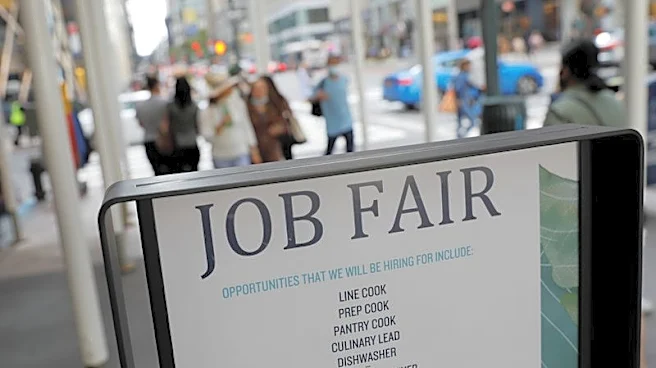
WASHINGTON, Sept 24 (Reuters) - New claims for US unemployment benefits hovered near 57-year lows last week, suggesting the labor market regained momentum after struggling through much of summer and was so far weathering headwinds from the Middle East conflict.
The Labor Department's weekly jobless claims report on Thursday, the latest gauge of economic health, suggested the unemployment rate remained steady at 4.1% this month. The number of people collecting unemployment checks was
near three-year lows during the week the government surveyed households for September's jobless rate.
The US-Israeli war has raised energy prices, with diesel hitting record highs. Economists said this will eventually stoke inflation and restrain economic activity. On Wednesday, a survey from S&P Global showed business activity increased in September to the highest in more than five years, with mounting price pressures.
"It is a race against time perhaps as energy prices have kicked up again as the Iran war stretches on and the economy could always suffer through a soft patch in demand," said Christopher Rupkey, chief economist at FWDBONDS. "But in mid-September the economy seems to be firing on all cylinders in part due to the extraordinary capex expenditures on AI."
Initial claims for state unemployment benefits slipped 1,000 to a seasonally adjusted 197,000 for the week ended September 19, the Labor Department said. Economists polled by Reuters had forecast 201,000 weekly claims. Claims are near levels last seen in 1969.
Economists have cited difficulties seasonally adjusting the data around the moving Labor Day holiday. They also noted what they call residual seasonality, which pushes claims lower as the year winds down. Still, the underlying trend in claims remains in line with a labor market that has regained its footing.
The four-week moving average of claims, which irons out week-to-week volatility, fell 1,750 to 202,250 last week. Low layoffs account for much of the labor market stability, with companies not in a rush to boost headcount.
While companies are hoarding workers, they remain hesitant to ramp up hiring, with economists blaming uncertainty stemming from the Iran war and tariffs on imports.
Worker shortages during an immigration crackdown and retirements have shrunk the labor supply and are also hindering hiring. The S&P Global survey noted that companies in September were "also reporting increasing problems finding suitable staff."
ANOTHER FED RATE HIKE ANTICIPATED
Labor market stability supports expectations that the Federal Reserve could raise interest rates again before year end as it battles inflation.
The US central bank last week lifted its overnight benchmark interest rate by 25 basis points to the 3.75%-4.00% range, the first raise in three years.
Policy makers flagged further increases in borrowing costs ahead, and investors were pricing in a 64.2% chance of another rate increase next month, CME's FedWatch tool showed.
US stocks were trading lower as oil prices rose. The dollar gained versus a basket of currencies. US Treasury yields increased, with the yield on the 30-year bond climbing to just over 5.45%, its highest since 2004.
"More than a year ago, weak labor demand and a rising unemployment rate had Fed officials focused on balancing downside risk to employment with upside risk to inflation," said Andrew Hollenhorst, chief U.S. economist at Citigroup. "But at least for now, stable labor market data have convinced most Fed officials that downside employment risks have been so diminished that focus can shift entirely toward inflation."
The number of people receiving unemployment benefits after an initial week of aid, a proxy for hiring, increased 2,000 to a seasonally adjusted 1.719 million during the week ended September 12. The small increase left continuing claims near levels last seen in May 2023.
Continuing claims fell between the August and September survey weeks for the unemployment rate. The Chicago Fed forecast the jobless rate unchanged at 4.1% in September. Still, long bouts of unemployment are rampant for some.
Rising mortgage rates in line with soaring Treasury yields are choking the housing market despite a price cut and incentives-driven surge in new single-family home sales in August. Home sales jumped 6.4% to a seasonally adjusted annualized rate of 684,000 units last month, the Commerce Department's Census Bureau said in a separate report, beating the 615,000-unit rate that economists had forecast. It was the highest level since December 2025.
Sales fell 2.0% in August from a year ago. The 30-year fixed-rate mortgage averaged 7.03% this week, its highest since January 2025, mortgage finance firm Freddie Mac said in a third report. That was up from 6.95% last week. It has jumped more than 100 basis points since the Iran war started at the end of February.
Last week, a National Association of Home Builders survey showed more builders cutting prices and offering incentives to lure buyers. Still, the glut of unsold new homes persisted.
The median new house price dropped 5.8% to $393,700 in August from a year earlier, the Census report showed. The inventory of unsold new homes remained large and could further constrain new housing projects by builders.
The supply of new houses on the market was unchanged at 483,000 units. More than half were under construction. At the August sales pace, it would take 8.5 months to clear the inventory, down from 9.0 months in July.
Economists believe residential investment, which includes homebuilding and sales, has resumed its downward trend after a modest rebound in the second quarter.
"These incentives are aimed at allowing for greater affordability for many, but we do not see them lasting indefinitely," said Jonathan Millar, a senior US economist at Barclays.
(Reporting by Lucia Mutikani; Editing by Paul Simao, Andrea Ricci and David Gregorio)