
By John Kruzel
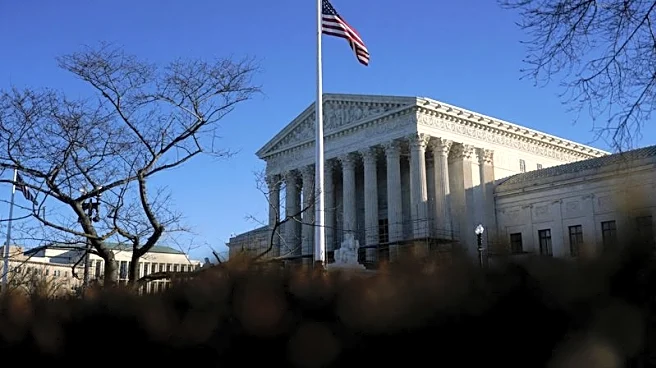
WASHINGTON, Feb 14 (Reuters) - Recent U.S. Supreme Court rulings allowing starkly partisan voting maps to be used in the November midterm elections crucial to Donald Trump's presidency highlight
how a 2019 decision by the justices helped supercharge a political practice that polling shows most Americans oppose.
The ruling by the justices in a 2019 case called Rucho v. Common Cause stripped federal courts of their power to police a practice known as partisan gerrymandering. It involves states redrawing the boundaries of electoral districts based on the partisan leanings of voters to boost a political party's candidates.
The Rucho decision, according to legal experts, set the stage for the current gerrymandering arms race that began with Texas and California, whose skewed maps were preserved by the Supreme Court. It has since unfolded around the country ahead of the midterms in which Trump's fellow Republicans are fighting to retain control of both chambers of Congress.
TEXAS AND CALIFORNIA MAPS
The Texas legislature, at Trump's urging, drew a new map of the state's U.S. House of Representatives districts last year that aims to flip up to five currently Democratic-held seats to Republicans. That led California's legislature to redraw its voting map, aiming to flip up to five Republican-held seats to the Democrats.
Those two states are the most populous in the country and, thus, have the most House seats.
Heavily skewed maps also have been pursued this election cycle by Democrats in Virginia, Maryland and New York, and by Republicans in Missouri, Ohio, North Carolina and Florida.
"Rucho absolutely paved the way for the current gerrymandering-fest around the country," said Harvard Law School professor Nick Stephanopoulos, a critic of the court's 2019 ruling that was decided with five conservative justices in the majority and four liberal justices dissenting.
"If there were a consistent, enforceable federal limit on gerrymandering, we'd see much less - maybe close to none - of this activity," Stephanopoulos said.
The court in Rucho said partisan gerrymandering is not reviewable by federal courts. Mapmaking driven primarily by race, such as voting maps intended to reduce the power of Black voters, remains illegal under Supreme Court precedent, though the justices recently made it harder to prove such claims.
Republicans hold a narrow 218-214 House majority, raising the stakes for every seat in the midterms. Ceding control of either the House or Senate to the Democrats would imperil Trump's legislative agenda and open the door to Democratic-led congressional investigations targeting him and his administration.
It remains to be seen whether Democrats or Republicans will prevail in the tit-for-tat fight to design a more favorable electoral landscape for their party. But public polling already suggests a clear loser: U.S. democracy.
The practice of redrawing the boundaries of electoral districts is called redistricting. In an October Reuters/Ipsos poll, 61% of Americans, including 75% of Democrats and 55% of Republicans, agreed with a statement that recent redistricting plans, such as those by Texas and California, were "bad for democracy."
"Voters fervently hate this," said Justin Levitt, a law professor at Loyola Marymount University in California and former White House adviser on democracy and voting rights under Democratic former President Joe Biden. "And they're right to hate it."
'POLITICIANS CHOOSING THEIR VOTERS'
Although partisan gerrymandering is not new, the timing of the current battle is. Redistricting typically is carried out after the once-per-decade national census, when states are required by law to redraw districts to account for population shifts.
The kind of mid-decade mapmaking happening now - not tied to a census tally - has been extremely rare since the 1960s, when the Supreme Court ruled in several major redistricting cases, University of Kentucky law professor Joshua Douglas said.
"This is unprecedented in the modern era," Douglas said.
The Rucho decision, Douglas added, has combined with partisan politics to produce "this race to the bottom that we're seeing today."
"It's the old adage of the politicians choosing their voters, instead of the other way around," Douglas said.
Stephanopoulos said, "I think extreme gerrymandering is the most anti-democratic practice in modern American politics. Fundamentally, it yields legislatures - which then enact policies - that don't reflect what the people want."
Supporters of the Rucho decision hailed the justices for keeping federal courts from being thrust into the highly politicized role of picking winners and losers in redistricting fights.
In most states, the legislature controls redistricting. Technological advancements over recent decades have enabled mapmakers to more precisely configure congressional districts for partisan advantage.
"Gerrymandering became sort of a 'scientific' thing in the 1990s, when it could be done using computer software that enabled mappers to sort voters down to the census block level," said elections analyst J. Miles Coleman of the University of Virginia's Center for Politics.
Coleman added, "I think the Supreme Court taking such a 'hands-off' approach has given partisan mappers, on both sides, even more of a mentality of 'if we can get away with pushing the envelope, why not try it?'"
In the years before Rucho, federal courts struck down egregious partisan gerrymanders as so politically biased that they violated rights guaranteed by the U.S. Constitution.
In the Rucho decision, Chief Justice John Roberts wrote that the court was not condoning excessive gerrymandering, which can yield election results that "seem unjust" and are "incompatible with democratic principles." Still, partisan gerrymandering is an inherently political act reserved for legislatures, not courts, whose review would appear political, Roberts said.
The ruling did not apply to state courts. But while some state courts have struck down gerrymanders since Rucho, "many more state courts haven't lifted a finger," Stephanopoulos said.
'PARTISAN ADVANTAGE PURE AND SIMPLE'
The Supreme Court ruled in favor of the pro-Republican Texas voting map in December and the pro-Democratic redistricting plan in California this month.
In those decisions, partisanship and race were deeply intertwined. Both rulings came in cases in which challengers accused the states of using race illegally in redrawing House districts. Texas and California, in response, cited partisan motives, not racial ones.
"Overwhelming evidence shows that each of California's new districts was motivated by partisanship, not race," lawyers for California Governor Gavin Newsom, a Democrat, told the justices in court papers defending the state's map.
Black and Latino voters have supported Democratic candidates at significantly higher rates than Republican candidates in U.S. elections.
The Supreme Court, which has a 6-3 conservative majority, revived the Texas map after a lower court found it was likely an unlawful racial gerrymander and blocked its use. The three liberal justices dissented from the Supreme Court's action.
Justice Samuel Alito, in a concurring opinion joined by fellow conservative Justices Clarence Thomas and Neil Gorsuch, wrote that the challengers to the Texas map had failed to show that race, not political advantage, was the new map's main driver. Alito suggested that they should have produced an alternative map capable of achieving the legislature's partisan aims but with greater racial balance, citing a 2024 redistricting ruling he authored.
Alito, addressing the dissenting liberal justices, wrote that "the dissent does not dispute - because it is indisputable - that the impetus for the adoption of the Texas - like the map subsequently adopted in California - was partisan advantage pure and simple."
Liberal Justice Elena Kagan, sounding a wistful note in her dissent, referenced "those innocent days - prior to Texas's redistricting - when partisan gerrymanders seemed undemocratic or at least unsavory, rather than a mark of political conviction or loyalty."
(Reporting by John Kruzel; Editing by Will Dunham)