




By Luciana Magalhaes and Ricardo Brito
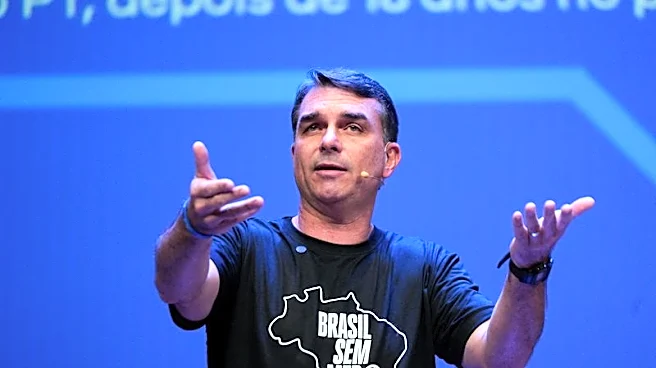
SAO PAULO/BRASILIA, July 6 (Reuters) - Brazilian Senator Flavio Bolsonaro plans to urge the Trump administration at a Washington hearing on Monday to delay a proposed 25% tariff on Brazilian goods until after the country's October election, seeking to distance himself from U.S. levies blamed on his camp.
In June, the Trump administration proposed tariffs on Brazilian goods over alleged trade violations, such as illegal deforestation and what it calls unfair electronic
payment practices, shortly after presidential hopeful Bolsonaro, the son of former President Jair Bolsonaro, met with senior U.S. officials.
The sequence of events prompted President Luiz Inacio Lula da Silva, who is expected to run for reelection, to accuse the right-wing senator of helping trigger the measure, which the senator denies.
"It is deplorable that, once again, members of the Bolsonaro family are traveling to the United States to advocate for foreign interference in Brazil," the government said in a statement shortly after the senator met with U.S. President Donald Trump.
The younger Bolsonaro's push to make U.S.-Brazil ties a campaign issue largely aligns with Trump's growing engagement with Latin America, which included capturing former Venezuelan President Nicolas Maduro in Caracas, and supporting right-wing presidential candidates, such as Colombia's Abelardo De La Espriella, who won a narrow victory last month.
TRUMP'S LATIN AMERICA ENGAGEMENT
But new U.S. tariffs on Brazilian products "would hand the current Brazilian government precisely the political victory it has been engineering," Bolsonaro argued in a filing with the U.S. Trade Representative.
According to a survey published last month by polling firm Quaest, 47% of Brazilians agreed with Lula, who accused Bolsonaro of asking the U.S. to impose fresh tariffs on Brazilian goods, while 35% agreed with Bolsonaro, who said he requested the opposite.
"They are trying to do damage control," said Leonardo Paz, a professor of international affairs at Ibmec and Fundacao Getulio Vargas, two academic institutions in Rio de Janeiro.
SENATOR PROPOSES 180-DAY SUSPENSION
Brazilian officials have been negotiating with their U.S. counterparts to try to avoid new tariffs for months.
But Bolsonaro argued Brazil had not done enough to find common ground with the U.S., and proposed a 180-day suspension before any decision on the levies.
"Brazil holds general elections in October 2026, and the political landscape that determines the viability of any negotiated resolution will be redefined within roughly ninety days," Bolsonaro wrote in his submission to the USTR.
The U.S. has until July 15 to decide whether to impose the Section 301 tariffs, which would still exempt products such as beef, coffee, rare earths, and aircraft parts.
Bolsonaro's latest trip to Washington is part of a broader push by his family to win support from the Trump administration, which includes negotiations last year to seek White House intervention in the trial of the elder Bolsonaro over his attempt to overturn his 2022 election defeat.
Trump imposed steep tariffs on Brazilian products last year as a response to what he called a witch hunt against Bolsonaro. The former president was convicted months later.
So far, however, the senator's efforts to avert new tariffs appear to have had little impact.
Responding to a letter Senator Bolsonaro sent last month urging Washington not to impose additional levies on Brazilian products, Secretary of State Marco Rubio wrote that U.S. officials "continue to have substantial differences in resolving the issues" identified as justification for the proposed measures.
(Reporting by Luciana Magalhaes in Sao Paulo and Ricardo Brito in Brasilia, Editing by Manuela Andreoni and Matthew Lewis)