


By Richard Cowan and Kanishka Singh
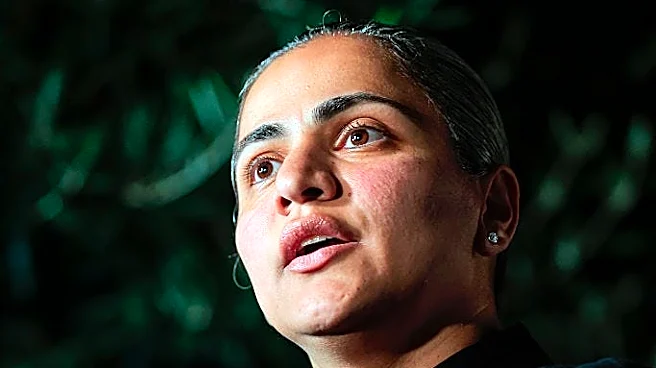
WASHINGTON, Aug 20 (Reuters) - Democrat Aisha Wahab, a member of the California state Senate, was projected on Thursday to win a special election to fill a vacant seat in the U.S. House of Representatives, according to multiple U.S. media outlets.
Wahab defeated Democrat Melissa Hernandez, an official with the San Francisco Bay Area mass transit system.
Once sworn in, Wahab, an Afghan American, will fill the seat that was held by Democratic Representative Eric Swalwell,
who resigned in April amid allegations of sexual misconduct, which he denied. That will give Democrats 213 seats in the House, while Republicans will hold 218.
The solidly Democratic district is near San Francisco and San Jose. Wahab will be the first Afghan American member of the U.S. Congress. The progressive Democrat was also the first Muslim woman and Afghan American elected to the state legislature.
Wahab had over 53% of the votes while Hernandez secured about 47% with 95% of the votes tallied, according to NBC News.
United Democracy Project, a super PAC of the American Israel Public Affairs Committee, a pro-Israel lobbying group, spent nearly $2.5 million since early August to boost Hernandez, according to the Washington Post and multiple other media reports.
The lobbying group has become a focus of criticism in some Democratic primary contests this year during intra-party tensions over candidates' positions on Israel.
Prominent progressive Democrats have opposed U.S. support for Israel over the U.S.-Israeli war on Iran, Prime Minister Benjamin Netanyahu's close ties to Republicans, and particularly over Israeli attacks on Gaza and Lebanon, leading to an erosion of Democratic backing for Washington's ally.
Wahab and Hernandez will again face each other in November. The winner of that election will hold the congressional seat for a full two-year term.
Wahab, who has positioned herself as a state lawmaker aiming to reduce inequality, had authored a bill that would have made California the first U.S. state to explicitly ban caste discrimination. It was vetoed in 2023 by Governor Gavin Newsom, who said existing laws already banned ancestry discrimination.
(Reporting by Richard Cowan and Kanishka Singh; Editing by Stephen Coates)