





By Leila Miller
ANELO, Argentina, July 30 (Reuters) - Ramiro Ramirez, a trained mechanic, found work in just a month at Argentina's Vaca Muerta, home of one of the world's largest shale oil and gas reserves, where he earns 10 times his previous salary as a cook.
His new life operating a gas compressor is not easy. Ramirez, 25, leaves his city in Neuquen province at 5 a.m. for a daily two-hour ride to oil fields by the small, dusty town of Añelo, which has swelled with newcomers seeking work since the formation's
production rose sharply in recent years.
He hopes to make a career at Vaca Muerta, a bright spot in President Javier Milei’s austerity-heavy economic playbook that contrasts sharply with job losses across the country.
“All in all, I feel pretty good,” said Ramirez. “These are very desired positions.”
Vaca Muerta could be a transformative force for Argentina's economy, which needs dollars to contain inflation and repay loans to the International Monetary Fund. YPF, Argentina’s state-run energy company, projects that by 2031, the formation will generate $50 billion in export dollars, rivaling Argentina’s agriculture sector.
It is well on its way: In 2024, Argentina logged its largest energy trade surplus in nearly two decades, and last year broke its record again exporting $11.1 billion worth of energy.
Economists say Milei is smart to focus on capital-intensive sectors such as Vaca Muerta, which he has called “the new Argentine panacea." But they caution that as Vaca Muerta develops, much of Argentina waits for economic relief.
Workers in Neuquen in western Argentina's Patagonia region earn the country's highest average private-sector salary. Much of Argentina, by contrast, is suffering from lost manufacturing and construction jobs amid Milei’s lowering of import tariffs, suspension of federal infrastructure projects and austerity measures that have decreased purchasing power.
IMF Managing Director Kristalina Georgieva recently applauded Milei's reduction of once-staggering inflation but highlighted hurting sectors, saying Argentina needs to create better conditions for businesses and individuals to take out bank loans and mortgages.
“There’s no way for Argentina not to prioritize (Vaca Muerta),” said Lucas Pussetto, an economist at Argentina's Austral University, later adding, “Is it enough? No.”
Milei has framed job loss in some sectors as inevitable as Argentina’s economy opens and competition increases.
In a statement to Reuters, Argentina's Economy Ministry said that "as in any process of economic transformation, the recovery shows differences between sectors in the initial stage" but that the objective is "for growth to progressively extend to the rest of the sectors and translate into greater formal job creation."
TWO ARGENTINAS
From 30 meters (98 feet) up on an aerial platform where he works in a shale field, Ramiro Feeser, 35, has had a prime seat to Vaca Muerta’s transformation. New production plants and wells quickly appear.
"It looks like Texas," he said.
Exploration began in earnest in the early 2010s. While presidents across party lines have supported its development, energy experts underline the importance of Milei’s program of tax breaks and regulatory stability, known as the RIGI, which has attracted $25 billion in approved energy investment. The industry has also benefited from his liberalization of oil and gas prices and easing of import restrictions that has facilitated technology purchases.
Vaca Muerta's production will accelerate with the gradual startup of two private-sector projects around late 2026 and 2027: a 550,000-barrel-per-day oil export pipeline and infrastructure for Argentina to begin exporting liquefied natural gas.
But some question the RIGI’s long-term effect, pointing to how it allows companies to avoid a requirement to convert foreign currency through Argentina’s exchange market starting after an investment’s third or fourth year.
“The positive effect that all this could have for the macroeconomy you’ll see in the short term but not in the medium and long term, because the dividends may not return to the country,” said Juan Jose Carbajales, a former undersecretary of hydrocarbons in former President Alberto Fernández's government.
Guido Zack, an economist at the Fundar think-tank in Buenos Aires, said the RIGI only requires employers to hire 20% of workers locally, and that Vaca Muerta’s boom shouldn't hide the jobs lost by the closure of conventional oil fields in the shift to shale.
According to Fundar, 28,000 businesses have closed in Argentina under Milei, 5.5% of the total.
“Today we have two Argentinas, one Argentina that grows and another that falls,” Zack said. “The need to improve the lives of a good part of the population is now. How much more time will we wait?”
AVOIDING A BOTTLENECK
The continued rapid development of Vaca Muerta is not guaranteed.
In a 2025 report, the Argentine Institute of Oil and Gas found that the sector will need 30,000 to 43,000 more workers in the next few years.
In response, the oil industry, led by YPF, opened the Vaca Muerta Institute in March to train workers. More than 17,000 have applied.
Neuquen's average monthly salary in the oil and gas sector is $5,600, compared to the average private-sector salary of $1,800 in the city of Buenos Aires.
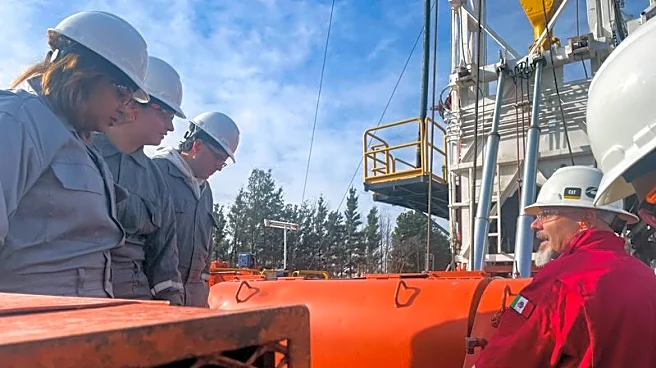
Recently, near Vaca Muerta’s oil fields, about a dozen of the institute's students stood on a drilling rig, listening to an instructor say they could one day be certified to climb to its upper platform to service the machine. Some get vertigo, he cautioned.
The group included Daiana Emilia Rodriguez, 33, a police officer who previously studied industrial maintenance.
“Right now, there’s a range of possibilities; there are many companies that can hire you,” she said of Vaca Muerta.
Gustavo Schiappacasse, director of the YPF Foundation, which helped create the institute, said the school will have trained 2,100 people by December. Oil companies such as Tecpetrol have reached out to more vocational high schools to train potential engineers and technicians.
“All of the companies are looking for workers,” said Andrea Fernandez, a Tecpetrol community relations manager, later adding, “It’s like a battle to attract talent.”
Besides workers, Vaca Muerta’s rapid development depends on high oil prices, pipeline infrastructure, roads and financing, said Daniel Dreizzen, managing director of consulting group Aleph Energy.
“If that doesn’t happen, it’ll develop in slow motion," he said.
‘LAND OF OPPORTUNITIES’
A replica of Wall Street's charging bull adorns the front of a modest hotel in Añelo. Around the corner is a high-end gym chain. “Land of opportunities” reads a large sign on a dirt lot nearby, advertising investment for a mall.
The town of 18,000 has received so many migrants that its mayor recently publicly pleaded with workers not to move there with their families because services are saturated.
Outside a gas station coffee shop this month, people queued for interviews to work at a security company. Several had migrated from the northern, poorer province of Jujuy.
Alfredo Aguilera, 25, arrived four months ago from the province of Formosa, where he stocked merchandise.
He now earns double his old salary as a gas station cashier. After arriving, he learned that oil and gas companies are looking for skilled workers and would consider taking a course to enter the industry.
“I get into that and I secure my future,” he said. “It would be a dream.”
(Reporting by Leila Miller; additional reporting by Eliana Raszewski; Editing by Rod Nickel)