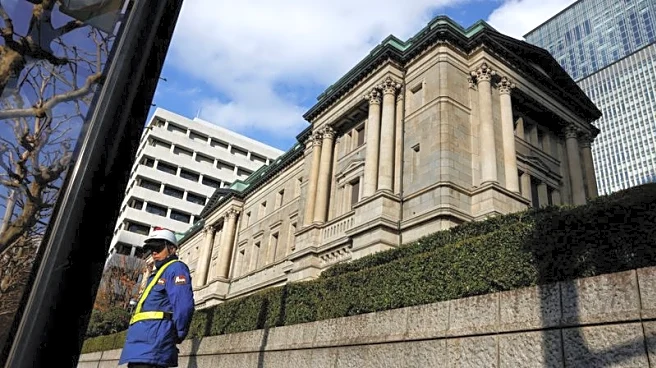




TOKYO, Jan 23 (Reuters) - The Bank of Japan kept interest rates steady on Friday and raised its economic and inflation forecasts, signalling its readiness to continue hiking still-low borrowing costs.
As widely expected, the central bank maintained short-term interest rates at 0.75% by an 8-1 vote.
COMMENTS
HIROFUMI SUZUKI, CHIEF FX STRATEGIST, SMBC, TOKYO:
"As expected, the BOJ left monetary policy unchanged. With risk factors such as a slowdown in overseas economies gradually receding, and with the BOJ having
just raised rates last month, it is now in a phase of taking time to assess the effects of the hike."
"Key focus points in the Governor's press conference will be the BOJ's stance on yen weakness and its view on this week's rise in JGB yields. While the messaging will be quite delicate, we expect the Governor to strike as cautious a tone as possible on FX, and to indicate that the BOJ stands ready—if necessary—to coordinate with the government regarding bond market developments."
"Looking ahead, while it will depend on the outlook for growth and inflation, we expect the BOJ to continue raising rates at a very gradual pace, roughly once every six months to one year."
FRED NEUMANN, CHIEF ASIA ECONOMIST, HSBC, HONG KONG:
"After its hike in December, it is no surprise that the BoJ remained on hold today. However, the central bank's outlook report hints at growing hawkishness, with officials revising up their growth forecasts for the coming year and, crucially, also nudging up their inflation expectations for the next couple of years."
"Governor Ueda's press conference will receive greater scrutiny than usual, with investors looking for greater clarity on the policy rate path ahead amid lingering bond market and exchange rate pressures. Governor Ueda. in his remarks. will likely lean into a more hawkish direction, which may keep the next meetings 'live' for a further policy rate hike. The Board appears to be leaning more hawkish as well, with one dissenter at today's meeting indicating that further policy rate hikes are on the table."
KIERAN WILLIAMS, HEAD OF ASIA FX, INTOUCH CAPITAL MARKETS, LONDON:
"A hawkish undercurrent remains at the BOJ, highlighted by Takata's dissent in favour of a 25bp hike, while today's data confirmed that core CPI remains sticky at 2.9%. The upgrade to the fiscal 2025 GDP forecast to 0.9% from 0.7%, alongside a broadly unchanged inflation outlook and the absence of additional bond buying despite this week's bond rout, signals a bias toward eventual normalisation."
"Still, Governor Ueda is likely to adopt a cautious tone in the press conference mindful of elevated market and political sensitivity around inflation and the yen ahead of the upcoming election."
YUSUKE KOSHIYAMA, SENIOR ECONOMIST, MIZUHO RESEARCH & TECHNOLOGIES, TOKYO:
"The outcome itself was unchanged, so there were no surprises. The dissenting vote was by Takada. Previously, both Takada—who had said the inflation target would be achieved a bit earlier than the baseline outlook—and Tamura had made somewhat hawkish remarks."
"Since Takada was the only one who supported a rate hike this time, you could say that, conversely, Tamura does not see an immediate risk of falling behind the curve in response to the current yen weakness."
"In the outlook report, the lower end of the core CPI forecast range has risen from the last time. Taking that into account, while I can't say whether the timing will be March or April, at least based on what was presented in January this time, the BOJ doesn't seem to view the risk of being behind the curve as especially high. However, compared with the previous time, we should probably assume there's a chance the next rate hike could come somewhat earlier."
CAROL KONG, CURRENCY STRATEGIST, COMMONWEALTH BANK OF AUSTRALIA, SYDNEY:
"The BOJ's characterisation that real interest rates are significantly low, and upgraded forecasts for economic growth and underlying inflation, suggests the BoJ remains firmly on its tightening path."
"What markets are most interested in are whether Governor Ueda drops hints of an earlier rate hike because of the recent weakening of the JPY, and whether the sharp sell-off in JGBs necessitates a BoJ intervention in the bond market."
KAZUTAKA MAEDA, ECONOMIST, MEIJI YASUDA RESEARCH INSTITUTE, TOKYO:
"With uncertainty still high due to the election and the subsequent parliament sessions, it's difficult for the BOJ to make any policy moves.
"If the yen weakens well beyond 160 per dollar, the BOJ would have no choice but to act, but in that case I would expect currency intervention to come first. If the yen keeps weakening, the political climate may become more tolerant of a hike, raising the possibility of an earlier-than-expected rate increase."
"As for rising bond yields, since this is driven by political factors in Japan, it would be difficult in practice for the BOJ to step in and increase JGB purchases. Doing so would run counter to the path toward normalising monetary policy."
TOHRU SASAKI, CHIEF STRATEGIST, FUKUOKA FINANCIAL GROUP AND FORMER BANK OF JAPAN OFFICIAL, TOKYO:
"The focus on inflation looks a little bit hawkish. I think it shows that the BOJ intends to continue to hike the policy rate. So the question is how fast, how far? Core inflation is expected to be above 2% according to the BOJ's forecast, which means that the question now is not the lower bound of the neutral rate but rather the upper band of the neutral rate."
"If the Ueda press conference comes across as hawkish on inflation, I think it will be positive for the yen. My forecast has been for an April rate hike from the beginning."
"I expect the dollar-yen rate to go higher, and now the BOJ's reaction function is obviously the dollar-yen. So if dollar-yen goes up to about 160, it will be a good excuse for the government and the BOJ to hike policy rates in April.
"If the BOJ shows a very aggressive attitude toward JGB purchasing, that's very negative for the yen. So I think Governor Ueda will just continue to say the same thing about the JGB purchases."
MOH SIONG SIM, FX STRATEGIST, OCBC, SINGAPORE:
"The market was expecting a more hawkish tilt perhaps in response to the yen weakness but I think they maintained the same rhetoric. So net-net, I think it comes out as pretty neutral for the market."
"The market was hoping this yen weakness might trigger a more forceful Bank of Japan response. After all, yen indirectly fits into the economic projections if the weakness is sustained."
"I think we have reached a point where the yen is politically unpopular and hence the government has stepped up this rhetoric in terms of verbal intervention to cap yen."
(Reporting by Rocky Swift, Satoshi Sugiyama, Ankur Banerjee, Makiko Yamazaki; Editing by Janane Venkatraman)