




By Rozanna Latiff and Ashley Tang
KUALA LUMPUR, Oct 9 (Reuters) - Malaysia will raise minimum wages and expand tax relief measures next year, as the government looks to address rising living costs ahead of a possible election despite growing fiscal pressure from a jump in global oil prices.
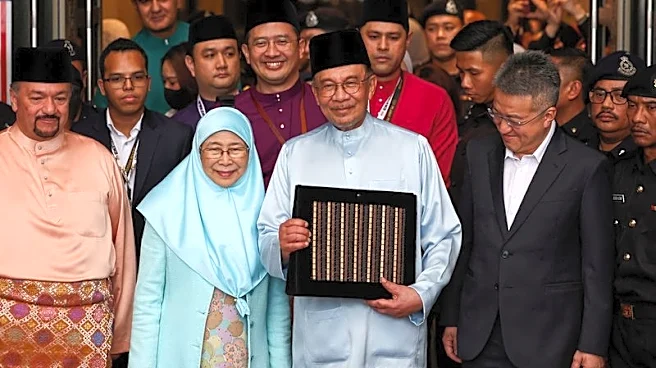
Prime Minister Anwar Ibrahim on Friday proposed an expansionary budget of 459.8 billion ringgit ($112.48 billion) for 2027 and pledged to implement reforms that he said would allow economic growth to trickle down
to ordinary Malaysians.
"Our question is not just how large the economy is to be built, but whether its growth will open up space for families to build savings, for workers to enjoy more dignified wages, for small businesses to continue to grow," he said in a two-hour speech to parliament.
EARLY ELECTION POSSIBLE
Anwar's coalition has faced a series of setbacks in regional elections, with simmering tensions within his multi-party ruling alliance fuelling expectations of early national polls.
The next national election is not due until February 2028 but Anwar has said he may call for snap polls if internal divisions worsen.
Anwar announced plans for wide income reforms, including raising the minimum wage to 2,000 ringgit ($490) monthly from 1,700 ringgit, beginning in June.
Individual income tax relief will increase to 12,000 ringgit a year from 9,000 ringgit, its first revision since 2010, he said.
Anwar also announced increased cash aid of 16 billion ringgit for lower income Malaysians, and expanded support measures for first-time home buyers and small businesses.
Analysts described the budget as a pragmatic one, ahead of a possible election.
"The government has an incentive to demonstrate that the benefits of strong economic growth are reaching households. Tax relief, wage increases and continued subsidies are clearly an effort to do so," Capital Economics senior Asia economist Gareth Leather said in a note.
OUTLOOK FOR 2026 GROWTH RAISED
Malaysia’s economy was expected to expand by between 4.2% and 5.2% from a year earlier in 2027, according to budget documents released ahead of Anwar's speech.
Malaysia also raised its 2026 growth projections for the second time this year, with the economy now expected to expand close to the upper end of a 4.8% to 5.3% forecast range. The economy grew 5.7% in the first half of 2026.
The Southeast Asian country has benefited from the artificial intelligence boom, with gross exports seen rising 31% this year on robust demand for tech products and semiconductors.
Anwar said state-linked companies would continue to invest in high-value industries, including through data centre developments and providing support to local startups.
Headline inflation was forecast to range between 1.8% and 2.8% in 2027 from a revised estimate of 1.5% to 2.5% in 2026, it added.
PETRONAS INCREASES DIVIDENDS TO GOVERNMENT
The 2027 spending plan, an increase of 3.6% over this year’s revised budget of 444.1 billion ringgit, includes development expenditure of 83 billion ringgit and operating expenditure of 376.8 billion ringgit, the government reports said.
Revenue was seen rising by 4.7% to 380.8 billion ringgit in 2027, including a 32 billion ringgit contribution from state energy firm Petronas.
Malaysia's annual subsidy bill has ballooned amid higher energy costs, prompting a narrow upward revision of its 2026 fiscal deficit target to 3.6% of gross domestic product from 3.5%, the reports showed.
Anwar, however, played down worries of fiscal slippage, saying Malaysia remained committed to its medium-term fiscal objectives. In 2027, the deficit was projected to decline to 3.3%, he said.
“This does not represent a departure from fiscal consolidation. It demonstrates the value of having built the capacity to respond when circumstances demand it,” he said in the foreword to the fiscal outlook report.
($1 = 4.0830 ringgit)
(Reporting by Rozanna Latiff and Ashley Tang; Editing by Martin Petty, Kim Coghill and Alison Williams)