
By Daniel Wiessner
Oct 8 (Reuters) - Three Republican-led US states are testing a novel legal argument as they seek to stem the flow of abortion pills to residents who can still obtain them from out-of-state
providers despite their abortion bans.
Louisiana, Alabama and Arkansas filed two lawsuits last week claiming that medical providers are creating a "public nuisance" by mailing abortion drugs over state lines and that New York, California and Massachusetts have aided that conduct by adopting shield laws protecting abortion providers from out-of-state prosecution and civil liability.
Experts said the lawsuits represent an unprecedented attempt to use public nuisance law, traditionally applied in environmental pollution and other public harm cases, to curb access to abortion pills. They also mark the first direct challenge to state shield laws by states that ban abortion.
The novel claims come as anti-abortion groups and officials search for ways to combat the growth of telehealth prescribing of abortion drugs protected by shield laws. About 91,000 abortions were provided in 2025 via telehealth to patients in states with total abortion bans, a significant increase from 74,000 in 2024, according to the Guttmacher Institute, an abortion rights advocacy group.
New York Attorney General Letitia James and her counterpart in Massachusetts, Andrea Joy Campbell, both Democrats, said in separate statements that the Republican-led states were seeking to impose their abortion bans on other states and punish doctors for providing legal health care.
The office of California Attorney General Rob Bonta did not immediately respond to a request for comment.
CURBING PILL ACCESS
Nearly half of US states have banned or severely restricted access to abortion since the US Supreme Court in 2022 overturned Roe v. Wade, the 1973 ruling that had legalized abortion nationwide. Women in those states have had to travel out of state or rely on telehealth prescribing and mailing of pills, driving a surge in medication abortion, which accounted for 65% of US abortions in 2023, according to the Guttmacher Institute.
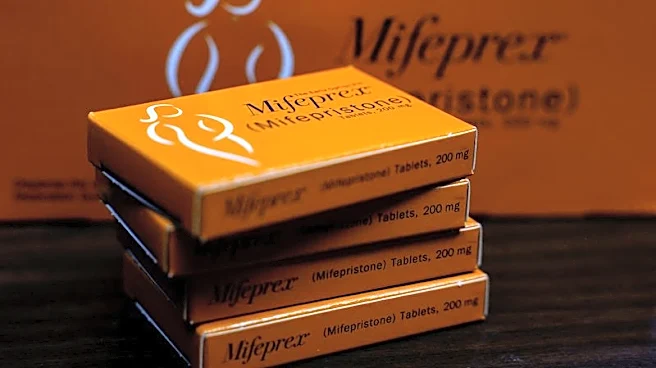
Medication abortion is a two-drug regimen consisting of mifepristone followed by misoprostol used to terminate a pregnancy within the first 10 weeks.
In response, Republican-led states have sued or indicted doctors and filed lawsuits challenging the initial federal approval of mifepristone in 2000 and subsequent rules expanding access, which are pending. The Supreme Court in May refused a request by Louisiana in one of those lawsuits to block telehealth prescribing and mail delivery of mifepristone nationwide while that case proceeds.
And a safety review by the US Food and Drug Administration has drawn criticism from some anti-abortion groups for moving too slowly. The agency on Wednesday, in a filing in the case that reached the Supreme Court, said it expects to complete its review by March 2027.
Most major medical groups, and the FDA at various times since 2000, have said that mifepristone is safe and effective when taken as directed and that serious adverse events are rare.
PUBLIC NUISANCE
A public nuisance claim generally targets activities that unreasonably interfere with public health and safety, such as blocking a road, polluting a waterway or emitting noxious fumes. States have invoked public nuisance law in recent decades in a broader range of cases involving tobacco, opioids, climate change, vaping, and social media use by children.
Bringing a public nuisance claim can have various advantages, including the ability to seek wide-ranging court orders requiring defendants to abate nuisances. It also allows plaintiffs to sidestep the typical legal requirement of proving harm to individuals, both to establish standing to sue and to win cases.
But the states' claims are unusual because they involve abortion drugs that have repeatedly been approved for sale by federal regulators and they focus on the states' ability to enforce their abortion bans rather than public safety, some experts said.
"That is not protecting their residents from harm, nor is it in line with typical public nuisance claims," said Linda Goldstein, senior counsel at the Center for Reproductive Rights, an abortion rights group.
The new lawsuit against states with shield laws was filed directly with the US Supreme Court, which can take up disputes between states that have not been heard in lower courts but routinely turns away such cases.
The second lawsuit, which names nearly 30 individual medical practitioners and groups as defendants, was filed in Louisiana federal court. Both lawsuits include a variety of other legal claims.
The offices of the attorneys general in the three states that filed the lawsuits did not respond to requests for comment.
Two nonprofits that are defendants in the second lawsuit, A Safe Choice Network and Cambridge Reproductive Health Consultants, did not respond to requests for comment.
In the court filings, the states said that both the shield laws and the alleged conduct of out-of-state providers were classic examples of public nuisance because they are aimed at thwarting state abortion bans adopted to protect public safety.
If states "enacted laws goading their residents into sending anthrax, fentanyl, or mail bombs into Plaintiff States ... there would be no question that Plaintiff States could sue to abate those public nuisances," they said in the Supreme Court filing.
(Reporting by Daniel Wiessner in Albany, New York; Editing by Alexia Garamfalvi, Aurora Ellis and Andrea Ricci )