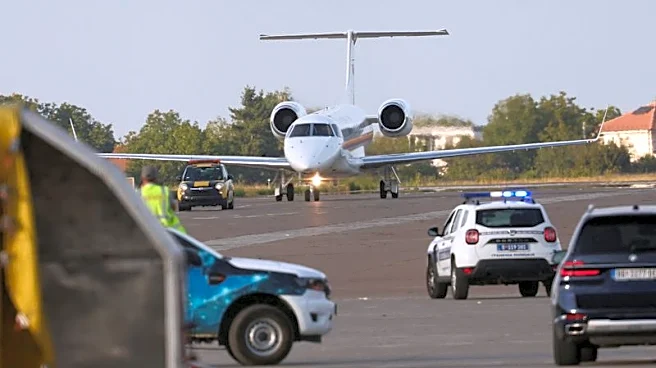






BELGRADE, Sept 3 (Reuters) - A Serbian government plane brought the body of former army commander Ratko Mladic, who died last week serving a life sentence for war crimes, back to Belgrade on Thursday for what is expected to be a huge funeral.
Mladic, who was convicted of genocide, crimes against humanity and war crimes committed during Bosnia's 1992-95 war, died last week in a U.N. detention facility in The Hague aged 84.
The plane landed at Belgrade airport minutes before 6 p.m. (1600 GMT) carrying
his coffin, which was wrapped in a Serbian flag, along with Mladic's son, granddaughter and Serbian Justice Minister Nenad Vujic.
Serbian soldiers carried the coffin to a red van which Serbian media said would take it to a military hospital where the autopsy will be conducted over the weekend.
PRESIDENT SAYS TENS OF THOUSANDS ARE EXPECTED AT HIS FUNERAL
A Serbian government minister said initially that Mladic would be given a state funeral but, following an outcry by European leaders, the government has not confirmed that.
Serbian media said a commemoration ceremony will take place on Saturday in the army hall in central Belgrade and the funeral will be held in a church in a Belgrade suburb on Monday, with Mladic then buried at a cemetery beside his daughter.
Serbian President Aleksandar Vucic said on Thursday that he expected tens of thousands of people to attend the funeral and that it would be a challenge to provide security.
Mladic was found guilty by the United Nations International Criminal Tribunal for the former Yugoslavia (ICTY), of genocide for his role in the 1995 Srebrenica massacre, in which about 8,000 Bosniak Muslim men and boys were killed after Bosnian Serb forces overran the U.N.-designated enclave.
He was also convicted over the 43-month siege of Sarajevo, during which about 10,000 people were killed.
However, he remained a revered figure among many Serbs in Serbia and in Bosnia's autonomous Serb Republic.
His death stirred tensions in the region, with officials warning that a state funeral would put Serbia's prospects of joining the European Union at risk.
"The glorification of Ratko Mladić as a war criminal is against fundamental European values and has no place in the European Union or in the countries that aspire to become members of the Union," EU enlargement commissioner Marta Kos said on Tuesday.
"I hope that the government in Belgrade is aware of what is at stake."
Croatia's Prime Minister Andrej Plenkovic put it more bluntly, saying that if "Serbia was to organise a state funeral for Mladic it would close the door to the European Union".
The Hague-based U.N. mechanism that deals with residual cases from the Yugoslav war crimes tribunal is investigating the circumstances of Mladic's death, a regular procedure when inmates die at the U.N. detention unit in The Hague. It is not yet clear when the results will be made public.
Mladic, who had suffered health problem for years, had been treated in the prison hospital before his death. His relatives, and Russia, had criticised his treatment. The U.N. war crimes court said his health was fragile but well managed.
(Reporting by Ivana Sekularac; Additional reporting by Stephanie Van Den Berg; editing by Philippa Fletcher)