




By David Milliken and Andy Bruce
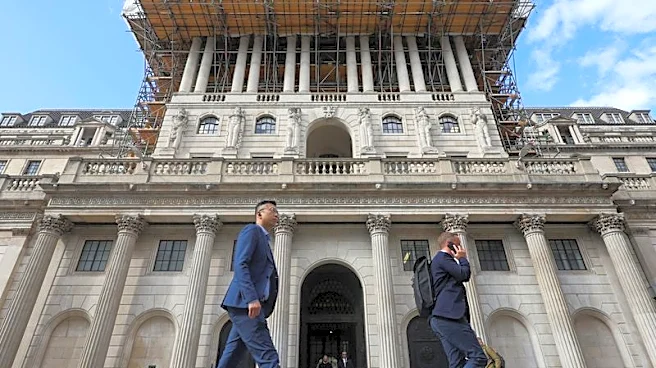
LONDON, Sept 24 (Reuters) - Two senior Bank of England interest rate-setters suggested on Thursday that they were getting closer to voting for an increase in borrowing costs, as unrelentingly high energy costs raised the risk of inflation getting stuck at high levels.
Deputy Governors Clare Lombardelli and Sarah Breeden, who both voted to hold the BoE's benchmark rate last week at 3.75%, said they were considering shifting position.
"The longer higher energy prices persist,
the greater the risk that indirect effects build and that inflation expectations, wage bargaining and price-setting behaviour begin to adjust in response," Lombardelli said in a speech in Warsaw.
Breeden, speaking at an event in London, sounded a similar warning.
"The more sparks we're throwing in the tinderbox, the more likely we might have to turn the hose on it," Breeden told the London Macro Policy Forum organised by the National Institute of Economic and Social Research.
Breeden said the BoE would watch carefully for signs of how big the energy price shock was proving and how much the rise was filtering through into the broader economy.
BOE KEPT RATES UNCHANGED AFTER OUTBREAK OF IRAN WAR
Britain's central bank has so far not followed the U.S. Federal Reserve and the European Central Bank which have raised rates. But it warned last week it might follow suit if the Iran war drags on and it predicted British inflation will top 4% early next year, more than double its 2% target.
A third member of the Monetary Policy Committee speaking on Thursday sounded a less urgent note about the prospect of an increase in borrowing costs.
Swati Dhingra, who was one of the strongest advocates of lowering borrowing costs when the BoE was cutting rates, said the extent of long-term inflation pressures in Britain caused by the Iran war would become clearer over the coming winter months.
Dhingra said Britain was not experiencing the kind of broad-based price rises that occurred in 2022, when energy prices jumped in response to Russia's full-scale invasion of Ukraine, and that the country's jobs market was now weaker.
However, investors are assigning a 75% chance of the BoE raising its Bank Rate by a quarter of a percentage point at its next meeting in November. Another hike was fully priced in by February.
Governor Andrew Bailey has said previously that the BoE's decision not to follow through on expected rate cuts earlier this year, after the start of the conflict in the Gulf, had done much of the job of tightening financial conditions in markets.
But last week he said "the longer this goes on, the more difficult this becomes", referring to the rise in energy prices.
Bailey is due to speak publicly on Friday.
Analysts at bank Investec said they now saw the probability of the BoE moving at its next MPC meeting.
"Unless there is material progress in negotiations that see substantial energy flows resume transit through the Strait of Hormuz, we imagine that tolerance for the majority of committee members will soon run thin, triggering a 25bp rate hike, likely in November," they said.
(Writing by William Schomberg; Editing by Jon Boyle)