




By Howard Schneider and Ann Saphir
JACKSON HOLE, Wyoming, Aug 28 (Reuters) - The U.S. central bank will "have work to do" if policymakers don't get the confidence they need that inflation is heading down to 2%, Federal Reserve Chairman Kevin Warsh said on Friday, coming closer than he has to acknowledging interest rate hikes may be needed to ease price pressures.
"Here is my standard: We must be confident that underlying inflation is moving to our objective, clearly and at sufficient speed. Otherwise,
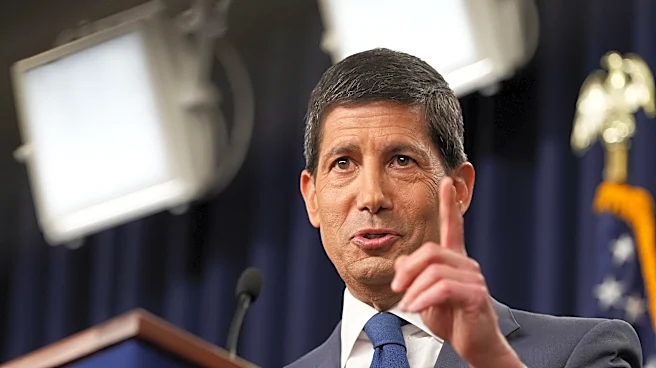
we have work to do. That's our job ... our mandate ... and our charge to keep," Warsh said in the keynote speech to the Fed's Jackson Hole economic symposium in Wyoming.
With the labor market stable, inflation too high, and little in financial conditions to indicate that the Fed's policy rate is restraining it, he said, "The Fed's predominant focus right now should be on prices."
The remarks drew applause from an audience of global central bankers hungry for more than his previous vague promises to deliver price stability, and unsettled by his refusal to say how he would do so. Markets heard the change in tune, and moved to increase bets on a rate hike next month even as they still priced in a healthy dose of skepticism that he will deliver it.
"We're moving up on six years where we've been above target" on inflation, former Philadelphia Fed President Patrick Harker said. "You can't keep saying this is our job" and then not act, he added. "As the old saying goes, actions speak way louder than words."
While much of Warsh's 16-page address focused on large issues, like the influence of artificial intelligence, that he feels will be critical in the long run, it also included some key acknowledgements — including that "short-term interest rates are the predominant tool to achieve the dual mandate."
Notably, Warsh said the recommendations of five task forces he has commissioned to study longer-term issues "will come later and have no bearing on decisions we make in the current policy conjuncture. But I believe that for future policy challenges, this intellectual investment today will leave us far better prepared."
He did not directly address recent market interventions by U.S. Treasury Secretary Scott Bessent, which have put downward pressure on long-term Treasury yields. But he did say the Fed "needs clear market signals, as unfiltered as possible" to set proper monetary policy.
And what came through — to a degree not evident in his first 99 days in a role in which he promised to deliver sweeping change at the Fed — was a sense of central banking normalcy: a Fed chief giving his take on the economy and his thoughts about what may be next for policy.
Warsh was picked for the job by President Donald Trump, and the Fed chief's reticence to signal the possibility of higher rates despite inflation that remains too high had been seen in some quarters as overly deferential to Trump's explicit expectation that his appointee will lower rates.
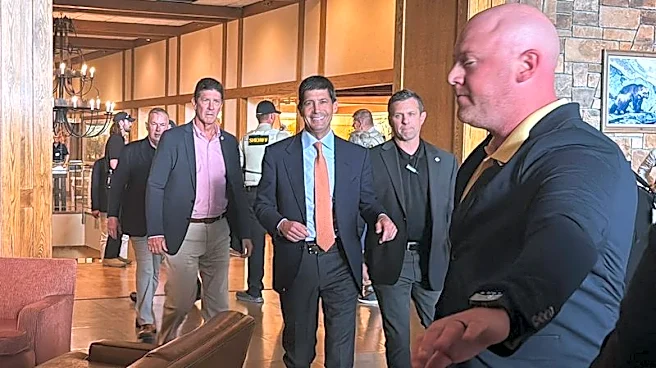
After his speech, Warsh took a stroll in the rain in the company of his counterparts from the central banks of Canada and England, something that any Fed chief might do.
INFLATION EXPECTATIONS MUST BE 'CLOSELY MINDED'
It was his comments on inflation that arguably went the furthest to meet what some had seen as a gap in Warsh's remarks at his first two press conferences.
"Progress over the past two years has been modest," Warsh said of inflation readings that by the Fed's preferred Personal Consumption Expenditures Price Index remained at 3.7% on an annual basis as of July.
Recent data "do not tell me that underlying trends have meaningfully improved," he said, with about half of the items in the PCE basket of goods and services increasing at more than a 3% annual rate, below the ratio seen during the COVID-19 inflation surge but above the pre-pandemic norm.
Warsh's speech "delivered a far clearer — and hawkish — message than his last press conference appearance," Capital Economics analysts wrote. "That leaves the door open to a hike earlier than our current forecast of December, if the forthcoming price data are firm."
At the same time, Warsh said that he and a large majority of Fed policymakers had felt at the July 28-29 meeting that they could wait for more data to decide if there was a need to change course. With just one more inflation report expected before the September 15-16 meeting, it is unclear if that wait will be over very soon.
Rate futures are pricing in about a 60% chance of a rate hike next month, up from about 40% before the speech.
Warsh did not suggest a timeline for rate hikes, and explicitly said his remarks should not be taken as "forward guidance" or even as the more explicit "reaction function" investors and Fed analysts have suggested he provide — neither of which he feels would be appropriate or possible to accurately provide.
But they do amount to his most detailed comments yet on where the Fed stands in its efforts to return inflation to its 2% target after more than five years above it, and on how, exactly, he is making sense of the data that shows a "stable" labor market, resilient economic growth, fast-rising business investment, and financial conditions in which he is "hard-pressed" to see any signs of restrictiveness.
"Inflation is running above our 2% target," Warsh said, noting that the Fed's inflation target, as measured by the 12-month change in the PCE, is "firm" and "fixed."
The Fed chief noted, in another elaboration, that he currently sees inflation expectations as anchored, though they must be "closely minded."
"It's the Fed's job to make sure that inflation expectations do not get unanchored," Warsh said.
He also said that not only does the economy appear resilient, but that given current market interest rates and a Fed short-term policy rate that has remained unchanged in the 3.50%-3.75% range since December, "credit and loan markets are showing few signs of policy restraint," comments that could lay the groundwork for arguments in favor of a rate hike if inflation persists.
There was sentiment at the meeting last month to tighten policy, with three policymakers dissenting from the decision to leave the policy rate unchanged.
Key unemployment, job growth and consumer inflation data for August will be released early next month.
(Reporting by Howard Schneider; Additional reporting by Ann Saphir, and Michael S. Derby; Editing by Dan Burns and Paul Simao)