






Mission Climax Approaches
The Artemis II mission is drawing to a close, with its four-person crew preparing for the ultimate challenge: a swift and precise return to Earth's embrace
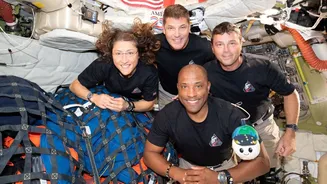
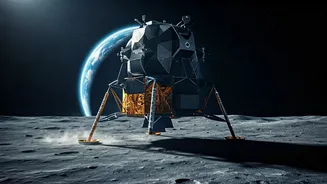
after their groundbreaking orbital journey around the Moon. This expedition has not only set new distance records, pushing beyond the 252,000-mile mark from our planet and surpassing Apollo 13's long-held record, but it has also significantly advanced our scientific knowledge and demonstrated crucial technologies vital for future lunar endeavors. The crew, comprising Reid Wiseman, Victor Glover, Christina Koch, and Jeremy Hansen, is slated to splash down in the Pacific Ocean near San Diego, bringing an end to their nearly 10-day voyage. This return marks a pivotal moment, signifying humanity's first trip around the Moon since the Apollo 17 mission and laying essential groundwork for NASA's ambitious Artemis program, which aims to re-establish a lasting human presence beyond Earth. The mission's journey itself was an achievement, reaching a peak distance of approximately 252,760 miles from Earth, a new zenith for human exploration, and included a significant flyby of the Moon's far side, offering direct human observation of a region previously only seen through remote sensing. This direct engagement provided invaluable insights, with the Moon serving as a 'witness plate' to the solar system's early history, as noted by the crew, fostering dynamic exchanges between astronauts and Earth-based scientists about planetary formation.
Free-Return Trajectory Unveiled
The return leg of the Artemis II mission relies on a meticulously calculated orbital path known as a free-return trajectory, a testament to the elegance of orbital mechanics. This ingenious approach leverages the gravitational interplay between Earth and the Moon to guide the Orion capsule, dubbed 'Integrity' by the crew, back home without the need for continuous engine thrust. The path itself resembles a grand figure-eight, with our planet and its lunar companion acting as the dual focal points. As the spacecraft neared the Moon, it entered a zone where lunar gravity became the dominant force, effectively 'capturing' the capsule and redirecting its momentum back towards Earth. This maneuver is a sophisticated application of the principles governing the 'three-body problem,' which accounts for the complex gravitational tug-of-war between the Earth, Moon, and the spacecraft itself. NASA experts explain that this is achieved through a transfer of angular momentum; as Orion passed the Moon, it exchanged some of its forward momentum, allowing the Moon's gravity to bend its path. This is conceptually similar to the 'gravitational slingshot' maneuvers used in deep space exploration, where spacecraft harness the gravity of planets to alter their speed and direction. The inherent brilliance of the free-return trajectory lies in its built-in safety net: even in the event of propulsion system failure, the path itself ensures a natural return to Earth, a critical safeguard inherited from the Apollo era missions and vital for Artemis II.
Reentry: A Fiery Descent
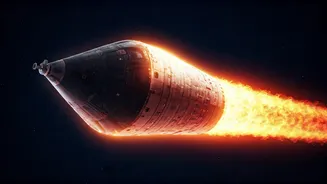
The journey's end brings the Orion capsule to a point of extreme peril and scientific marvel: atmospheric reentry. As the spacecraft plunges back into Earth's atmosphere, it will encounter speeds of up to an astonishing 23,839 miles per hour (38,365 kilometers per hour). This immense velocity, coupled with the friction generated by colliding with atmospheric particles, will create temperatures so high that the air surrounding the capsule will ionize, forming a glowing plasma sheath that makes the spacecraft appear as a blazing fireball. Astronaut Victor Glover has expressed the profound nature of this impending experience, noting its significance alongside the mission's other accomplishments. To withstand these incredibly harsh conditions, the Orion capsule is equipped with a state-of-the-art heat shield, a critical component designed to dissipate the extreme thermal and mechanical forces. This shield is not merely for this mission; it is a crucial piece of technology being rigorously tested during Artemis II, paving the way for future lunar landings and even potential missions to Mars. NASA anticipates this dramatic reentry sequence to last approximately 13 minutes, commencing with the capsule's initial atmospheric contact and culminating in its splashdown in the Pacific Ocean. During this intense period, Orion will employ its thrusters for stabilization and deceleration, followed by a series of parachute deployments to gradually slow its descent.
Controlled Landing and Recovery
The final moments of the Artemis II mission are orchestrated with meticulous precision, culminating in a safe splashdown. As the Orion capsule decelerates, it will deploy drogue parachutes, which serve to stabilize its orientation in the descent. These will be followed by pilot parachutes, designed to gently pull out the much larger main parachutes. Once deployed, these main parachutes will dramatically reduce the capsule's speed, bringing it to a final descent rate of approximately 25 feet per second just before it impacts the ocean surface. NASA's recovery operations are a significant undertaking, with the U.S. Navy playing a crucial role. The USS John P Murtha has been strategically positioned in the designated splashdown zone in the Pacific Ocean to oversee the retrieval of both the crew and the spacecraft. Upon landing, divers will quickly approach the capsule, securing it and assisting the astronauts as they egress. The crew will then be transferred to an inflatable platform, referred to as the 'front porch,' before being brought aboard the recovery vessel. This entire recovery process has undergone extensive simulations to guarantee maximum efficiency and safety. The chosen splashdown location, near San Diego, is a result of the free-return trajectory's natural inclination towards the Pacific, refined by minor course corrections to ensure ideal conditions, including favorable weather, proximity to naval assets, and established recovery infrastructure.
Crew Preparations and Future Vision
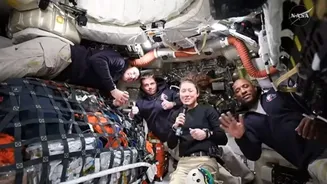
In anticipation of their return, the Artemis II crew has been diligently preparing both technically and mentally for the demanding reentry phase. NASA officials have outlined a comprehensive series of activities designed to ensure that all onboard systems are functioning optimally and that the astronauts are fully ready for the mission's final segment. This includes conducting critical tests to validate Orion's manual control capabilities, a vital skill set for future missions that might involve intricate docking procedures with other spacecraft in orbit. These exercises are part of a broader certification process for Orion's systems, essential for upcoming Artemis expeditions. To maximize focus on reentry readiness, some planned mission activities were adjusted; for example, an exercise to construct a radiation shelter within the capsule was canceled, allowing more time to configure the spacecraft for its descent. On the day prior to reentry, the astronauts are scheduled to perform thorough simulations and system checks, verifying that every component is operating as intended. While mission officials express strong confidence in the spacecraft's performance to date, they emphasize that Artemis II is fundamentally a test flight, with each phase yielding invaluable data for future endeavors. The broader significance of Artemis II lies in its foundational role within NASA's long-term exploration strategy, aiming to establish a sustained human presence on the Moon and ultimately pave the way for human missions to Mars. Astronaut Christina Koch likened the program to a relay race, where each mission builds upon the successes of those that came before, symbolizing this continuity with physical batons to be passed to subsequent crews, with every action taken with future explorers in mind.