


The Fiery Descent
Following their groundbreaking 10-day mission to the Moon, the Artemis II astronauts are on the cusp of their return to Earth. This final leg of their journey
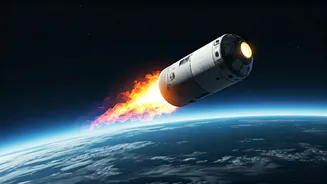
is perhaps the most critical, involving a rapid descent through the atmosphere at hypersonic speeds. The Orion spacecraft, carrying the four-person crew, will reach velocities exceeding 11 km/s (40,000 km/h), a pace approximately 40 times faster than a commercial airliner. This immense speed translates to a colossal amount of kinetic energy, nearly 2,000 times that of a passenger jet per kilogram. To safely land, this energy must be dissipated, and the spacecraft must decelerate to a speed where parachutes can effectively deploy. This controlled deceleration is achieved by deliberately engaging the Earth's atmosphere as a braking mechanism, a stark contrast to aircraft designed to minimize drag for fuel efficiency. The spacecraft are engineered to maximize this atmospheric resistance, transforming the air into a formidable brake. This process generates intense forces, measured in 'g-forces,' which represent the acceleration or deceleration experienced relative to Earth's gravity. While uncrewed capsules might endure over 100 g's, human-rated vehicles like Orion are designed for a more gradual deceleration over several minutes, keeping the g-forces within survivable limits for the astronauts.
Surviving Extreme Heat
As the Orion capsule hurtles back into Earth's atmosphere at over 30 times the speed of sound, it encounters an environment of unimaginable heat. A powerful shock wave forms around the spacecraft, compressing the air to temperatures potentially reaching 10,000°C, a figure roughly double that of the Sun's surface. This extreme heat ionizes the surrounding air, transforming it into a plasma that temporarily disrupts radio communications, leading to a blackout period for the astronauts during the most intense phase of re-entry. To withstand these conditions, spacecraft rely on a meticulously designed trajectory to minimize the heat load and a sophisticated thermal protection system. This system acts as an insulating shield, safeguarding the crew and internal components from the hypersonic airflow. The materials used are carefully selected and applied, with more robust substances placed on surfaces expected to endure the harshest thermal assault. These materials are designed to glow intensely and gradually degrade during re-entry, effectively radiating heat away from the spacecraft and into the atmosphere, rather than absorbing it. This precise engineering allows the exterior of the capsule to reach temperatures around 3,000°C while maintaining a survivable internal environment for the crew.
The Ablative Shield
The primary defense against the extreme heat of atmospheric re-entry is the ablative heat shield. These shields are typically constructed from advanced composite materials, often a combination of carbon fiber and phenolic resin. The genius of ablative materials lies in their ability to absorb immense amounts of energy by undergoing a controlled process of burning away. As the material vaporizes, it releases a relatively cool gas that flows over the spacecraft's surface, further dissipating heat. The specific ablative material employed on the Orion capsule is known as AVCOAT, a descendant of the technology that protected the Apollo missions during their returns from the Moon. During the uncrewed Artemis I test flight, analysis revealed that the ablation of the heat shield was more significant than anticipated, with material loss observed in certain areas. Engineers attributed this to potential pressure buildup within the material during the 'skip' phase of entry—a maneuver where the spacecraft briefly exits the atmosphere before re-entering. For Artemis II, to mitigate this concern, engineers have subtly adjusted the re-entry trajectory. While still utilizing lift for deceleration, the modified path aims to create a less pronounced 'skip,' thereby managing the pressures and ensuring the integrity of the heat shield for the safe return of the Artemis II crew.