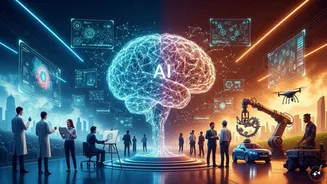








Understanding FOBO's Rise
The rapid evolution of Artificial Intelligence (AI) has introduced a pervasive new anxiety in professional environments, known as FOBO, or the Fear of Becoming
Obsolete. As AI systems grow more sophisticated, capable of performing tasks once exclusive to humans, a significant portion of the workforce is experiencing unease about their job security and continued relevance. This apprehension is fueled by AI's increasing ability to automate routine duties, process enormous datasets, and even generate creative outputs. While these technological leaps promise enhanced efficiency and productivity, they simultaneously cast a shadow over the future of employment and the essential skills that will be in demand. Data indicates a tangible increase in this concern, with a Gallup survey revealing that 22% of American workers worried about job obsolescence due to technology in a recent period, a notable rise from 15% in 2021. The intensity of this fear is so pronounced that some employees are reportedly willing to forgo salary increases in exchange for opportunities to enhance their AI and digital skill sets, as highlighted by a Mercer report where 63% of global employees expressed this willingness for a 10% pay hike.
Assessing the AI Threat
The apprehension surrounding AI's potential to displace human workers is not merely speculative; it is echoed by industry leaders and reinforced by executive surveys. For instance, Anthropic CEO Dario Amodei has projected that AI could potentially eliminate half of all entry-level white-collar positions within the next five years. Furthermore, a comprehensive report from Mercer indicated that an overwhelming 99% of polled executives anticipate some level of workforce reduction due to AI within a two-year timeframe. However, the precise manner and extent of AI's impact on jobs remain subjects of ongoing discussion and uncertainty. MIT researchers offer a nuanced perspective, suggesting that AI's integration into the labor market is more akin to a 'rising tide' rather than abrupt, transformative 'crashing waves,' implying a gradual but widespread influence across numerous tasks simultaneously. Despite the significant discourse on potential job market upheaval, the actual adoption of AI by businesses has, thus far, been relatively slow. Goldman Sachs economists noted that less than 19% of American establishments had adopted AI as of March 2026, with projections indicating this figure would only reach 22.3% in the subsequent six months. This suggests that workers may have considerable visibility into these changes, mitigating the shock of sudden, drastic automation.
AI's Current Workplace Impact
While the long-term implications of AI on employment are still unfolding, its immediate effects are observable in enhanced productivity and task acceleration. Economists from Goldman Sachs have reported significant impacts on labor productivity in areas where generative AI has been deployed, citing academic studies that suggest an average uplift of 23%, with company anecdotes pointing to even higher efficiency gains of around 33%. However, it's crucial to understand that AI is largely being integrated as a supplement to existing workflows rather than a fundamental redesign of how work is performed. Career expert Keith Spencer clarifies that while AI can speed up daily tasks like drafting emails, summarizing information, or automating administrative duties, this acceleration doesn't automatically translate into increased output of products or services, which is what drives revenue growth. In the realm of text-based labor market tasks, AI is demonstrating rapid improvement, achieving minimally acceptable quality levels with high success rates. Research from MIT FutureTech suggests that by 2029, AI systems could complete most text-based tasks with 80% to 95% accuracy. For the majority of tasks that humans currently complete in a few hours, the projected 2029 success rate for AI stands at 90%, indicating its growing proficiency in handling information-processing roles.
Employer's Role in Adaptation
Despite the rapid advancements in AI technology and the growing employee anxiety, many organizations are lagging in providing adequate support for their workforce to adapt. Research from the workforce nonprofit JFF reveals that only about one-third of employees feel their employer is offering sufficient AI training, guidance, or reskilling opportunities, marking a decline from previous periods. This deficiency leaves a significant gap between employees who are embracing AI tools and those who are hesitant or lack the necessary skills. Data from OpenAI indicates that enterprise workers utilizing AI are reclaiming substantial time, estimated at 40 to 60 minutes per day, with approximately 75% reporting an enhanced ability to complete tasks they previously found impossible. To bridge this gap and foster effective AI integration, experts like Ravin Jesuthasan, a prominent future-of-work specialist, emphasize that simply providing access to AI tools like ChatGPT is insufficient to guarantee returns. He advocates for mandatory training programs and allocating dedicated learning time during the workday to encourage employee engagement. Jesuthasan also suggests 'reverse mentoring,' where senior employees collaborate with younger colleagues who are more adept with modern technology, to address potential age-related disparities in AI learning and adoption.
Individual Empowerment and Future
Ultimately, navigating the evolving landscape shaped by AI hinges on individual initiative and a commitment to continuous learning. While organizations can and should provide the necessary resources, infrastructure, and a supportive environment for reskilling and upskilling, the impetus for change must originate from within each employee. As Jesuthasan highlights, individuals must actively cultivate curiosity and a proactive approach to staying relevant in their respective fields. The future of work is not a scenario where AI entirely replaces humans, but rather one of collaboration and augmentation. By embracing AI as a tool, acquiring new skills that complement AI's capabilities—such as critical thinking, emotional intelligence, creativity, and complex problem-solving—and fostering a mindset of adaptability, individuals can transform potential obsolescence into opportunities for growth and innovation. The key lies in recognizing that AI is an enduring presence, and the choice is between adapting to leverage its power or being left behind.