



The Artemis II Crew
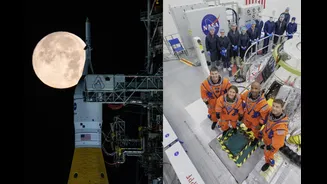
The Artemis II mission will carry a distinguished four-person crew, a testament to years of dedicated training and selection. Commander Reid Wiseman and pilot
Victor Glover, both seasoned NASA astronauts, will be joined by mission specialist Christina Koch. Adding to the international collaboration, Jeremy Hansen from the Canadian Space Agency will also serve as a mission specialist. This crew, chosen back in 2023, represents a significant milestone: Victor Glover is poised to become the first Black astronaut to journey to the lunar vicinity and venture beyond low Earth orbit, while Christina Koch will achieve the same distinction for women. Their selection underscores NASA's commitment to diversity and inclusion in its ambitious space exploration endeavors.
Launch and Trajectory
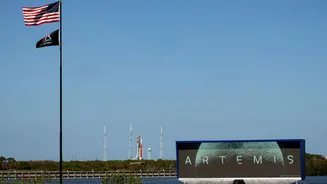
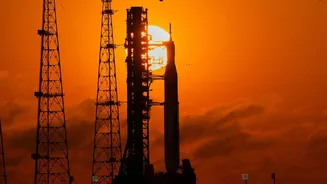
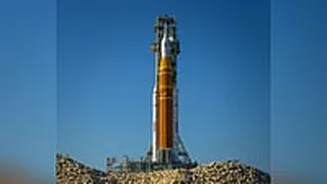
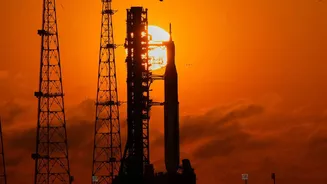
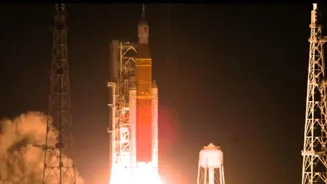
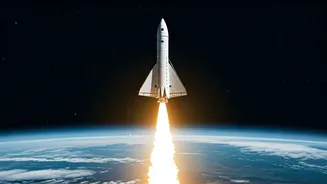
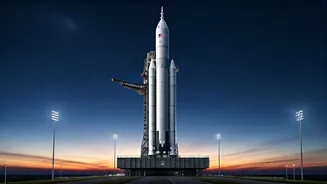
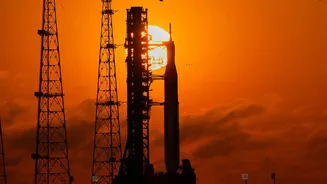
The Artemis II mission is slated for launch from Florida's Kennedy Space Center, with an 80% chance of favorable weather conditions on April 1st. The launch window extends from April 1st to April 9th, with a final opportunity on April 30th if needed to maintain the mission's schedule. The astronauts will ascend aboard the formidable Orion spacecraft, perched atop the colossal 322-foot Space Launch System (SLS) rocket. This rocket, a product of collaboration between Boeing and Northrop Grumman, stands as the most powerful ever constructed. Following liftoff, the Orion craft will execute a gravitational slingshot maneuver around the Moon, a technique previously employed by the Apollo 13 mission, propelling them on their journey.
Mission Objectives & Tests
The Artemis II mission's primary goal is to rigorously test the integrated systems of the SLS rocket and the Orion capsule, particularly their life support capabilities and performance in the harsh environment of deep space. Approximately three and a half hours after launch, pilot Victor Glover will take manual control of the Orion craft to evaluate its thrusters and overall maneuverability, practicing steering and alignment procedures. The mission's itinerary includes a voyage to the far side of the Moon, reaching an unprecedented distance of approximately 402,000 kilometers from Earth, surpassing the Apollo 13 crew's farthest reach. During this phase, the crew will experience up to 50 minutes of radio silence, testing the spacecraft's communication resilience.
Deep Space Exploration
While orbiting the Moon, the Artemis II crew will conduct comprehensive tests of Orion's critical systems, including life support, propulsion, and navigation. They will meticulously collect their own medical data, offering invaluable insights into the physiological effects of prolonged deep space travel. Furthermore, the astronauts will capture stunning images of deep space, transmitting this vital data back to Earth. This collected information is indispensable for the success of subsequent Artemis missions, specifically Artemis III and Artemis IV, the latter of which is targeted for a lunar landing in 2028. The mission's trajectory will involve a loop around the far side of the Moon, utilizing lunar gravity to initiate their return to Earth without requiring additional engine burns.
Re-entry and Recovery
Upon their return, NASA anticipates the Orion capsule will achieve a peak re-entry speed of approximately 40,200 kilometers per hour, potentially setting a new record that would eclipse the one held by the Apollo 10 astronauts. As the capsule pierces Earth's atmosphere, a protective shield will be jettisoned, followed by the deployment of parachutes to decelerate their descent. The spacecraft is expected to splash down in the Pacific Ocean, near the coast of California. Upon landing, five orange airbags will inflate around the capsule's upper section, ensuring it flips upright for the crew's safe egress. Recovery teams will then be on standby to retrieve the astronauts and the Orion capsule, concluding this monumental mission.
The New Lunar Race
The Artemis II mission is part of a larger international push to return humans to the Moon, a renewed focus driven by geopolitical competition, particularly with China. The United States, having been the sole nation to land humans on another celestial body through the Apollo program, faces a formidable rival in China's ambitious lunar exploration initiative, which aims for a crewed landing by 2030. Mission specialist Christina Koch highlighted the Moon's significance not only as a scientific marvel, offering clues to the solar system's formation, but also as a crucial stepping stone for missions to Mars, where the search for extraterrestrial life may yield significant discoveries. The growing international recognition of the Moon's value underscores the critical question for humanity: 'Should we lead, or should we follow?' in this new era of space exploration.