






A New Lunar Chapter
For the first time in nearly 54 years, humanity is once again en route to the lunar surface, thanks to NASA's Artemis II mission. This monumental undertaking
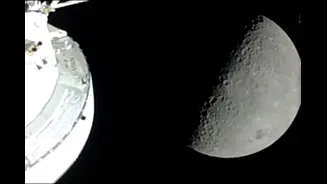
signifies a broader objective by the US space agency to cultivate a lasting human presence on the Moon. The Artemis II flight, a crucial step in this grand plan, involves the powerful Space Launch System (SLS) rocket carrying the Orion crew capsule, launching from the historic Kennedy Space Center in Cape Canaveral, Florida. As the world watches, this mission represents more than just a return to space; it's a bold stride towards humanity's future beyond Earth. The launch itself, on April 1st at 6:35 pm EDT, marks NASA's significant re-engagement with Earth's natural satellite, a celestial body not visited by humans since December 1972. The astronauts of Artemis II are carrying not just themselves, but the collective aspirations of a world eager for new frontiers. This program aims to realize the construction of a multibillion-dollar lunar base at the Moon's south pole by the 2030s, building upon the foundational knowledge gained from previous missions and pushing the boundaries of human exploration further than ever before.
Echoes of Apollo, Dreams of Artemis
The name 'Artemis' itself is deeply resonant, chosen by NASA as a deliberate homage to its pioneering Apollo missions that first landed humans on the Moon between 1968 and 1972. In Greek mythology, Artemis is the divine twin sister of Apollo and the revered goddess of the Moon. NASA articulates that the combined names, Artemis and Apollo, serve as both a symbolic and tangible link connecting the past achievements of human spaceflight with its future potential. The underlying philosophy is straightforward yet profound: Apollo demonstrated humanity's capability to reach the lunar surface; Artemis aims to revisit and establish a sustained presence with a long-term vision. The mythological Artemis is often depicted as an independent, fiercely protective figure deeply connected to nature. These qualities are seen as mirroring NASA's aspirations for a sustainable lunar program and exploration of uncharted territories on the Moon. Furthermore, the name Artemis carries additional significance as it aligns directly with the program's paramount goal: to land the first woman on the Moon, broadening the scope of human representation in space exploration.
The Artemis Program's Grand Design
The Artemis II launch is just one phase within NASA's overarching Artemis program, a comprehensive initiative designed for sustained human lunar exploration. The program's ultimate objective is to facilitate astronaut landings at the Moon's south pole and ultimately establish a permanent human habitation there. Artemis I, the initial phase, was successfully completed in 2022, featuring an uncrewed test of the Space Launch System (SLS) rocket and the Orion capsule during a lunar flyby. Artemis II represents the subsequent stage, marking the first crewed lunar flyby in this new era, with astronauts venturing to a record distance of approximately 252,000 miles (406,000 km) from Earth. This surpasses the previous record for the farthest human spaceflight, held by the Apollo 13 mission in 1970, which encountered critical technical issues and was unable to complete its planned lunar landing. Following the successful Artemis II mission, the program progresses to Artemis III, anticipated for 2027. This mission aims to send a crew to low-Earth orbit to rendezvous with a lunar lander, paving the way for Artemis IV, which intends to land a four-person crew on the Moon's south pole. Beyond its lunar ambitions, the Artemis program also functions as a critical stepping stone for future human expeditions to Mars, furthering the reach of human presence in the solar system. Moreover, the Artemis program carries significant geopolitical implications, as the United States seeks to maintain its leadership in space exploration amidst increasing global competition.
Launch Day Spectacle
Wednesday's launch of Artemis II was an event charged with considerable anticipation and excitement, drawing an estimated 400,000 spectators to Florida's Space Center. At precisely 6:35 pm EDT, NASA's SLS rocket ascended flawlessly, carrying the four-person Artemis II crew: Commander Reid Wiseman, Pilot Victor Glover, Mission Specialist Christina Koch, and Mission Specialist Jeremy Hansen, a Canadian astronaut. Minutes before liftoff, Hansen, speaking from within the Orion capsule, conveyed a profound message to mission control in Houston, stating, "This is Jeremy, we are going for all humanity." In response, Launch Director Charlie Blackwell-Thompson acknowledged the crew's monumental task, articulating, "Reid, Victor, Christina, and Jeremy, on this historic mission, you take with you the heart of this Artemis team, the daring spirit of the American people and our partners across the globe, and the hopes and dreams of a new generation." She concluded with, "Good luck, godspeed, Artemis II. Let’s go." This historic journey will span 10 days, during which the crew will undertake numerous mission objectives, notably the first human lunar flyby in over fifty years. Experts emphasize that Artemis II is fundamentally a mission to validate systems, allowing NASA to rigorously test the Orion spacecraft's life support, navigation, communication systems, and overall performance in the demanding environment of deep space with a crew aboard – conditions that are impossible to fully replicate on Earth. Upon completion of their 10-day voyage, the Artemis II will return to Earth via a 'free-return' trajectory, culminating in a splashdown in the Pacific Ocean off the California coast. Despite a minor technical issue with the capsule's toilet, which saw it shut down shortly after activation, the enthusiasm surrounding the mission remains undiminished, with ongoing monitoring of the crew's progress throughout their space voyage.