


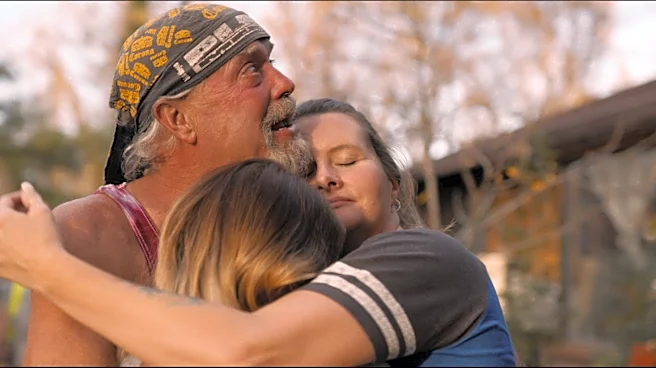

Nearly two years after Tropical Storm Helene, recovery can be measured in dollars and cents, but it can also be measured in what returned, what emerged, what was born or reborn. A general store is rising again beside a battered river. A couple who watched nearly everything disappear beneath floodwater rebuilt a livelihood and found new meaning in an old symbol of hope. A child born as the storm tore across Western North Carolina has grown into something his parents once scarcely believed possible.
In each case, Helene wasn’t the end — it was only the beginning.
Somewhere over the flood
The first rainbow David and Kate Donald remember after Helene appeared over the wreckage of the Swannanoa home they thought they were leaving for the last time.
Everything was covered in mud,
knee-deep in places. The Donalds had returned to see what they could salvage and meet with Federal Emergency Management Agency officials after floodwaters destroyed nearly everything they owned. As they drove away, Kate looked back and saw a rainbow hanging over the house. She said it “felt like a sign that we would be OK.”

Only days earlier, whether David would be OK was very much in doubt.
Kate was in Florida when Helene struck. David was home with their dog, Coco, watching floodwaters rise around the house. He tried to save equipment from his DJ business before water began pouring inside. Within about 45 minutes, water had risen nearly to the roof.
Standing on a laundry basket, David forced himself through a small attic opening while talking with a 911 operator. Coco jumped back into the water, forcing David to yank her back into the attic by her harness. Kate was eventually brought onto the 911 call, in case the couple needed to say their final goodbyes.
A neighbor paddling through the floodwaters on a kayak heard David and cut a hole through the roof, allowing him and Coco to escape the attic. David then spent more than two hours on the roof as sheds, debris and other objects swept through what had become a raging river below. He eventually made it to higher ground with help from another kayaker.
Helene took the Donalds’ home, their vehicle, most of their belongings and almost all of David’s DJ equipment. One important piece survived — before the water rose too high, David had sealed his computer and iPad inside waterproof totes. When he later opened one, both were dry.

That became the beginning of rebuilding his business.
David was back behind the turntables at a wedding about a week after Helene, using equipment available at the venue after the event was moved to Raleigh. Some couples told him they would understand if he could not fulfill their bookings.
“I made a commitment to these people,” David recalled thinking. “If I can do it, then I will do it.”
Help came from relatives, friends, strangers and even people the Donalds had not heard from in years. Donations helped David replace his equipment. Someone gave them a truck after they lost the vehicle David had used for work. As of Aug. 27, the Donalds’ DJ business is booked solid through the end of 2026 and into 2027.
The Donalds now rent their best friends’ home in Asheville while those friends are out of the country. Their lives have moved far beyond the hotel rooms, temporary housing and uncertainty that followed Helene.
And recently, another sign appeared to them.
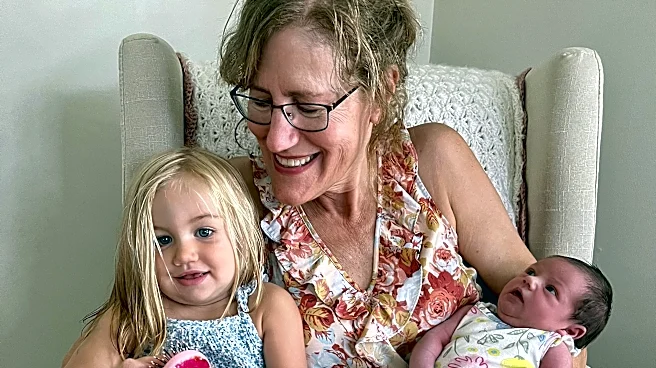
The Donalds were in Florida to meet their new granddaughter, born July 4. She had complications after birth, leaving the family uncertain whether she would be able to go home or would have to remain in neonatal intensive care. From their hotel window, David and Kate saw a rainbow.

For Kate, the two moments now seem connected. The first followed catastrophic loss. The latest arrived amid a new life, but also another period of fear and uncertainty.
Helene, Kate said, changed and expanded her faith. Rainbows have changed for her, too.
“Now I'm going to look for more meaning when I see a rainbow,” she said.
A town, a store and a second act
When Peter O’Leary returned to Chimney Rock two days after Tropical Storm Helene, he found two disasters waiting for him.
One belonged to Peter O’Leary, mayor of the Village of Chimney Rock.
The other belonged to Peter O’Leary, businessman.

O’Leary and his wife had operated Bubba O’Leary’s General Store on Main Street for more than three decades. The building, a former movie theater dating to 1927, was among the most visibly damaged structures on Main Street after the Rocky Broad River ripped through the tiny mountain village.
Water and debris slammed into a corner of the building, collapsing a wall. Floodwaters poured through the store and basement, tearing away floors and merchandise. The force blew the front doors outward, then grabbed a gas pump outside and sucked it back inside, through the building.

O’Leary estimates his losses at about $1.5 million.
His home, in an apartment above another Main Street building, escaped direct damage, but the destruction of water and sewer service made it uninhabitable for 10 months.
Yet when O’Leary returned to Chimney Rock after being briefly stranded on Tybee Island, Georgia during the storm, there was little time to dwell on any of it.
“It was like I went into ‘mayor mode,’ trying to help people mode,” O’Leary told the Citizen Times Aug. 9.
He and Village Administrator Steve Duncan began working through the immediate problems confronting a town that had been ripped apart — accounting for residents, restoring access, determining which buildings were safe and figuring out how a small municipal government could begin rebuilding. His own business largely had to wait.
Eventually, the remains of Bubba O’Leary’s had to be torn down completely. O’Leary and his wife wondered whether that might simply be the end of a 34-year chapter of their lives.

Flood insurance and a Small Business Administration loan made rebuilding financially possible. What convinced them to actually do it, however, was something else.
Volunteers poured into Chimney Rock. Faith-based nonprofit Spokes of Hope helped organize workers and materials to rebuild small businesses. The Tryon International Equestrian Center provided space where about a dozen displaced Chimney Rock merchants could operate temporary shops for months.
There, customers repeatedly told O’Leary how much the store — and Chimney Rock itself — meant to them.

“I’m not doing this for me,” O’Leary said. “I’m doing this for everybody else.”
Now, two years after, that rebuilding remains unfinished for both O’Leary and the village. Bubba O’Leary’s is rising again, with the exterior of the new building nearly complete and O’Leary hoping to reopen it by Christmas.
Chimney Rock itself is following much the same trajectory. Chimney Rock State Park reopened about 10 months after the storm. Main Street businesses began reopening about a month later after water and sewer service was restored. O’Leary said his business is now doing about 60% of its normal sales, while attendance at Chimney Rock State Park is running around half of normal.
Major work remains. Plans include rebuilding the road toward Bat Cave, constructing a permanent bridge to the state park, expanding water and sewer service and spending about $7 million on a rebuilt streetscape. The village also hopes to create a business hub for merchants who cannot rebuild on their former properties and expand a riverwalk that could turn the Rocky Broad River into a larger part of Chimney Rock’s tourism economy.
Some of those projects will take years. The rebuilding is not only about restoring what Helene destroyed, but is also about preparing Chimney Rock for when — not if — another disaster tests the village.

For a mayor who has served in Chimney Rock government since 1993, that means the same two recoveries that confronted him when he returned after Helene will remain intertwined — rebuilding his own livelihood while helping rebuild the place that made that livelihood possible.
“The old Chimney Rock’s gone, but the new Chimney Rock is going to be better than ever,” O’Leary said. “We still firmly believe that.”
True to his name
As Helene began tearing WNC apart and lives were ending across the region, another was just beginning — in tense, tenuous fashion.
Nearly a week earlier, Jewelia Crowe had started having contractions while staying with family in Robbinsville. She and fiancé Samuel Dillard drove to Cherokee Indian Hospital, where doctors found problems and transferred her by ambulance to Mission Hospital in Asheville.

Dillard followed alone for the hour-long drive. He didn’t listen to music or call anyone. His mind raced instead.
“It was a quiet ride of just a million thoughts,” Dillard said at the time.
The pregnancy already seemed improbable. Crowe said she had been told since age 15 that she could not have children. Dillard, after surgeries, said he had been told his chances of fathering a child were “one in a million.”
Crowe was admitted to Mission Sept. 21. Doctors managed to slow her contractions. Dillard stayed at the hospital throughout the ordeal, unwilling to leave because neither knew whether the baby would arrive within weeks, days or even hours.
The couple had heard a hurricane was coming, but expected the mountains to sap its strength.
Around midnight Sept. 27, Crowe began to labor in earnest. Outside, Helene’s winds were roaring. Crowe watched light poles sway through the hospital window and during her final contractions yelled, “The trees are gonna go!”
Doctors delivered the child at 1:41 a.m. Sept. 27, 2024 — nearly three months early. Crowe held her baby for the first time, for two minutes, until doctors whisked the baby away to the neonatal intensive care unit.

Crowe feared the baby, who was bluish and bruised at birth and initially did not cry, might not survive, but hospital staff reassured the couple he was breathing on his own. Soon after he reached the NICU, the hospital lost power and water and switched to backup generators.
Crowe was medically cleared to leave within two days, but Mission allowed the couple to remain four additional days because travel was still dangerous in the immediate aftermath of the storm. After that, they bounced among hotel rooms for about a week before bringing a camper to Pride RV in Waynesville, near the last open Interstate 40 exit before the highway closure. Their baby remained at Mission.
Crowe visited the hospital daily. Dillard drove from Waynesville to Robbinsville for work, returned to the camper each evening after his shift and then drove with Crowe to Asheville to feed, hold and spend time with their child.
They finally brought the child home Dec. 8, 2024, more than two months after his birth, with oxygen and a heart monitor in tow. The next few months were a blur of appointments with eye, heart and lung specialists.

Today, that child weighs about 25 pounds. His parents say he has chronic lung disease and an extra vein in his heart that doctors continue to monitor, but a hole in his heart healed on its own.
He was expected to need developmental follow-up until age 4 or 5. Instead, he was cleared before his second birthday.

“He’s running around, getting into everything,” Dillard said. “Just a normal two-year-old.”
He loves trucks, motors, climbing and almost any food put in front of him — except peas.
Even his name now seems prescient. Crowe and Dillard had narrowed their choices to Grayson and Phoenix before Helene ever arrived. Both kept leaning toward Phoenix.

For parents who once wondered whether they could have a child at all, then watched that child arrive 10 weeks early as a historic storm raged outside, the name has taken on even more meaning.
“Phoenix just kind of showed us from the start he’s a fighter,” Dillard said. “He’s never going to give up, and he’s kind of taught us to do the same.”
Cory Vaillancourt is the Helene Recovery/Investigations Reporter for the Asheville Citizen Times. Find him on X at @The_CoryV or on Signal, via email at cvaillancourt@citizentimes.com or at 912-508-5640.
This article originally appeared on Asheville Citizen Times: Two years after Helene, survivors are still rebuilding their lives