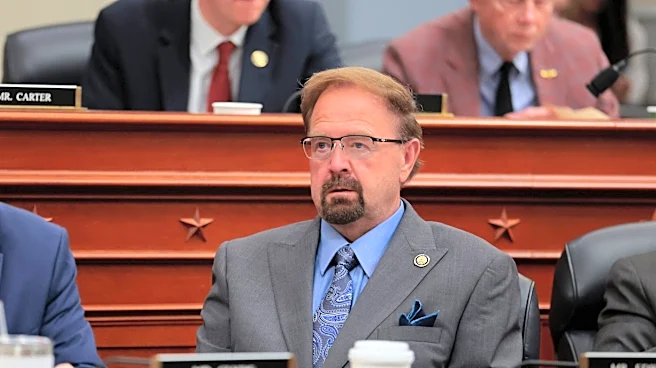








ASHEVILLE - The U.S. House moved Sept. 1 to censure Rep. Chuck Edwards after an extraordinary floor debate in which the Western North Carolina Republican apologized to the two former staffers at the center of a sexual harassment investigation and to his wife — but not his constituents — while insisting that poor judgment and inappropriate behavior did not amount to sexual harassment.
Chuck Edwards arrived in Congress in 2023 after presenting himself to WNC Republicans as a steadier alternative to scandal-plagued incumbent Madison Cawthorn. Edwards, a Henderson County businessman and McDonald’s franchise owner, had served three terms in the North Carolina Senate beginning in 2016. In the 2022 Republican Primary Election for the 11th Congressional
District, Edwards narrowly defeated Cawthorn, who had been endorsed by Donald Trump but had alienated other Republicans through a series of controversies. Edwards went on to win the General Election and was reelected in 2024 with nearly 57% of the vote.
But allegations involving Edwards’ treatment of two young female employees eventually brought scrutiny of his own. The House Ethics Committee began investigating Edwards in spring 2026, publicly confirming May 14 that it was reviewing whether he had engaged in sexual harassment or created a hostile work environment. Both women had previously worked for Edwards while he was a state senator and followed him to Washington after his election to Congress. One had started as an intern at age 19.
The committee’s Aug. 3 report described what it called “persistent unprofessional and inappropriate conduct” spanning several years. Investigators said Edwards gave the women expensive gifts including jewelry, designer purses, electronics and trips, sent personal late-night messages, arranged one-on-one dinners and made repeated comments about their appearance. The report also described Edwards traveling privately with one staffer to Las Vegas and skipping House votes on another occasion to help decorate a staffer’s Christmas tree. Investigators said senior staff warned Edwards about concerns over his behavior as early as May 2025.

The bipartisan Ethics Committee concluded there was substantial reason to believe Edwards violated House rules related to sexual harassment and hostile workplaces and recommended that the full House censure him. The committee said the conduct toward the two employees, repeated over a sustained period, was “beyond inappropriate.”
Edwards has denied that his relationships with the women were sexual or romantic and argued that the committee mischaracterized friendships, reciprocal gift-giving and mentorship. In a 22-page appeal circulated to House colleagues ahead of the censure vote, Edwards urged them to reject the committee’s recommendation.
Two days after the report became public, however, Edwards withdrew from his reelection campaign, saying he would complete his current term. The North Carolina Republican Party subsequently selected state Rep. Jennifer Balkcom to replace Edwards on the November ballot.

Balkcom will face Fairview Democrat Jamie Ager in that contest. Ager had outraised Edwards by substantial margins before his withdrawal from the race, and national political forecasters had moved the race away from the solidly Republican ratings it had earned in the past.
Edwards makes his case
Rep. Mike Guest (R-MS) the Ethics Committee chair who introduced the censure resolution Aug. 3, opened the debate by emphasizing what investigators did not find — the committee found no evidence that Edwards engaged in sexual activity with the women, explicitly propositioned them or engaged in quid pro quo harassment. Guest said the case instead rested on whether Edwards’ repeated conduct created a hostile workplace when viewed as a whole.
Guest recounted the gifts, comments about the women’s appearance, intimate dinners, vacations, late-night messages and other attention. He said Edwards knew rumors had developed around the relationships and had been told by senior staff that the women were uncomfortable, yet continued the behavior.
“The committee found that Rep. Edwards was, at a minimum, blind to the reality, and at worst, dismissive of the impact his conduct had on the career and well-being of the women on his staff,” Guest said.

Edwards followed shortly after, beginning with apologies to the two women. He said he was sorry that his actions, judgment or expressions of friendship had made them uncomfortable and acknowledged that his understanding of the relationships may not have matched theirs. He then apologized at greater length to his wife, Teresa, and his family for the embarrassment, hurt and scrutiny they endured. He did not offer an apology to his constituents.
Edwards then turned to the central argument of his defense. He said the committee had acknowledged there was no sexual activity, no explicit proposition, no quid pro quo harassment and no violation of federal sexual harassment law. He argued that investigators nevertheless took years of friendships, reciprocal gifts and communications out of context and assembled them into a finding the evidence did not support.
“Possibility is not proof, inference is not evidence, and selective context is not totality,” Edwards said.

Edwards said he had provided investigators about 186,000 emails, text messages, voicemails and other documents that showed longstanding relationships with the women dating to his time in the North Carolina Senate. He said the records showed the women sometimes initiated dinners and other activities, expressed affection, complimented him and remained in contact after leaving his office.
He also acknowledged that he would handle some of those interactions differently in retrospect. His argument to colleagues was not that every interaction had been appropriate, but that censure was disproportionate to what the committee had actually established.
“I am imperfect. I have made mistakes, but I do not believe I committed sexual harassment, and the factual findings of this investigation do not justify branding me as though I did,” Edwards said.
Guest briefly responded after Edwards finished, saying the facts Edwards cited in his defense were not omitted from the investigation. Guest said the committee deliberately included evidence favorable to Edwards alongside evidence supporting its findings rather than presenting only the allegations against him.
Guest said the committee ultimately concluded that individual acts that might appear merely inappropriate in isolation took on greater significance when considered together, particularly after Edwards had been made aware of the women’s discomfort.

“But these actions, when taken in combination with each other, and when viewed under a totality of the circumstances test, led the committee to find that Representative Edwards engaged in unprofessional conduct toward two young female staffers, and said conduct created a hostile work environment that resulted in both staffers leaving the employment of Mr. Edwards’ office,” Guest said.
Rep. Mark DeSaulnier (D-CA) the ranking Democrat on the Ethics Committee, said the four-month investigation included interviews with 16 people and a review of nearly 1,500 pages of documents. He described Edwards’ behavior as a sustained pattern rather than a collection of isolated incidents and focused heavily on the power imbalance between members of Congress and their employees.
DeSaulnier said neither woman felt free to reject Edwards’ attention without risking professional consequences. One told investigators she feared having a member of Congress working against her career. DeSaulnier said the absence of physical advances or explicit propositions did not prevent the committee from determining that Edwards created a hostile workplace.
Rep. Teresa Leger Fernández (D-NM) went further, arguing that Edwards had shown little remorse and accusing him of continuing to minimize his conduct. She pointed in particular to the 22-page letter Edwards circulated among colleagues before the vote, calling it “basically a rant defending his actions.”
Leger Fernández argued that censure itself was inadequate and that Congress should impose stronger consequences when misconduct drives employees from their jobs.
“These women lost their jobs because of Mr. Edwards’ behavior. He should lose his,” Leger Fernández said.
She also criticized Edwards for missing House votes to help decorate one staffer’s Christmas tree, saying his constituents had sent him to Washington to perform his congressional duties. Leger Fernández called for stronger protections against retaliation and consequences beyond censure for lawmakers whose conduct warrants them.

Rep. Glenn Ivey (D-MD) another Ethics Committee member, focused on professional boundaries and the long-term consequences that misconduct by lawmakers can have for young congressional employees. He singled out the scale and nature of Edwards’ gifts, including jewelry, designer purses, firearms, electronics, vacations and tickets to “Hamilton” on Broadway, saying they were plainly different from ordinary workplace gifts.
Ivey, who said he had worked as a congressional staffer before becoming a member, warned that scandals involving powerful lawmakers can follow young employees throughout their careers. He also urged the House to better educate staff about the Office of Employee Advocacy and said some future cases of sexual misconduct may need referral to law enforcement when allegations involve sexual assault rather than harassment.
“You know that this is over the line. He knows this was over the line, and he knew it when he was doing it,” Ivey said.
After debate ended, the chair announced that the censure resolution had been adopted by voice vote. Edwards then demanded the yeas and nays, forcing a recorded vote before the House’s action could become final.
Cory Vaillancourt is the Helene Recovery/Investigations Reporter for the Asheville Citizen Times. Find him on X at @The_CoryV or on Signal, via email at cvaillancourt@citizentimes.com or at 912-508-5640.
This article originally appeared on Asheville Citizen Times: US House moves to censure Chuck Edwards after ethics probe