







North Carolina is home to several military bases - 10 miles northeast of one such base, a catastrophic nuclear accident was once narrowly avoided.
On Jan. 24, 1961, a B-52 military aircraft carrying two thermonuclear bombs crashed in rural Wayne County, N.C., 10 miles northeast of Seymour Johnson Air Force Base, as explained by the N.C. Department of Natural and Cultural Resources.
The parachute for one bomb deployed, tangling the bomb in tree limbs. The other parachute did not deploy, and the bomb dropped into a tobacco field at roughly 700 miles per hour, leaving a crater six feet deep and 15 feet wide.
It didn't detonate...luckily.
In the process of recovering the bombs, it was discovered that the buried bomb was only one step on a long checklist
away from detonating. Part of this bomb was unable to be recovered, instead being buried roughly 180 feet underground.
Here's what else we know about North Carolina's nuclear close call.
Did a hydrogen bomb fall in Goldsboro, NC, in the 1960s?
An account of the story from Popular Mechanics explains that the Goldsboro bombs were not made to arm automatically after falling out of an airplane, but required a precise checklist of steps to be enacted by a crew before a launch could be confirmed.
A technical team was sent to disarm and secure the bombs; the bomb stuck in a tree by its parachute was intact, unarmed and was able to be safely removed.
The second bomb took several days to fully locate in its hole in the ground. According to the N.C. DNCR, seven of eight arming, fusing and firing switches and devices in the bomb had automatically actuated, with only a crew-controlled switch preventing a nuclear detonation.
The N.C. DNCR notes that "debate has raged among nuclear historians as to whether the two bombs were armed," but adds that the local press was told they were unarmed. The webpage also notes that many historians believe the Goldsboro incident was "one of the closest near-disasters related to the Cold War."
Is the Goldsboro bomb still there?
No. However, part of the buried bomb - the secondary fissile component buried 180 feet underground - was unable to be located, and the hole was filled over it.
What if the Goldsboro bomb detonated?
The bombs dropped in Goldsboro were two Mk 39 Mod 2 hydrogen bombs weighing 6,750 pounds at 11 feet long. Each carried a yield of about 3.8 megatons, meaning each bomb was capable of destructive power 240 times that of the atomic bomb that was dropped on Hiroshima, Japan.
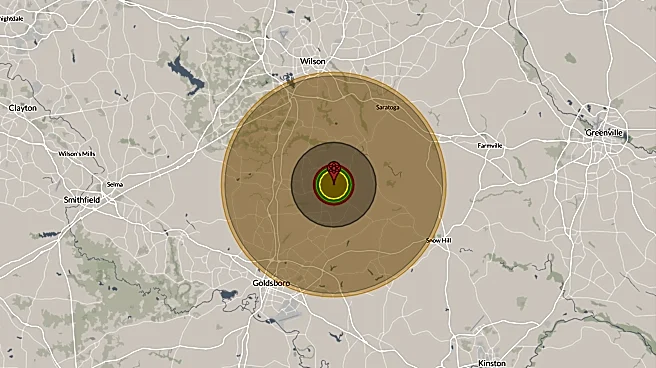
The "NUKEMAP", created using online map programs and information from the 1977 book "The Effects of Nuclear Weapons" by Samuel Glasstone and Philip J. Dolan according to creator Alex Wellerstein's website, can be used to estimate the effects of a bomb detonation on the nearby area.
The map below is a simulation of the immediate effects that would likely have been caused by the detonation of a single bomb at the Goldsboro site, not including wider radioactive fallout.
- The innermost yellow circle measures the maximum radius of the fireball of a 3.8 megaton surface blast, an estimated 1.48 miles in which anything inside is effectively vaporized
- The green circle marks the radiation radius of about 1.83 miles, in which a 500 rem ionizing radiation dose is released, likely fatal to anyone inside in about one month, with an additional 15% of survivors estimated to eventually die of cancer as a result of exposure
- The red circle marks the heavy blast damage radius of about 2.11 miles, in which heavily built concrete buildings are severely damaged or demolished and fatalities approach 100%
- The inner gray circle marks the moderate blast damage radius of 4.44 miles in which injuries are essentially guaranteed and fatalities are widespread, with residential buildings likely to collapse and chances of fires starting are high
- The outer gray circle marks the light blast damage radius of 11.4 miles in which glass windows are expected to break and injuries are likely
- The outer orange circle marks the thermal radiation radius of 11.8 miles, in which third degree burns are likely

Where is Goldsboro, NC?
Golsboro is located about 56 miles from the state's capital of Raleigh and about 300 miles from Asheville. The map below marks the location of historical marker number F-70, titled "nuclear mishap," which reads "B-52 transporting two nuclear bombs crashed, Jan. 1961. Widespread disaster averted; three crewmen died 2 mi. S.
Iris Seaton is the trending news reporter for the Asheville Citizen Times, part of the USA TODAY Network. Reach her at iseaton@citizentimes.com.
This article originally appeared on Asheville Citizen Times: 2 hydrogen bombs were dropped in North Carolina. It was 'close' call