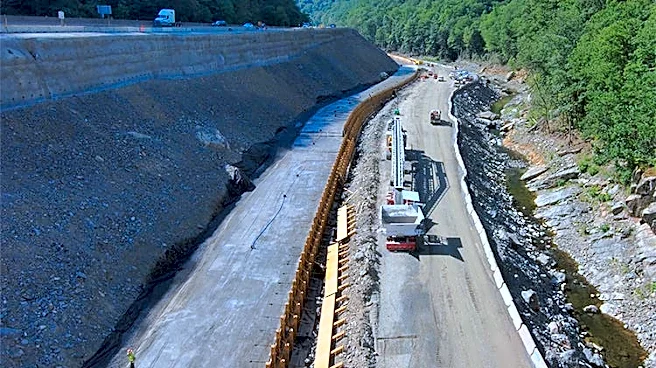







Rebuilding Interstate 40’s path through the Pigeon River Gorge after Hurricane Helene will cost about $2.8 billion — a 40% increase over a projection earlier this year — according to a newly released estimate from the N.C. Department of Transportation.
Driving the higher costs are better measures of how deep crews will have to drill to anchor steel piles into the bedrock of the gorge. Those piles, meant to prevent water from washing out the concrete wall that will support the interstate, are critical for the long-term durability of the reconstructed road.
“The variability of the depth of bedrock is tremendous, much more than our designers had anticipated,” said Wesley Grindstaff, the NCDOT engineer overseeing the project, in a video update. “Unfortunately,
it has trended to be a little deeper than what our first estimates were, which ultimately will drive the cost and schedule.”

The more complicated drilling will delay the full reopening of I-40 until late 2029, a year later than previously estimated. However, Grindstaff said NCDOT still planned to have two westbound lanes and one eastbound lane open by the end of 2028. The road was completely closed for over five months after Helene and has since had just one lane open in both directions.
NCDOT’s announcement is the second major increase in cost estimates for the project, which was initially projected at about $1 billion. The previous estimate of $2 billion, announced in February, also referenced a need for deeper drilling, along with higher costs for backfill material and rock mining in the Pisgah National Forest.
The department has made substantial progress on repairing other roads across Western North Carolina, as previously reported by the Citizen Times. As of July 30, NCDOT had finished work on about 8,500 of the 9,000 projects responding to Helene, opening over 99% of roads closed after the storm. But the I-40 reconstruction is uniquely challenging in its scope and complexity.
Grindstaff, the NCDOT engineer, said that it was critical to rebuild I-40 the right way, with an eye toward the future. North Carolina is likely to experience more frequent and intense storms in the coming years due to climate change driven by the burning of fossil fuels, according to the N.C. State Climate Office.
“Our team continues to examine opportunities to expedite schedules and minimize costs within the design, construction methods, materials and sequencing without compromising the long-term resilience of the interstate,” Grindstaff said in a press release about the project. “We are reconstructing it to withstand future extreme weather and reduce the risk of another catastrophic failure.”
Daniel Walton is the City Government Watchdog Reporter for the Asheville Citizen Times. Email him at dwalton@gannett.com.
This article originally appeared on Asheville Citizen Times: Why Interstate 40 repairs now cost $2.8B, up from initial estimate