






Big changes are stirring for nearly 60 acres in West Asheville’s Deaverview neighborhood.
At the Asheville City Council meeting on Tuesday, Sept. 8, members will vote on whether to approve a nearly $400,000 contract to develop an ambitious master plan for the land.
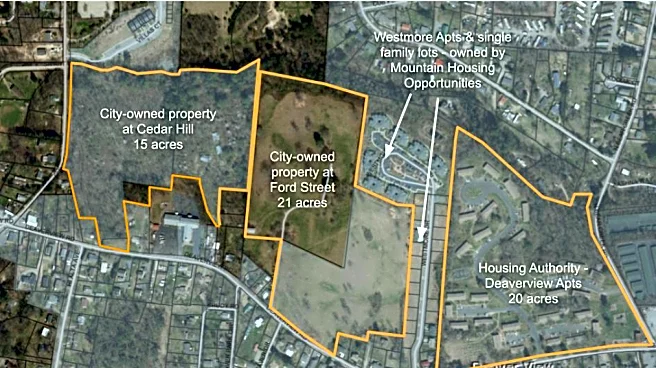
City government, the Housing Authority of the City of Asheville, and the Asheville PEAK Academy charter school would team up with urban design consultant City Collective to consider options at Deaverview. Across 36 acres of city-owned property and 20 acres owned by HACA, the partnership would consider new mixed-income housing, replacement of the existing Deaverview Apartments, a 4-acre campus for PEAK Academy, city parks and other “community and supportive services.”
HACA’s current Deaverview
complex houses 258 residents across 160 housing units, 134 of which are occupied. Those apartments were built in 1971. As is the case across the authority’s developments, multiple vacant units are in disrepair. James Shelton, the city’s community development division manager, said the new project would construct at least 340 housing units, with a mix of affordability levels and ownership options.

This isn’t the city’s first attempt to catalyze new development in the area. As outlined during a Sept. 3 council briefing by Shelton, Asheville bought 21 acres at 65 Ford Street for $1.6 million in 2021 to develop a “purpose-built community,” with plans to have new apartments built by 2023.
The city then allocated another $2.5 million in affordable housing bond proceeds and housing trust fund money toward the work. Although “Reimagining Deaverview” also received a federal housing tax credit, the city canceled the project and rescinded those funds in late 2024, citing “further funding gaps.”

But Ella Santos, HACA’s president and CEO, blamed the prior project’s collapse on the authority’s former leader, Monique Pierre. She was fired in an acrimonious dispute with the HACA board, after which council restructured the authority’s leadership.
“When she started, she wanted to have her stamp on it, and she completely scratched it,” Santos said of Pierre’s approach to the project, which had been led by previous HACA head David Nash.
City spokesperson Kim Miller did not dispute Santos' account. "Given this was a HACA project, they would be the best source for context," Miller wrote, in response to a Citizen Times request for comment. "The 'further funding gaps' comment in the linked presentation was to provide background context to Council members as to why these funds would now be available for reallocation."
Santos is confident that the current work will succeed based on the strength of the collaboration between the three partners. She lauded city staff’s leadership and the project’s collective decision-making, guided by a formal memorandum of understanding among the organizations involved.
Yet council member Maggie Ullman raised concerns about PEAK as a city partner during the Sept. 3 briefing. She questioned how the charter school, operating as a nonprofit separate from the Asheville and Buncombe County school systems, was chosen to participate in a planning process funded by federal Hurricane Helene recovery dollars.
“There wasn’t a competitive process,” acknowledged City Manager DK Wesley. She said former City Manager Debra Campbell had initiated the partnership with PEAK. After reviewing the demographics, performance and vision of the school, Wesley agreed to move forward and signed the memorandum with PEAK and HACA “at the administrative level.”
In response to a Citizen Times public records request, the city provided a letter from Campbell, dated November 2025, which said that Asheville had started meeting with PEAK leadership early that year "to assess pre-development options," including a new school, at Deaverview. "This collaboration underscores our commitment to ensuring the Academy's long-term sustainability and integration within our community development goals," Campbell wrote.
City spokesperson Miller emphasized that the document "should not be viewed as an agreement of partnership at the time." She wrote that Campbell's letter "memorializes that conversations did take place with PEAK to get an idea of whether or not there were future partnership opportunities."

PEAK, developed to focus on serving Black and low-income students, has previously received support from the city. In 2024, council unanimously granted the school over $501,000 in COVID-19 relief funds, with Mayor Esther Manheimer calling the move “a form of reparations.” Vice Mayor Antanette Mosley has served on PEAK’sboard of directors since January; council member Sheneika Smith also served on the board until several months ago.
Mosley, who praised the project during an April 7 meeting of Council’s Housing and Community Development Committee, told the Citizen Times that she had disclosed her relationship with PEAK to the city and would recuse herself from the Sept. 8 vote. Smith said she had resigned from the school’s board “to achieve a better work-life balance” and had no conflict of interest.

The Citizen Times attempted to contact Kidada Wynn, PEAK’s executive director, by phone on Sept. 3. She did not return a message left with the school’s receptionist by press time.
If council approves the planning contract, City Collective’s work will take place over the next 18 months. Shelton said he would next expect an update to come before council in roughly a year, at which point members would evaluate potential concepts. Any further city funding allocations or land grants, he emphasized, would require separate votes.
Daniel Walton is the City Government Watchdog Reporter for the Asheville Citizen Times. Email him at dwalton@gannett.com.
This article originally appeared on Asheville Citizen Times: Asheville seeks fresh start for Deaverview neighborhood