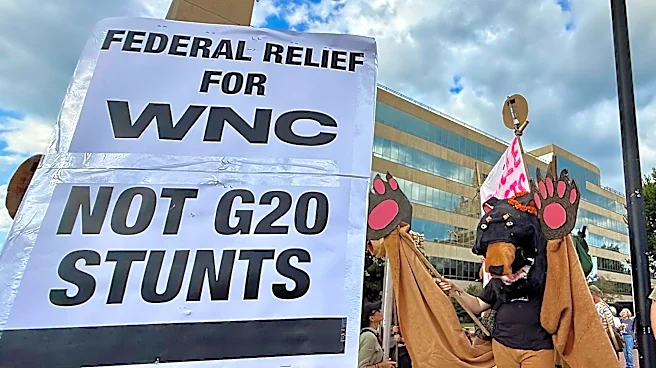








ASHEVILLE - The arrival of international finance officials in Asheville for the G20 this week brings heightened security and global attention to Western North Carolina, but protesters gathering downtown Aug. 28 said the group represents an economic system that concentrates wealth, excludes ordinary people from major decisions, exploits workers, neglects the climate crisis and has thus far failed to deliver a full recovery from Tropical Storm Helene nearly two years ago.
Speakers representing labor organizers, climate activists, democratic socialists and storm survivors contrasted the summit at the plush Omni Grove Park Inn with poverty, displacement and damaged infrastructure elsewhere in the region. Their concerns extended from local wages and housing
to U.S. foreign policy and the economic power wielded by G20 members.

Natalie Sweet, of the Asheville chapter of the Democratic Socialists of America, criticized the G20 as an unelected body whose officials influence economic policy without direct public control. Sweet said the setting underscored the distance between those officials and Asheville residents struggling with poverty.
“One must wonder why these officials need so much security — why they meet on the hill of luxury while poverty lies at the foot,” she said.
Sweet said the summit also reflected a global system dominated by U.S. priorities and corporate interests. She argued that companies profit from workers and resources in the "Global South" while the people producing those goods receive little of the wealth they create.
Workers and tenants bear the cost
Jen Hampton, co-chair of Asheville Food and Beverage United and an organizer with the Asheville Area Tenants Union and Southern Workers Assembly, focused on the service workers who sustain Asheville’s tourism economy. Hampton said more than 95% of food and beverage workers were laid off or furloughed immediately after Helene, just as peak leaf season normally helps them build financial reserves for winter.
The storm, she said, exposed an existing housing and labor crisis. Hundreds of homes were destroyed and municipal water service collapsed while some landlords continued demanding full rent for damaged housing without running water.
“Asheville’s recovery will not be measured by hotel occupancy rates or high-level summits,” Hampton said. “It will be measured by whether our service workers can keep a roof over their heads and food on their tables.”

Hampton called for deeply affordable housing, stronger tenant protections, living wages and direct aid for workers and independent businesses. She also urged the Buncombe County Tourism Development Authority to direct tourism revenue toward workers and recovery rather than continuing to market Asheville as a destination.
An organizer with Sunrise Movement Western North Carolina who gave their name only as “Timber” connected the region’s storm damage to a wider climate crisis. Timber said rising prices, wealth inequality and environmental destruction resulted from decades of failed policy while fossil fuel companies continued to profit.
“Yes, we are resilient,” said Timber, “but we shouldn’t have to be.”
Communities including Swannanoa, Marshall and Bat Cave, Timber said, remain far from fully recovered even as downtown Asheville’s utilities and businesses have largely returned. Timber called for aggressive climate action and an international response to disasters that don’t necessarily respect lines on a map.
Helene recovery and federal priorities

Maryjo Tucker, a founding member of the Helene Survivors Committee, described the experience of storm survivors who stayed in hotels with FEMA assistance. Committee members contacted displaced residents at more than 42 hotels and organized against the termination of temporary housing assistance in early 2025.
“We had to fight for 5,600 people and make sure that they were not thrown out in the middle of winter,” Tucker said.
Some survivors found apartments with assistance but later lost that housing after funding ended, according to Tucker; she also cited damaged roads and bridges stretching toward Chimney Rock and Bat Cave, arguing that the federal government had not provided enough money for infrastructure or long-term recovery.
In an Aug. 27 press call, senior officials with the U.S. Department of the Treasury said that $5 billion in federal aid had reached North Carolina in the 23 months since the devastating storm. A 2024 damage report issued by the state put the total recovery tab at $60 billion.
Cody Cogdell, an organizer with the Party for Socialism and Liberation, criticized federal officials for presenting the region as a model of recovery while residents continued facing displacement, damaged infrastructure and higher prices for everything from groceries to gasoline. He also objected to U.S. policy toward Iran and China, arguing that political leaders were directing public anger abroad instead of addressing problems at home.

“It wasn’t Iran that left Appalachia to drown,” Cogdell said.
Cogdell also criticized the expansion of data centers, which he said would leave working-class communities responsible for their economic and environmental costs.
After the speeches, Cogdell told the Citizen Times what he would like G20 officials to announce at the conclusion of the gathering.
“What I would want to hear — which I know I’m not going to hear — is that they’re going to use the $1.5 trillion in military budget, or the billions of dollars they’re spending to attack countries abroad or to have ICE terrorize our communities here, to spend that on health care and housing and edible food and clean water and getting rid of these data centers,” Cogdell said. “That’s what I would hope to hear. I don’t expect to hear that. I expect to hear the status quo.”
Cory Vaillancourt is the Helene Recovery/Investigations Reporter for the Asheville Citizen Times. Find him on X at @The_CoryV or on Signal, via email at cvaillancourt@citizentimes.com or at 912-508-5640.
This article originally appeared on Asheville Citizen Times: Helene recovery drives criticism as G20 convenes in Asheville