





MARSHALL ― A little more than one month from the midterm elections, Madison County Board of Commissioners candidates spoke in a forum on the local economy, why they're running, and their goals for the county.
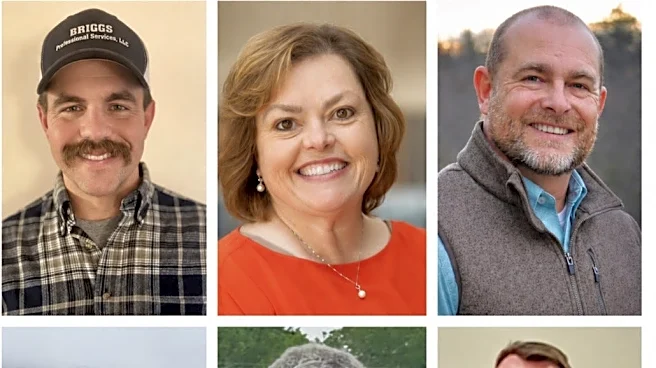
The five candidates — Bill Briggs, Shannon Dowler, Jeremy Hensley, Connie Molland and Alan Wyatt — fielded questions from Sarah Scully, a local reporter with WNC Grassroots Media who served as moderator of the Tuesday, Sept. 22, forum, organized by the Madison County Chamber of Commerce and hosted by AB Tech's Madison campus in Marshall.
Briggs; Hensley, the commission's current vice chair; and Wyatt, a current commissioner, are Republicans. Briggs, 37, owns a property maintenance company specializing in pressure washing and lives in Mars
Hill. Hensley, 47, has been a Verizon service technician for 20 years. Wyatt, 50, is a sales representative for L&W Supply in Arden. He is a firefighter with Ebbs Chapel Volunteer Fire Department, and president of the county firefighters association.
Both Hensley and Wyatt live in Mars Hill and have served as commissioners since 2022.
Dowler and Molland are Democrats. Dowler, a family physician and health policy consultant, is in her second term on the Madison County Board of Health. Molland owns Flow Gallery in Marshall and has been active with the Downtown Marshall Association and Rotary Club of Madison County for years. She was named the Rotary Club's first district governor in 2024.
Mark Snelson, another Democrat, did not participate in the forum. Snelson served on the board from 2018 to 2022 and served as the board's chair in his final year. He is director of the county emergency medical services, where he has worked since 1990.
The three top vote-getters will win seats on the board.

Why they're running
The candidates made introductory and closing statements, and addressed six topics: the economy, taxes, the question of resources for towns versus rural communities, accountability to the residents, the county's youth, and their personal top issues.
Briggs said he's running because he loves Madison County, and he wants the ability to make decisions for the county "to preserve what we love about it," and "encourage clean, responsible growth."
Dowler said her theme is "Madison matters."
"Whether you're in the towns, or you're in the far corners of our county, you matter," Dowler said. "None of us can really control where we're born and raised, so whether you were born and raised here, or whether you were someone who was chosen to live here, I think you matter as well."
Hensley said that as a native and lifelong resident of the county, he "was taught that faith, family and being a good neighbor meant something."
"We've got some great employees, and we've also got some great citizens here in Madison County," Hensley said.
Molland said one of her "superpowers" is "to bring people together to solve problems."
"I'm running because after Helene, I decided to stop being a spectator and to step up and become a part of the future of our county," she said, adding that she feels the board needs to be more representative of the people it serves.
Wyatt, who served on the county planning board before being elected a commissioner in 2022, said he felt a calling to seek reelection.
"This whole group up here worked hard during Helene and has helped build this county back, and I'm very proud of them," Wyatt said. "I'm proud of our commissioners and proud to serve you as Madison County."
The candidates name their top issues
Among the questions for the candidates was what they see as the biggest challenges facing the county in the next five years and what they would do as commissioners to address them.
Dowler said the most important thing she could do as a commissioner would be to listen to her constituents, adding that she decided to run after the commissioners' May 2025 proposed takeover of the county health board. The board ultimately voted in July 2025 to not follow through with the takeover following public outcry.
"I think Madison County needs more better-paying jobs," Dowler said. "We have lower-than-average wages in Madison County compared to the state, and we have higher-than-average poverty. That disconnect doesn't work for people. We also don't have enough affordable housing for our young families, for our adults that are disabled, and for our seniors who live on a fixed income."
She added that helping families keep land they've owned for generations was another top issue, as well as supporting local farms and celebrating the county's arts and nature.
Hensley said the biggest challenge for the county's government and residents is affordability. He said the current commission has managed to hold down costs by collecting state and federal funding for projects, highlighting the county's new Public Service Complex. The 80,000-square-foot facility, which broke ground in July, will include a judicial center at 500 Medical Park Drive in Marshall and consolidate governmental, social and judicial services into a single facility.
"Since we became commissioners in 2022, we've brought in more than $75 million in state and federal funding to this county. It took aggressive leadership, strong relationships, and it took a board that was willing to go to bat for this county to get that money," Hensley said.
For Molland, revising the county's comprehensive plan, last updatedin June 2022, would be a top focus.
"We need to hear from our residents when we put it together. The plan would help us proactively manage the growth in our county that is both inevitable and needed," she said, adding that the updated plan would outline goals for economic development and job opportunities, affordable housing strategies, land-use management, infrastructure, including schools and access to utilities, and cultural and natural resources.
Wyatt said affordability and jobs are the biggest issues, pointing to the County Commission's infrastructure projects, including the N.C. 213 water line. The project will bring Marshall and Mars Hill water and sewer services ― essential for development ― to properties along N.C. 213.
"If a county's not growing, it's dying," Wyatt said, highlighting the county's new covered arena and Public Service Complex. "We're planning for the future."
Briggs said the county's top challenge is one it always has faced: its location and need for more businesses that will keep spending, and the sales tax revenue it generates, within its borders.
"We're a big county and we just don't have anything to make sales tax. If you need something substantial, you drive over the line," Briggs said. "It's really hurting us ... . Our long-term decisions have to take into account that we've got to be very careful how we spend our money."
What the candidates would do for the economy
The candidates also were asked about economic development, including what types of businesses or industries they'd like to see attracted to Madison County, as well as county taxes.
Hensley said while it isn't the county government's responsibility to create jobs, it's the county's responsibility to create favorable conditions to attract potential businesses.
"We don't want someone coming in here that doesn't align with our values, but if they do align, we need to work with those on whatever they need," Hensley said, adding that businesses have unique needs, including potential tax incentives and infrastructural requests.
Molland divided the county economy into agriculture and agri-business, small manufacturing, retail, restaurants, overnight accommodations tied to tourism, service-related jobs, work-from-home jobs and commuter jobs.
"I think the role of the County Commission is to grow these areas and provide more job opportunities, but maintain a balance across these areas," she said, adding that she'd like to see the county hire an economic development director. It has been without a dedicated director since the development services director position was eliminated in May 2025.
Agreeing with Hensley, Wyatt said it's the county's responsibility to build infrastructure that will attract businesses to the county.
"That's why we have worked really hard with Advent Health. I have spoken on behalf of Advent Health many times. That's going to bring many, many jobs for our county citizens," he said. "I grew up in a time when we were farmers, and we lost that. We've been trying for many, many years to get something back. Now, with the infrastructure that we're building ... we're growing. We're attracting jobs and economics into this county."
While Briggs said the county should work to cut some red tape for small businesses, Dowler said one of the county's biggest issues is exporting jobs. While the county should want to attract health care jobs, she said, Advent Health coming to Weaverville is "a double-edged sword" because it will offer better pay and draw workers away from in-county health care organizations such as Hot Springs Health Program and the county health department.
"It's really important that we're investing in a community where people want to build jobs and bring jobs, which means housing that employees can live in and afford, it means a strong educational system, and it means having workers that are trained and ready to take these jobs," said Dowler.
As for what industry she would not welcome to the county, Dowler said she is against data centers.
A recording of the full forum can be found at The News-Record & Sentinel's Facebook page here.
Johnny Casey is the Madison County communities reporter. He can be reached at 828-210-6074 or jcasey@citizentimes.com.
This article originally appeared on Asheville Citizen Times: Madison County Commission candidates speak out on economy, top issues