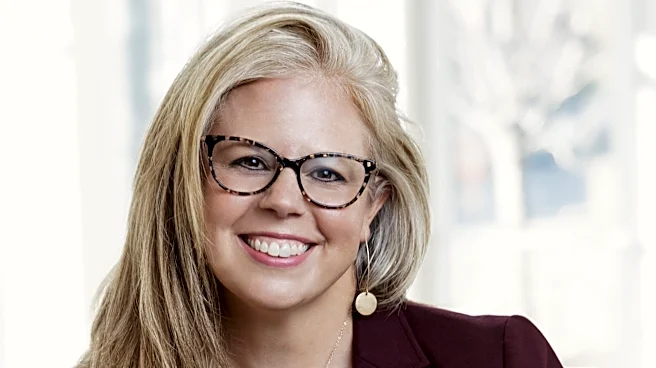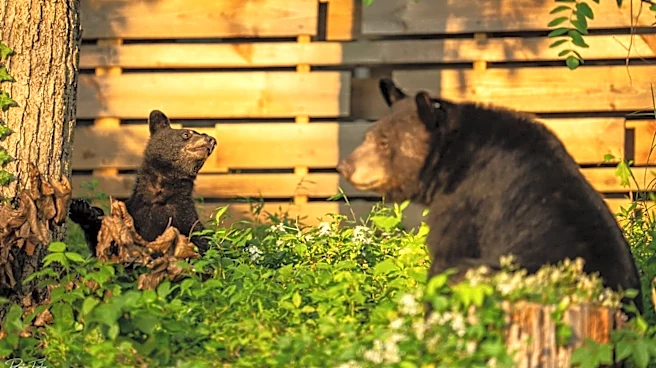



ASHEVILLE - The campaign to save "Dolly," the mother bear accused of breaking into multiple Asheville homes, began with a letter to the editor. Hannah Furgiulele, the Asheville woman behind the campaign to save the bear, said that she was on vacation when she heard the news that the bear, which she'd seen in her own backyard, would be euthanized.
"Initially, when I got the information about that, I was going to the beach and pretty sickened by the whole thing. I didn't really know what I could do. I felt kind of confused," she said.

Furgiuele initially wrote to the Charlotte Observer about the break-ins in her North Asheville neighborhood and the N.C. WRC's plan to end the bear's life. She later wrote a second letter to the Asheville Citizen Times.
The bear's story resonated with her on a personal level, and while she wasn't sure what she could do, she wanted to try. What started as a letter turned into a short but intense campaign that, while public facing, included behind-the-scenes negotiations with the N.C. WRC and others that ultimately changed the bear's fate.
"I kind of committed to myself that I wasn't going to let Dolly's story and the tragedy of her and her cubs be swept under the rug. I wanted to make sure that we shined a light on this story in a way that'd really get attention and bring real focus to this problem," Furgiuele said.

Dolly's home break-ins, one of which resulted in an injury to an Asheville woman, point to the fact that the issue of human-bear interactions is particularly pronounced in Buncombe County. The commission said in August that the woman who was injured by Dolly was not intentionally feeding the bear, but Dolly was able to access pet food inside the home through an unlocked door, as well as unsecured trash outside. The N.C. WRC said Sept. 22 that there have been a total of nine confirmed reports of Dolly successfully breaking into homes, as well as one attempted break-in following the August incident, with two of them occurring within 24 hours of the injury report.
Ashley Hobbs, Special Projects Biologist for the Wildlife Resources Commission, told the Buncombe County Board of Commissioners Sept. 15 that 38% of statewide calls about bears come from Buncombe County each year, which ends up being between 800 and 1,000 calls a year from a single county. The second highest number of calls comes from Henderson County, where people make between 100 and 150 calls a year, Hobbs said.
Since 2017, there have been 18 people injured by bears in North Carolina, 11 of them were in Buncombe County.
Hobbs also said during the meeting that humanely euthanizing a human-habituated bear is the only viable option for an animal in that circumstance.
Hobbs cited a study from the University of Tennessee, which found that only 20% of bears survive relocation. She also said that putting a wild bear in a sanctuary is stressful for the animal.
Still, Furgiuele was determined to save Dolly's life. She also wanted to use Dolly's story to spur change in Buncombe County that would lead to better outcomes for bears.
"Once that letter got published is when I really felt motivated to keep pushing and to keep elevating this story as a catalyst for some real attention on Asheville and Buncombe County's bear country situation," she said.
Furgiuele began looking into stories of bears that became habituated to humans. She found news articles about Mink, a bear in New Hampshire. Mink was scheduled to be euthanized, along with her cubs, but the governor of New Hampshire intervened, according to New Hampshire Public Radio. Mink was relocated, then traveled thousands of miles to get home.
Furgiuele saw clear parallels between Mink's story and that of Dolly.
Furgiuele was also thinking about Dolly Parton, who died Aug. 25, and her love of wildlife. After reaching out to a friend in marketing, she decided to name the bear Dolly and createda petition, asking Gov. Josh Stein to "pardon" Dolly. The petition drew more than 21,000 signatures.

In addition, she participated in multiple calls with officials from the N.C. WRC, and she reached out to The Wild Animal Sanctuary in Colorado, which agreed to take Dolly if the bear could be captured.
"I never wanted to be negative or not respectful of the commission's work. They have all been very gracious with their time and expertise, and I really do have nothing bad to say," she said.
Furgiuele eventually spoke with N.C. Sen. Julie Mayfield.
"I knew from others that she would be a really good resource or advocate, because she might have avenues that I didn't have," she said.
Mayfield told the Citizen Times Sept. 22 that she called the office of Gov. Josh Stein, as well as two N.C. WRC board members who she knows personally.
"I think like most people, I'm not interested in seeing wild animals killed because of bad human behavior. I'm not casting aspersions on the individual people who have bad interactions with this bear, … but as a community, Asheville is not doing enough to discourage bear activity," Mayfield said.
Mayfield said that she'd like to see people in areas where bears are frequently seen to all have bear-resistant trash cans. She'd also like there to be stricter rules around making food available to bears.
"I don't think it's fair to hold the bears responsible for the failure of local government and individuals to do the right thing. I didn't want Dolly to die," Mayfield said.
On the morning of Sept. 16, Furgiuele, who was in spin class at the time, learned from the N.C. WRC that the North Carolina Zoo had agreed to take Dolly.
"I got the message and just started sobbing in the spin class," she said.
Furgiuele said she was told that Stein's office was involved in the decision. A spokesperson from Stein's office did not respond to multiple calls from the Citizen Times.
The N.C. Wildlife Resources Commission did not answer questions from the Citizen Times about what led to the decision, instead it released a short statement on Sept. 18.
"NCWRC staff have been in contact with the N.C. Zoo and, in the event we can safely capture the North Asheville bear alive, the Zoo has agreed to temporarily care for the bear until an appropriate permanent home is identified," the statement read. "Biologists will continue efforts to safely capture the bear despite limited success thus far. Staff will continue to monitor the neighborhood and respond to reports to the NC Wildlife Helpline."
Furgiuele said the decision to spare Dolly was a surprise. She was told all along that saving Dolly's life was unlikely to happen. Now, she wants to continue the campaign on a broader scale. In an open letter to city council on Sept. 21, Furgiuele asked that the Asheville City Council reach out to the Buncombe County Commissioners to establish a joint city-county committee on bear safety and coexistence, with a seat at the table for the N.C. WRC.
"I feel completely overwhelmed by how many people stepped up to elevate the story," she said. "It's not a happily ever after. It's a new opportunity and a new chapter about how we talk about these types of situations."
Kara Fohner is the Public Safety Reporter for the Asheville Citizen Times. Email her at kfohner@usatodayco.com or call her at 980-241-8671.
This article originally appeared on Asheville Citizen Times: Inside the campaign to save 'Dolly' the Asheville bear from euthanasia