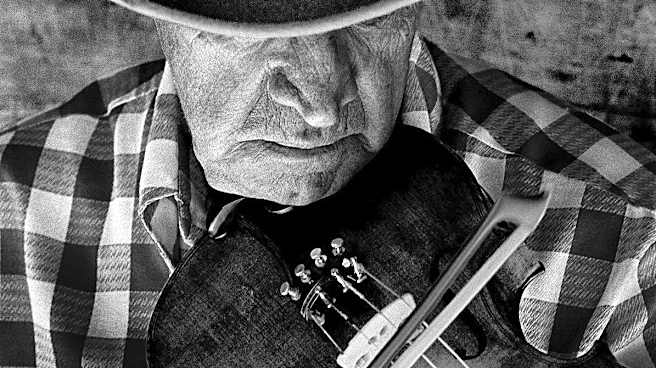









MARS HILL - Tim Barnwell has spent nearly 50 years exploring and preserving Southern Appalachian culture, with a particular emphasis on his native Western North Carolina.
On Sept. 4, Barnwell will hold an opening ceremony for his new photography exhibit, which looks back on his time documenting the region. "The Face of Appalachia: Five Decades of Photographs by Tim Barnwell" will run through Sept. 28 at Mars Hill University's Weizenblatt Gallery.
The work will feature approximately 50 photographs drawn from his landmark Appalachian book projects — "The Face of Appalachia: Portraits from the Mountain Farm," as well as "On Earth's Furrowed Brow: The Appalachian Farm in Photographs" and "Hands in Harmony: Traditional Crafts and Music in Appalachia"
— along with new work created throughout the past several years.
The first photo in the collection was from 1978, shortly after Barnwell graduated from UNC Asheville, of Sodom Laurel fiddle great Byard Ray, a frequent collaborator with celebrated old-time banjo musician Obray Ramsey.
The News-Record met with Barnwell in Mars Hill Aug. 13. Barnwell's parents were teachers in Madison County, including at Walnut Elementary School and Marshall High School. The family lived for a while on Skyway Drive in Marshall.
Barnwell said his journey into photography and documenting history was inspired by artists like Ansel Adams and environmental portrait photographer Arnold Newman. While working as a writer and photographer for Black Mountain-based magazine "Mountain Living," Barnwell suggested an article on traditional mountain life, rather than the typical upper middle class-focused stories.
"I was running a photography school at the time in the early '80s, and I'd have classes every weekend, so Monday would be a day off, I would just ride around the county," he said of his trips documenting Madison County residents. "It got me out of the house, and I had a lot of connection here."
Barnwell would find residents out at work, farming their fields, many of them working tobacco.
"I'd go back and try to develop friendships. Some became really good friends who I'd take lunch to every couple months, and we'd hang out and record their stories and take pictures," said Barnwell, whose YouTube page, The Face of Appalachia, has nearly 21,000 subscribers.

According to Barnwell, some people couldn't understand why he would want to photograph people doing everyday ordinary things.
"My role is to be objective, and take an outside look at something that is ordinary and realize what's extraordinary about it," said Barnwell, adding that traveling out west helped deepen his appreciation for the unique qualities of Southern Appalachian living.
But looking back at nearly 50 years of photographs, Barnwell said he's grateful for the photographs, as they serve as a keepsake for the people and the cultures of the past.
"It used to be that you couldn't drive a road in Western North Carolina, Eastern Tennessee or Kentucky that didn't have tobacco involved," he said. "When they did the buyback, it was gone the next year. To see that change not only in the culture but to the landscape was pretty remarkable."

In 2024, Mars Hill University began working on its Tim Barnwell Collection within the Southern Appalachian Archives, including a substantial permanent collection of photographs, his published books and related documentary materials.
"For almost 50 years I have documented the people, traditions, and landscapes of Southern Appalachia," Barnwell said. "It's deeply gratifying to know this work will be preserved and made available to students, researchers, and the public for generations to come. I am honored that Mars Hill University has chosen to become its home."

50 years of preservation
Barnwell said when he thinks back on his time documenting Southern Appalachia, he sometimes can't believe that he did it, or that he stuck with it all those years.
He said he recently sent off 20 cassette tapes of past interviews to have them transcribed and digitized. The interviews' preservation is self-funded commercial photography.
"I never charged anybody for photographs. I just wanted it to be an honest interaction. There's what I call 'poverty porn' today with videos and photographs and all these kinds of stereotypes," he said. "I've always tried to steer away from the stereotypes. Poverty's an economic condition, not a condition of the spirit."

Barnwell's work saw him spotlighting many different cultures, among them shrimp fishermen on the coast of North Carolina and South Carolina, as well as Cherokee culture.
"Photography's been my excuse to get into situations I could never otherwise talk myself into," he said. "It's been my key to unlock a lot of doors that would not have otherwise been open. I think it's really got me out from being the real introverted person I was growing up, and to just kind of put myself out there more."

One of the things Barnwell is most proud of throughout his career is the legacy of passing on the culture to the next generations.
"I'm really proud that I've been able to do this, and create something that's not only meaningful to the families, hopefully, but also preserve the community for future generations to look back on and try to understand."
An opening reception will be held Sept. 4 from 5-8 p.m., featuring live music by dulcimer player, Don Pedi, and refreshments. Renowned ballad singer, and Madison County native, Sheila Kay Adams will perform one of her ballads around 6 p.m. followed by remarks by Barnwell, who will be available to meet and discuss his work.

Johnny Casey is the Madison County communities reporter for The Citizen Times and The News-Record & Sentinel. He can be reached at 828-210-6074 or jcasey@citizentimes.com.
This article originally appeared on Asheville Citizen Times: WNC preservationist Barnwell's exhibit celebrates 50 years of culture