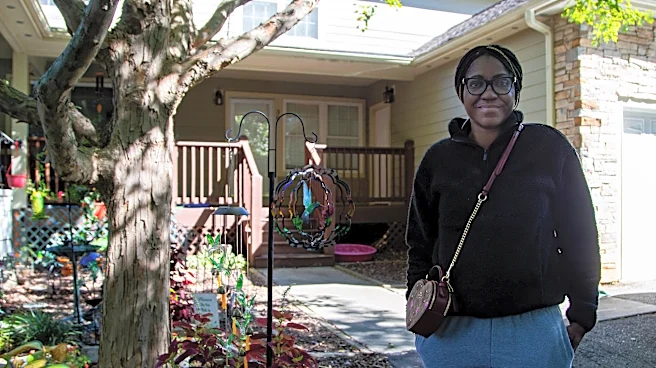








Arden resident Ayisha Motley has a lot on her plate. A mother of two school-aged children, she went through a kidney transplant in July and regularly travels to Winston-Salem for medical appointments. She's currently living on disability payments of about $1,200 per month.
The email that arrived from the Housing Authority of the City of Asheville Aug. 31 did not ease Motley's burden. Instead, it said that due to an error in HACA's calculations for the Housing Choice Voucher Program, her monthly rental payment for her three-bedroom townhome would go up $248: a 74% increase, effective at the start of October.
As someone on a fixed income, Motley told the Citizen Times, she found it "kind of crazy" to get the new rent figure with barely a month's
notice. She's concerned that she won't be able to make the higher payments, and she knows finding another landlord with a lower rent willing to take her voucher will be a challenge. Homelessness, she says, is a real threat.

At least 80 other Asheville-area households using Housing Choice Vouchers, also known as Section 8, are facing similar worries. That's because mistakes in how HACA pays private landlords — which have gone largely uncorrected for almost two years — helped pushed the organization’s finances onto what it calls “an unsustainable financial trajectory.”
The authority is now fixing those mistakes. But tenants and landlords say the lower payments are creating an unexpected burden for some of the city’s most vulnerable residents.
What happened?
Housing Choice Vouchers help low-income tenants afford housing by applying a federal subsidy to the cost of a private rental. Tenants apply for vouchers through local housing authorities like HACA. After an approved tenant rents a property, the housing authority receives funding for the voucher from the federal Department of Housing and Urban Development and passes it through directly to the landlord
According to Ella Santos, the housing authority’s president and CEO, the problems with voucher payments originated in October 2024 under former HACA head Monique Pierre. Pierre has denied responsibility, instead flagging HACA's Board of Directors and staff.
HUD determines the size of voucher subsidies, known as Housing Assistance Payments, based on factors such as tenant income, family makeup, and an area's fair market rent. As of fall 2024, HACA had federal support to pay voucher landlords based on 120% of fair market rent, in recognition of Asheville’s uniquely strong rental market.
In the wake of Tropical Storm Helene, however, Pierre asked HUD to increase those payment standards to 150% of fair market rent. The HACA Board of Commissioners authorized higher payments to landlords effective December 2024, pending HUD’s approval. But HUD never gave that permission, Santos wrote in response to questions from the Citizen Times.

According to Santos, Pierre told HACA staff to implement the higher payments without waiting for the federal OK, while also neglecting to document the move in the authority’s administrative plan. HACA provided an email from Pierre dated Oct. 22, 2024, in which she told staff that the 150% payment standard "is not a mistake, it is what HUD allows because of the disaster." HUD formally denied Pierre’s request in March 2025, citing her failure to provide necessary supporting data.
Over the same period, HACA’s leadership underwent a major shakeup. Its commissioners fired Pierre in November 2024, citing an email she sent to staff about pending changes to the board’s makeup. The board named Rhodney Norman, HACA’s maintenance director, as the interim CEO. Asheville City Council proceeded to add four new commissioners to the board, then eliminate the seats held by then-Chair Tilman Jackson and Vice Chair Reggie Robinson.
Pierre, who now lives in Alabama, declined to comment when reached by phone Sept. 28. She directed all inquiries to the office of Brian Elston Law, which is representing her in an ongoing wrongful termination lawsuit against HACA.
Corey Atkins, an attorney with Brian Elston Law, provided a statement by email Sept. 29. "Ms. Pierre denies directing staff to implement any higher payment standards. The Board of Directors would have made any approvals, and those records should be found in the Board book. Monthly checks and balances were in place with HR, finance and resident services all around the table, ensuring no errors were made," he wrote.
Pierre's October 2024 email, Atkins added, showed her "instructing staff to update resolutions on the eve of a Board meeting. Not instituting a new policy. As Executive Director/CEO, she lacked the authority to pass resolutions or institute new policies."

Amid HACA's leadership changes, wrote Santos, word of HUD’s decision never reached the board, and staff didn’t flag that anything was amiss. Santos, who became the authority’s head in November 2025, wrote that staff didn’t identify the payment problem until “late 2025.”
After flagging the issue, HACA stopped using the unauthorized standards for new properties entering the voucher program. Yet the authority continued to make the higher payments for properties already in the program. Santos noted that commissioners “were briefed individually,” but the whole board did not receive an update about the issue until Sept. 12.
“Before implementing the change, it was important to confirm HUD’s guidance, ensure the applicable requirements were clearly understood, and carefully evaluate the appropriate steps for implementation, particularly given the potential implications for both participating families and landlord partners,” wrote Santos, when asked why HACA didn't immediately reduce its payments.
What does this mean for HACA families?
It's not clear how many families will see their rent support change as a result of HACA's corrections. Roughly 1,800 households participate in the Housing Choice Voucher Program through HACA. As of Sept. 24, Santos wrote, the authority "was still reviewing cases" for payments with the unapproved standards. She couldn’t confirm the total number of properties that would receive lower assistance payments or the overall amount by which payments would be cut.
Approximately 85 households, however, have gotten a “Rent Adjustment Letter” from HACA. Those include the renters of five properties managed by Reade Walker, among them Motley's Arden townhome. According to documents Walker received in late August, as reviewed by the Citizen Times, total monthly payments for rent and utilities across those units are set to decrease by $1,155 starting in October.
HACA’s letters note that if landlords don’t lower their rents, tenants will be responsible for picking up the difference between their contracted rent and the new, lower assistance payment. If a tenant can’t meet the larger rent contributions, said Walker, they’ll still retain their vouchers and can apply them to another property. But there’s no guarantee that they’ll find another affordable rental with a landlord willing to accept vouchers, or that the location and space will meet their needs.
Walker said his HACA voucher participants are “some of the best tenants I’ve ever had,” and he has no plans to evict any of them if they can’t meet the higher rents.
“However, I can’t absorb all that from a financial standpoint,” Walker continued. He’s asked HACA officials if the authority would consider temporary assistance for impacted households or a more gradual reduction in payments.
Asked the same question by the Citizen Times, Santos wrote that HACA had no plans to offer such support.
“Continuing to operate under a payment standard that was not approved by HUD creates financial and compliance risk for HACA, particularly given the significant financial demands facing the agency. For that reason, it is important that we correct the standard and operate within HUD’s authorized requirements moving forward,” she wrote.
The bottom line
Nearly two years of federally unauthorized overpayments have already made a big dent in HACA’s balance sheet.
Since December 2024, HACA has been paying landlords based on the 150% standard, but HUD has only been funding those payments at the 120% standard. According to Santos, the authority covered the difference using its own financial reserves.
In a June press release, HACA noted that it had spent about 75% of the savings it had available in 2024. The same release announced that the authority would lay off over more than 60 employees, over half its workforce, by the end of next year. The resulting savings are meant to rebuild the depleted cash reserves and “strengthen the agency’s long-term financial sustainability.”
A June “talking points” document on the layoffs noted that HACA had about $3.5 million in available funds. According to spokesperson Lauren Stepp, the authority spent roughly $9 million in reserves during 2024 and 2025. Its annual budget is about $55 million.
Santos wrote that she could not provide “a verified figure” for the total cost of the overpayments. But HACA Housing Choice Voucher Program Director Noele Tackett, in a Sept. 10 conversation with Walker reviewed by the Citizen Times, acknowledged that the impact had been substantial.
“Because we have overpaid for all this time and within a lot of households, the budget — things aren’t well financially,” Tackett said. “We’re kind of bleeding, if you will, with the extra that we have been having to pay, to pull from other resources to make ends meet.”
HACA board members silent
The June talking points document noted that the authority’s budget situation ”reflects weak financial control and lack of timely intervention.” While it blamed Pierre, the former CEO, for not providing “the level of operational discipline needed to keep the system functioning effectively,” it also said the HACA board “did not exercise the level of oversight required.”
The Citizen Times reached out to all nine sitting board members: Chair Mychal Bacoate, Vice Chair Kimberly Collins, and commissioners Scott Farkas, Maggie Burton-Hughes, Carol Goins, Laura Sotelo Garcia, Sean Aardema, David L Robinson, Sr., and Kidada Wynn. According to Stepp, the commissioners "decided not to comment for this story."
Asheville Vice Mayor Antanette Mosley, who serves as city council’s liaison to the HACA board, said she hadn’t known about the unauthorized overpayments until recently.
“I am just learning of the internal issues facing the Housing Authority's new leadership,” she wrote in a Sept. 23 statement to the Citizen Times. “I take comfort that this leadership is not only identifying issues but, along with their board members, addressing them”
Under state law, Mayor Esther Manheimer is responsible for appointing and removing members of the HACA board. She confirmed that she was unaware of the payment issues when she worked to expand the board and appoint its new members in early 2025.
Manheimer provided a statement to the Citizen Times Sept. 23, expressing her confidence in the current board.
“This is an example of why I moved to appoint a new board, which resulted in the hiring of a new executive director, and that director, Ella Santos, is working hard to right the ship,” Manheimer wrote. “It is unfortunate that any of our residents would experience an unexpected burden, but I am encouraged that the Housing Authority of the City of Asheville new leadership is identifying and addressing internal issues.”
Walker, the voucher landlord, said he’d hoped to question commissioners at a meeting noticed for Sept. 23, but the meeting was cancelled. HACA spokesperson Kyle Parks told the Citizen Times that the cancellation reflected the board’s previously announced move to a bi-monthly meeting schedule.
The board’s next meeting will take place Wednesday, Oct. 28 — after the rent changes are set to hit Walker’s tenants and other voucher users. He said he was frustrated by how quickly, and with how little notice, HACA was proceeding with changes that could force people to move.
“How do you take that away from them and interrupt their school, where they live, their house — I mean, it’s their life,” Walker said. “It’s really concerning that people are making these decisions and not knowing the impacts.”
Daniel Walton is the City Government Watchdog Reporter for the Asheville Citizen Times. Email him at dwalton@gannett.com.
This article originally appeared on Asheville Citizen Times: Asheville's housing authority overpaid landlords for almost 2 years | Exclusive