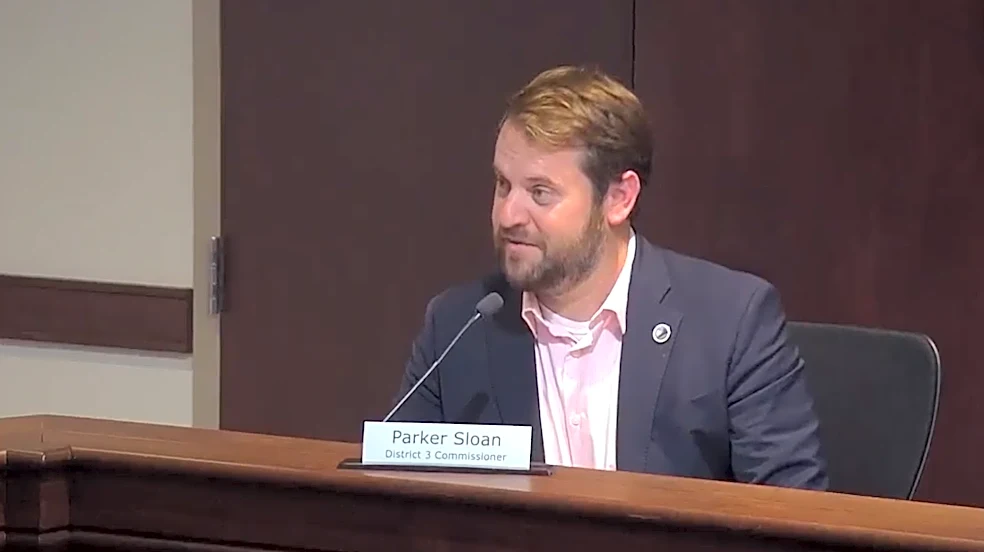









Buncombe County Commissioner Parker Sloan acknowledged that what the county’s leaders were about to do was “a little unusual.” But “reckless” moves by North Carolina lawmakers, he argued, had pushed the Board of Commissioners to take action at its Oct. 20 meeting.
Sloan and his colleagues adopted a resolution against a constitutional amendment, proposed by Republicans at the state General Assembly, that would require the legislature to put limits on how local governments could increase property taxes. North Carolina citizens will vote on whether to enact that amendment as part of the 2026 midterm elections.
Although individual board members have spoken against state constitutional amendments in the past — most notably in 2018, when then-Commissioner
Jasmine Beach-Ferrara joined with other local officials to call six proposed amendments “deceptive” — the Oct. 20 vote marked Buncombe government’s first formal statement against such a measure. The county joins at least five others across the state, including Durham and Orange, in passing an anti-amendment resolution this year.
The all-Democratic Buncombe board was united in its criticism. If passed, commissioners said, the amendment could shift more of the state’s tax burden onto lower-income residents, raise the county’s interest rates on government debt, and eliminate local flexibility in responding to crises like Tropical Storm Helene.

Buncombe and other North Carolina counties rely heavily on property taxes to fund government services, as outlined in a recent report by the nonprofit NC Budget and Tax Center. Roughly two-thirds of the county’s general fund budget, about $287 million last fiscal year, came from property taxes. While the amendment doesn’t specify how tax law would change, the nonprofit NC Housing Coalition found that Buncombe would have lost $5 million last year if a 2% tax increase cap had been in place.
“This is another example of Raleigh doing something to us that, as 100 counties, we did not ask for,” said board Chair Amanda Edwards, referencing broad opposition to the amendment by the NC Association of County Commissioners. “Our state officials get to hide behind elected local governments when they make decisions like this to put on the ballot.”
Public commenters at the board meeting also railed against the property tax amendment. Alex Ramirez, representing the local chapter of national advocacy group Public School Strong, said the potential loss of tax revenue was particularly concerning for public education. He referenced the NC Budget and Tax Center’s analysis, which found that property taxes support nearly a third of K-12 education funding and 215 staff positions in Buncombe County.
Yet recent polling has found that the amendment is broadly popular with voters statewide. According to a September survey by Elon University, for example, 72% of all likely North Carolina voters back the property tax measure. According to The Assembly, voters have approved 42 of 52 amendments proposed by the legislature since 1970.
The proposed property tax amendment, along with proposed amendments on capping state income tax and requiring photo ID for all forms of voting, will be on the Nov. 3 midterm ballot. More information on the elections is available through the Citizen Times voter guide.
Daniel Walton is the City Government Watchdog Reporter for the Asheville Citizen Times. Email him at dwalton@citizentimes.com, and connect with him on social media through Facebook, Instagram, or Reddit.
This article originally appeared on Asheville Citizen Times: Buncombe board opposes constitutional amendment on property tax