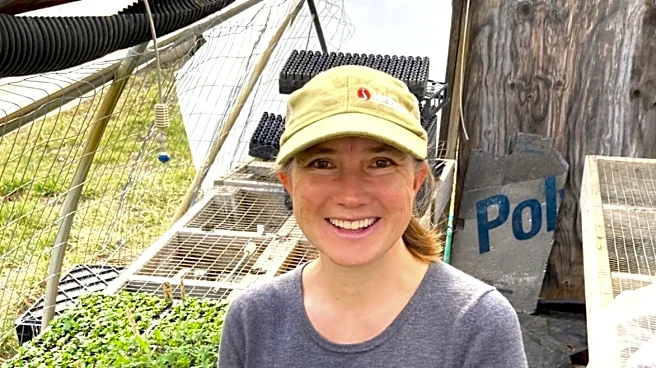






ASHEVILLE - Anna Littman remembers the mud first. Two to three feet of it filled the wash-and-pack shed at Littman's Ivy Creek Family Farm after Tropical Storm Helene tore through Barnardsville. Trees had fallen across hoop houses. Storage and irrigation sheds were flattened. Her bridge was broken. In some fields, holes carved by floodwaters were deep enough to reach her chest.
At one point, Littman looked around the shed and saw a doctor, a physics professor and an electrical engineer holding shovels. No, it’s not the beginning of some pithy joke — it was the reality of a community digging a farm out from beneath the wreckage Helene left behind.
“I was like, ‘Whoa, this is by far the most skilled volunteering I’ll ever have,’” she said.
Two years
later, the mud is gone, but the harder work remains. Across Western North Carolina, farmers who survived Helene are confronting a second phase of recovery that is less visible than washed-out fields and collapsed barns. Rebuilding a farm does not necessarily mean rebuilding a viable farm business. Producers are repairing soil, changing what they grow, searching for reliable buyers and confronting rising costs and shrinking access to agricultural land.
Littman and Nick Listo of Oak Holler Farm near Marshall arrived at that problem from opposite directions. Littman's farm suffered extensive physical damage. Listo’s farm largely escaped it. Both had to change anyway.

Helene stripped years from Barnardsville farm
Littman has farmed for about 18 years, growing on roughly 9.5 acres she owns or leases and sells through tailgate markets, restaurants, a farm stand and other outlets.
Helene took about an acre out of production and stripped topsoil from other fields. In some places, she said, the upper two to three feet of growing soil disappeared — soil she had spent 17 years building through cover crops and regenerative practices. The timing compounded the damage. Small farms do not stop growing when summer ends, Littman said. September and October are among her busiest months.
“The fields were really full, and so were the hoop houses,” she said.
After volunteers cleared debris, Littman faced questions with no obvious answers. Should she clean immediately or wait for FEMA? What would insurance cover? How many photographs would be enough? How could soil be rebuilt after a disaster unlike anything local growers had confronted?

“We did everything with a fear that we were doing the wrong thing,” Littman said.
She began repairing what she could, bringing in soil and organic material, rebuilding hoop houses and applying for assistance wherever it was available.
This year, another source of stability arrived.
MANNA FoodBank began connecting farms directly with food pantries and buying produce at market value through a multi-year effort designed to give farmers a predictable customer while supplying fresh food to people facing hunger.
Littman now delivers produce to a pantry about two miles from her farm, often harvested that morning or the previous day. She arrives before distribution begins and talks with the people waiting outside about what they want her to grow.
To Littman, the model changes where the response to hunger begins.
“It’s dealing with the issue of food insecurity, not starting with the empty plate, but starting with the seed,” she said.
Farmers lose buyers after Helene boom
Listo had a different experience. Oak Holler Farm, on just under 12 acres between Marshall and Mars Hill, lost trees and fences during Helene but escaped the catastrophic flooding suffered by farms elsewhere. He spent the immediate aftermath loading produce into his truck and taking food wherever it was needed.

“We survived, and we did our best to take care of others,” Listo said.
The economic blow came later. As emergency food demand surged after Helene, food banks became some of Listo’s largest customers. By mid-2025, he said, the disappearance of Healthy Opportunities Pilot funding wiped out much of that buying power. Two customers that had been purchasing roughly $2,000 a week folded, contributing to layoffs at his farm by the end of the year.
The disruption also changed his fields. Listo had traditionally grown the higher-turnover crops common in community-supported agriculture programs — tomatoes, peppers, greens and other produce customers expect week after week.
Relationships with MANNA FoodBank and other food organizations pushed him toward potatoes, storage cabbage, root crops and other produce that could last longer after harvest. The change allows his farm to supply food that can reach hundreds of families each week, he said, but he also sees a broader problem beyond any single funding stream.

Farmland around Asheville has become increasingly difficult for farmers to afford, he said, limiting his ability to expand even as demand for locally grown food continues.
His farm, purchased for about $170,000 roughly a decade ago, could now sell for more than $500,000, Listo said.
“I don’t know how you expand or grow your farm business when suddenly farmers are being completely priced out,” he said.
For farmers who stayed after Helene, higher fuel, material and operating costs have added another layer of uncertainty. Still, Listo keeps returning to the outlook embedded in the profession itself.
“We’re farmers,” he told the Citizen Times Oct. 1. "There’s always next year.”
MANNA sees recovery from both ends
For MANNA, the health of the region’s farms and the number of people needing food are increasingly connected.
The organization serves 16 western counties and the Qualla Boundary through more than 330 partners. Last year, it distributed more than 24 million pounds of food.
When Helene tore through the mountains on Sept. 27, 2024, floodwaters overwhelmed MANNA’s Swannanoa River Road facility, upending the operations of an organization that serves as many as 190,000 people a month.
Now, CEO Claire Neal says food donations have declined 24% over the past two years as farms, businesses and households throughout the region continue absorbing Helene’s economic impact.

Some farmers lost operations entirely. Others rebuilt land that may take years to return to full productivity.
MANNA has responded in part by making a multi-year commitment to purchase local produce at market value from farmers like from Littman and Listo, providing them with income they can plan around while putting locally grown food into emergency food distributions.
The organization has also felt the loss of the Healthy Opportunities Program. Neal said MANNA dismantled its portion of the program after state funding disappeared, although it retained enough infrastructure to restart if funding returns. The current state budget contains partial funding, she said, but how much will support food programs remains uncertain.
Meanwhile, the people who depended on that help did not stop needing food.
That leaves organizations such as MANNA responding to greater demand while many of the farmers who help supply WNC are still rebuilding themselves. Two years after Helene, Neal said, progress can obscure how much remains unfinished.
“The community has come together in really beautiful ways. People look out for each other. They support each other, but that doesn’t mean that all the work is done,” Neal said. “There’s always this tension — there’s so much progress and there’s so much to celebrate, and at the same time, right now we’re seeing this record-breaking need as well. It’s possible for both of those things to be true.”
Cory Vaillancourt is the Helene Recovery/Investigations Reporter for the Asheville Citizen Times. Find him on X at @The_CoryV or on Signal, via email at cvaillancourt@citizentimes.com or at 912-508-5640.
This article originally appeared on Asheville Citizen Times: These WNC farms survived Helene. Their next challenge is bigger