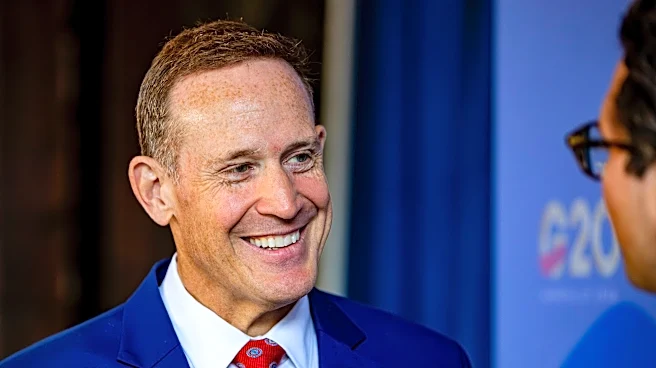

ASHEVILLE - U.S. Sen. Ted Budd used a visit to the G20 meetings in Asheville Sept. 1 to press for more federal money for Tropical Storm Helene recovery, defend the Trump administration’s handling of delayed
reimbursements and argue that stronger economic growth — rather than a greater emphasis on climate change — would make communities better prepared for future disasters.
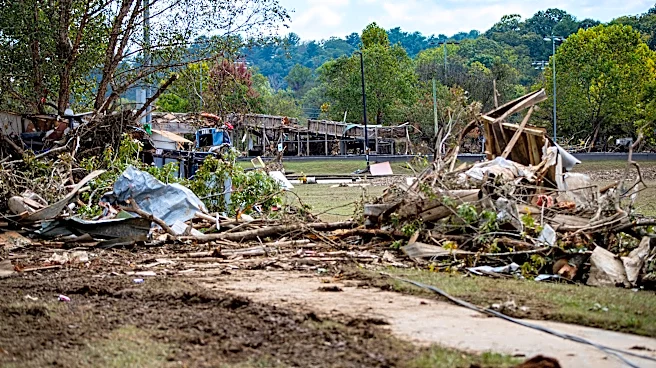
The stakes remain enormous nearly two years after the Sept. 27, 2024 storm. North Carolina now estimates Helene caused $60 billion in damage and recovery needs, including $44.4 billion in direct damage. As of June 30, the federal government had approved, allocated or awarded about $9.7 billion for the recovery, according to the Governor’s Recovery Office for Western North Carolina.

Budd vowed in June to vote against any supplemental appropriations package that did not include more money for Helene recovery. The legislation under discussion centered on military spending but also contained aid for Florida farmers who suffered weather-related losses. While Budd admits funding for those particular needs is critical, he has not lost sight of the region's ongoing needs.
“If you're going to add extra things outside supporting our warfighters and our military, let's make sure that you're including Western North Carolina too,” Budd told the Citizen Times at the Omni Grove Park Inn Sept. 1.
Gov. Josh Stein has sought another roughly $10 billion from Washington, revising an earlier request as federal and state money has been awarded and damage estimates have changed. The June request includes more than $3 billion for housing, about $3 billion for local infrastructure and $1 billion for water, wastewater and stormwater projects.

“The governor and I are in discussions on this and how we come to the calculation of what the right number is,” Budd said. “But I can guarantee you that 'zero' is the wrong number.”
Budd has repeatedly criticized the Biden administration over the federal response to Helene. Democratic President Joe Biden was a lame duck president five weeks after the storm, and was out of office just over three months later. President Donald Trump and his "recovery czar" Michael Whatley have now been at the helm for more than 20 months. Budd returned first to the storm’s earliest days, describing saturated ground and extraordinary rainfall before turning to Trump’s visits to the region and his administration’s response.
“Actually, even before day 1, at the end of this storm, early October (2024) he was down in Swannanoa. He was in Black Mountain. He was checking this out. He was on the phone. He's done a fine job, and he's never let up, and that's one of the things that I hear from Western North Carolinians — please don't forget about us,” Budd said. “President Trump never has.”

Much of Budd’s confidence now rests with Homeland Security Secretary Markwayne Mullin, the former Oklahoma senator who took over DHS earlier this year, and FEMA Administrator Cameron Hamilton, who was confirmed Aug. 10. Budd said Mullin flew to Asheville soon after taking office and accompanied him to Bat Cave. He also pointed to their shared backgrounds outside government.
“He puts great people around him,” Budd said. “He cuts through red tape, and he puts great folks in spots like the FEMA administration and Cam Hamilton.”
Promises vs. performance

That leaves a distinction increasingly important to county managers, town managers and finance officers across the mountains — the difference between federal dollars announced in Washington and reimbursements that reach local accounts.
FEMA project data dated Aug. 28 showed $2.484 billion in federal obligations statewide across 2,942 Helene projects. In nine heavily damaged WNC counties examined by the Citizen Times, $558.1 million had been obligated across 1,201 projects. But an obligation makes federal money available for an approved project and does not establish when a county or municipality actually receives the cash. The state’s latest quarterly report does not separately publish a consolidated total for money deposited with local governments. As of June 30, it listed about $2.35 billion in FEMA Public Assistance funding as allocated or disbursed among state agencies, local governments and nonprofits.
Budd said he has pressed state and county officials to trace delayed reimbursements and identify where money becomes stuck, particularly after local governments spent tens of millions of dollars on debris removal.
“Finally, that money is starting to move and giving some relief to these counties,” Budd said.

Climate change has received less attention at the Asheville G20 meetings than at some previous gatherings. Budd tied disaster resilience instead to the conference’s emphasis on economic growth, energy costs and international stability.
“What we need to focus on, in the theme of this conference, has really been about working together and resilience and growth. So the more we grow, the more we can afford to be resilient, and the more we're resilient, the tougher we are when we do have weather events," Budd said.
Cory Vaillancourt is the Helene Recovery/Investigations Reporter for the Asheville Citizen Times. Find him on X at @The_CoryV or on Signal, via email at cvaillancourt@citizentimes.com or at 912-508-5640.
This article originally appeared on Asheville Citizen Times: NC Sen. Ted Budd speaks on Helene recovery at G20