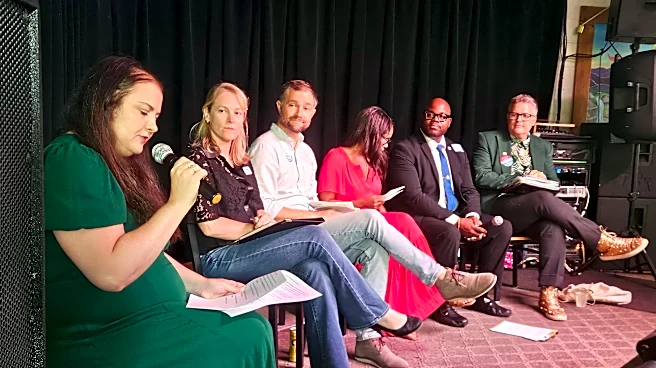







Nearly everyone in West Asheville’s One World Brewing shot up a hand Sept. 16 when Keith Young asked who among them was a Democrat.
The Asheville City Council candidate wasn’t surprised. After all, he and four other Democratic Council candidates — Drew Ball, Jeffrey Burroughs, Antanette Mosley, and Maggie Ullman — were there for a forum hosted by the Buncombe County Democratic Party. “We all agree on 99.9 of the same stuff,” Young declared.
But the candidates did reveal some differences of opinion over the nearly 90-minute forum, moderated by Mountain Xpress contributor Jessica Wakeman. On questions of leadership style and transparency, the five hopefuls laid out alternative approaches for how Asheville’s governing body should function.
Mosley,
the city’s vice mayor, and Ullman are incumbents seeking reelection on the November ballot. Young is a former council member looking to return to government after losing his seat in 2020. Ball currently serves on the Buncombe County Board of Commissioners. Of the six candidates competing for the three available Council seats, only Burroughs has never before held political office.
Incumbent Council Member Sheneika Smith, also a Democrat, did not respond to repeated invitations to the forum, according to West Asheville Democrats cluster leader David Perry.
‘Kumbaya votes’
In one question, Wakeman pointed out that the seven-member council needs a four-vote majority to make any policy change. She asked the candidates how they would go about securing those votes for the priorities they believe in.
Some responded by emphasizing the power of broad consensus. Ullman said she was proud of unanimous council votes that had resulted from long discussions among members and the public. “You do need four votes, right — ideally, you have seven,” she said.
Burroughs and Ball also valued a more conciliatory approach. Ball noted he had worked to build rapport with Republicans in Raleigh — “Don’t hold it against me,” he joked to the Democratic crowd — to get state support for Buncombe County goals. And Burroughs, who uses they/them pronouns, said their experience as a community organizer had taught them to “not let perfection kill a great idea.”
In contrast, Young took a harder line. While he said it was important to keep good working relationships with other council members, he pointed to split votes he had driven on issues like policing policy during his previous term.
“That’s how it works. That’s government. You’re not going to have kumbaya votes across the board,” Young said.
Mosley emphasized the value of sometimes voting in the minority. She said protest votes, such as her recent objection to cancelling Asheville’s contract with Flock Safety, could elevate community perspectives that would otherwise be ignored.
Opening doors?
Wakeman also asked the candidates about their attitudes toward council’s “check-in” or “three-by-three” meetings. Open government advocates have argued that these private gatherings allow council members and staff to evade North Carolina’s open meeting requirements.
Ball and Burroughs both advocated for doing as much of council’s work in public as possible. Ball said he’d pushed for the county to move more of its own discussions into public briefings, while Burroughs said the structure of check-ins — which require staff to repeat the same information to different elected officials multiple times — was “from a common-sensical standpoint a little redundant.”

Ullman, however, said some sensitive city matters were best served by the check-in format. She referenced early discussions in this year’s budget cycle, where council members were asked to consider staffing cuts as a strategy for balancing Asheville’s finances.
“As someone who stewards a $250 million budget with 1,400 people and their families, I thought that was appropriate to have that as a private conversation instead of on the headlines,” Ullman said.
Young said he couldn’t talk to council’s current use of check-ins but suggested they had improved information sharing during his previous term. Mosley echoed that theme, saying she’d be willing to eliminate the meetings but that “some parts of our community will suffer” if council chooses to do so.
Asked for clarification after the meeting, Mosley told the Citizen Times that she didn’t have any particular community group in mind. Instead, she said that without check-ins, some Council members could find themselves working with less information than others.
Role models
The forum’s last question asked each candidate to name the leader whose example of public service they most hoped to follow.
Young choked up with emotion as he recalled the late Isaac Coleman, a Black Asheville leader who played a key role in the civil rights movement and in building opportunity for Black residents. He said Coleman had given him the confidence to run for office when “nobody gave me a chance.”
Mosley also referenced a departed local civil rights leader, the attorney James Ferguson. “He taught me how to walk softly and carry a big stick, mean what you say and say what you mean, be respectful, and get the job done,” she said.

Burroughs named a trio of leaders: U.S. Rep. Alexandria Ocasio-Cortez, state Attorney General Jeff Jackson, and former U.S. Secretary of Transportation Pete Buttigieg. They said the last of these — the first openly gay Cabinet secretary — showed them that there was “space at the table somebody who’d had my lived experience to come and share and inform policy from that perspective.”
Ullman said she admired her mother, Wendy Ullman, who in 2019 became the first Democratic state representative for her Pennsylvania district after decades of Republican leadership. Although her mom was a college professor and a political novice, Ullman said, she was motivated to make a difference in government after the first election of President Donald Trump.
And Ball praised the late North Carolina Gov. Terry Sanford, a progressive Democrat who worked for racial integration and education funding in the 1960s. “He was in it for the people. He was in it for the right reasons,” Ball said.
Voting by mail is already underway in Asheville's City Council election. In-person early voting in Buncombe County runs Thursday, Oct. 15, through Saturday, Oct. 31. Election Day is Tuesday, Nov. 3.
Daniel Walton is the City Government Watchdog Reporter for the Asheville Citizen Times. Email him at dwalton@gannett.com.
This article originally appeared on Asheville Citizen Times: Asheville City Council candidates talk leadership, transparency