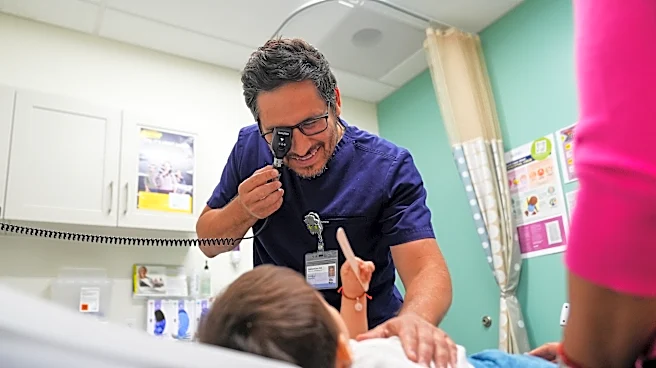









September is NICU Awareness Month, a time to recognize some of our smallest patients, their families and the specialized teams who care for them. It is also an opportunity to help our community understand neonatal intensive care, why different levels of newborn care exist and why having advanced care close to home matters.
A neonatal intensive care unit, or NICU, is designed for newborns who need more medical support than a well-baby nursery can provide. Some babies are born prematurely or at a very low birth weight. Others experience breathing difficulties, infection, complications during delivery or other conditions requiring close monitoring and treatment.
For families, a NICU admission can be unexpected and overwhelming. The hours after a baby's
birth are usually imagined as a time for holding, bonding and going home together. For NICU parents, those expectations can change in an instant. Some have a baby so small or medically fragile that they cannot hold them right away and instead find themselves beside an incubator, surrounded by monitors, wondering what the next hours, days or months will bring.
Behind that technology is a team focused on helping each baby grow stronger. Neonatologists, Neonatal Nurse Practitioners, neonatal nurses, respiratory therapists, pharmacists, nutrition specialists and other clinicians provide individualized care while helping parents participate in their baby's care, ask questions, understand each step and gain confidence caring for their baby as they prepare for the day their child can go home.
Not every hospital provides the same level of neonatal care. The American Academy of Pediatrics describes four levels of newborn care, from Level I through Level IV, based on the needs of the babies a facility is equipped and staffed to treat. Unlike trauma center designations, NICU levels increase with the complexity of care provided.
Level I nurseries primarily care for healthy, full-term and stable near-term babies and can stabilize newborns who need to be transferred for more specialized care. As the levels increase, so do the clinical expertise, technology and resources available to care for babies with more complex needs.
Level III NICUs provide comprehensive intensive care for critically ill newborns and babies born at all gestational ages and birth weights, including those born extremely premature or at very low birth weights. They provide advanced respiratory support and sustained life support, backed by specialized clinicians, technology and resources available around the clock.
Here in Western North Carolina, Mission Hospital is home to the region's only Level III NICU. That designation is more than a label. It means families have local access to a team prepared to care for critically ill and premature newborns 24 hours a day.
For a baby born months before their due date, a NICU stay may last not days or weeks, but months. Having this care close to home means parents can remain near their baby through a long, uncertain journey, celebrating progress and being present for important milestones, without also facing the burden of traveling hours away or temporarily relocating for care.
The NICU is about far more than advanced equipment. Newborns need care that supports development as well as survival, while parents need communication, compassion and opportunities to bond with their babies. In the NICU, milestones most of us rarely think about can become enormous victories: gaining another ounce, breathing with less assistance, taking a first bottle, being held for the first time or finally going home.
As a physician, I am continually reminded that caring for a newborn means caring for an entire family. Parents are essential members of the care team. Their voices, questions and presence matter, and helping them understand what is happening is part of excellent neonatal care.
NICU Awareness Month gives us a chance to honor the strength of these families and the dedication of the clinicians who care for their babies. It also reminds us of the importance of strong neonatal services within our region.
Most families never expect to need a NICU. But when a baby arrives too early, is critically ill or needs specialized support, the right care must be ready. For a family whose world has suddenly narrowed to a tiny baby in an incubator and the hope of taking that baby home, having that care close by matters in ways difficult to measure. For families across Western North Carolina, Mission Hospital's Level III NICU means advanced newborn care is here when it is needed most, close to the communities they call home.

Dr. Erik Thingvoll is a neonatologist at Mission Hospital in Asheville.
This article originally appeared on Asheville Citizen Times: Opinion: When the smallest patients need the highest level of care