







ASHEVILLE – A group of healthcare advocates rolled into Asheville Oct. 15 to protest rising medical costs and inaction by Congress and the North Carolina General Assembly by amplifying one simple message — they're "sick of it."
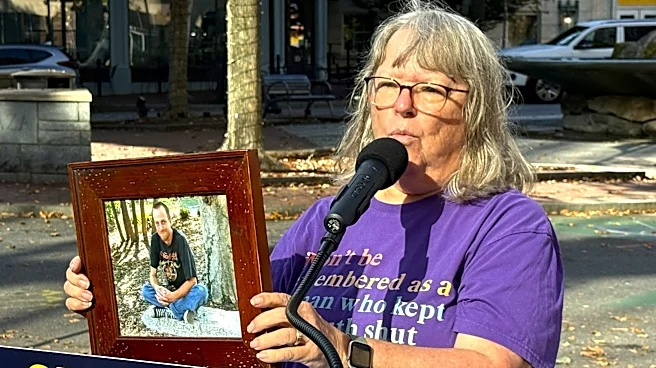
“I'll tell you what killed him — bad public policy,” Leslie Boyd told a crowd gathered in Pack Square Park. Boyd was talking about her son, who died after being unable to obtain the medical care he needed for a birth defect. His death, she argued, was preventable, and his treatment ultimately cost far more than regular preventive care would have.
“You take a decent human being and tell him he's going to die because he had a birth defect, like it was his fault,” Boyd said. “He was a college student. He worked 30 hours a week.
He was a volunteer. He was an extraordinary human being, and none of that mattered.”

Boyd was among the speakers at a rally organized by Protect Our Care, a national advocacy group conducting a four-week bus tour ahead of the Nov. 3 midterm elections.
The event brought state Reps. Brian Turner and Lindsey Prather together to criticize federal Medicaid reductions and the expiration of enhanced Affordable Care Act tax credits.
Boyd recalled how some conservatives questioned whether her son was working when he became sick, an assumption she said reflected a broader tendency to blame people for circumstances beyond their control.
“Poverty is a public policy,” she said. “We make people vulnerable and then criticize them and call them lazy when they can't make ends meet.”
NC Democrats condemn federal health care cuts
Turner, who represents part of Buncombe County in the General Assembly, criticized President Donald Trump and congressional Republicans for approving legislation that reduces projected federal Medicaid spending while delivering tax benefits to wealthy Americans.
The legislation, commonly called the One Big Beautiful Bill, also imposes additional eligibility requirements that Turner argued will make obtaining and maintaining coverage more difficult.
He contrasted an estimated $280,000 annual tax benefit for wealthy individuals with the earnings of someone eligible for Medicaid, who would need more than 12 years of full-time work to earn that amount.

“That math does not math in a functioning society or democracy,” Turner said. The consequences, he warned, would extend beyond Medicaid recipients.
Millions of Americans who purchase insurance through Affordable Care Act marketplaces face substantial premium increases following the expiration of enhanced federal tax credits, adding thousands of dollars to household budgets already strained by rising food, housing and fuel expenses.
Turner said that losing affordable insurance forces people to postpone routine medical treatment, allowing preventable conditions to become expensive emergencies.
Those costs can ripple throughout the health care system, increasing uncompensated care while jeopardizing financially vulnerable rural hospitals, clinics and nursing homes.
“Medicaid cuts plus increasing premiums equals what? It equals a loss of access,” Turner said. “It means more people sick and dying of preventable and treatable illnesses.”
Western North Carolina hospitals face growing risks
Prather, another Buncombe County Democrat, focused on the implications for Western North Carolina residents and medical providers.
She said 888,000 North Carolinians have experienced doubled premiums, while hospitals and clinics statewide face a projected $437 million funding loss and a 3.3% increase in demand for uncompensated care.
Among facilities she identified as financially vulnerable were Blue Ridge Regional Hospital, HCA/Mission facilities and Western North Carolina Community Health Services locations in Asheville, Candler and McDowell County.
Financial pressure could lead facilities to reduce staffing, eliminate services or close, forcing patients to travel farther for treatment.
Prather offered the example of a North Carolina family of four earning $130,000 annually whose average insurance premiums increased $13,428, reaching $24,478.

“Literally, what are people supposed to do?” she asked.
She also criticized the federal Rural Health Transformation Program, intended to support rural medical providers, as inadequate to offset the broader Medicaid reductions.
“Of course, we will take what we can get so that folks can stay open a little bit longer,” Prather said. “But it is not going to be enough unless something drastic changes.”
Prather faulted the Republican-controlled General Assembly for failing to adequately prepare for the potential financial consequences.
The Asheville rally marked the ninth stop on Protect Our Care's “Sick of It! Fix Health Care Now” tour, which is scheduled to make nearly 40 stops nationwide and has already visited states from Maine to Georgia and Maryland to Kentucky.
The organization advocates restoring enhanced Affordable Care Act premium tax credits, reversing Medicaid reductions, expanding Medicare's prescription drug price negotiation authority and extending Medicare cost protections to privately insured patients.
Organizers cited polling from KFF indicating that health care costs are a leading concern for voters ahead of November's elections.
Prather urged residents to pressure their elected representatives before additional coverage losses and provider reductions take effect.
“We need people to help force those in power to listen when we say that healthcare is essential, healthcare is a right, and healthcare should never be the reason that someone goes into debt,” she said.
Cory Vaillancourt is the Helene Recovery/Investigations Reporter for the Asheville Citizen Times. Find him on X at @The_CoryV or on Signal, via email at cvaillancourt@citizentimes.com or at 912-508-5640.
This article originally appeared on Asheville Citizen Times: Asheville health care rally targets Medicaid cuts, rising insurance premiums