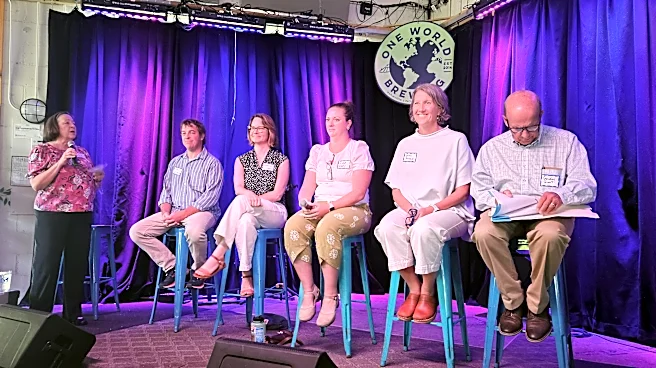






There was no musical accompaniment for the five Asheville City Schools Board of Education candidates who took the stage at West Asheville’s One World Brewing. But the sound of strings was an unmistakable subtext for their Wednesday evening forum.
The event, hosted by the Buncombe County Democratic Party, marked the first public appearance of incumbent school board members since the board voted Aug. 10 not to restore the Asheville City Schools orchestral program. Superintendent Maggie Fehrman canceled the program Aug. 3, citing low enrollment and budget limitations.
Three incumbents — board Chair Sarah Thornburg, Vice Chair Rebecca Strimer and Liza English-Kelly — are up for reelection. Challenging them are first-time candidates Daria Datnoff,
Gordon Grant and Daniel Shetley. Voters in the Asheville City Schools district will choose four of the six on November’s ballot. (As an unaffiliated candidate, Datnoff was not invited to the Democrat-run event.)
Thornburg and Strimer had voted against the orchestra program, while English-Kelly voted to preserve it. While the candidates only mentioned that specific cut a handful of times, they worked to stake out different positions on underlying issues such as budgeting, school culture and oversight of the superintendent.

‘Adults have to make hard decisions’
English-Kelly directly criticized the orchestra moves in her opening remarks, tying it to other ACS decisions like the closures of Montford North Star Academy and Asheville Primary School. “We tend to embrace a scarcity mindset in Asheville City Schools, where programs and schools are pitted against each other, and I am running again in the hopes of changing that culture,” she said.
In contrast, Strimer said the school board had to acknowledge its limited capacity, which she tied largely to state-level decisions around education funding. Although North Carolina’s legislature recently voted to raise teacher salaries, the state’s per-student spending remains well below the national average.
“There’s no limit to what children deserve, but there are limits to the resources that we get to use,” Strimer said. “So, the adults have to make hard decisions sometimes to say, ‘How will we put our energy and our resources toward what is going to do the best for the most?’”
Strimer and Thornburg both highlighted the financial stability they’d help bring to the school system by hashing out a new funding formula with Buncombe County. The school board’s role in budgeting, Thornburg said, should be to advocate for resources and set a high-level strategic direction, rather than second-guess tactical decisions.
“Speaking for myself, I am inclined not to micromanage the superintendent,” she said. “Different board members come at it differently.”
Shetley, a parent of two ACS students, noted that one of his own children was impacted by the Montford school closure. He said that his family and others “didn’t feel we were heard” when the administration made that decision. While he emphasized the importance of better listening, he generally agreed that the board’s main role should be providing a vision for the system.
Grant, a retired educator and a former principal at Hall Fletcher Elementary School, struck a middle ground. He said board members should be in partnership with the superintendent as he or she implements their broader vision.
“We can’t micromanage,” said Grant. “But we certainly can manage fund allocations if we don’t feel that that’s in keeping with our strategic plan.”
Narrowing the gap
The candidates also addressed the system’s struggles with the “achievement gap,” the persistent tendency of Black students to score worse than white students in reading and math proficiency. ACS has long had one of the worst such gaps among North Carolina school systems.
Strimer called the achievement gap “the No. 1 most important thing that we have to stay focused on.” She said the board had directed Fehrman to take bold action on the gap after hiring her in 2023 and was ready to accept the “hard times” that might be necessary to see that goal through.

Thornburg agreed, saying that “almost every decision we make” is designed with the achievement gap in mind. She added that even naming the gap’s existence was a step in the right direction — several years ago, the system had rebranded it as the “opportunity gap.” Thornburg said the Black community “felt like we were using flowery language to hide it.”
Reforming the school system’s culture, said English-Kelly, was critical for closing the gap. She recalled an incident when, while she was working as an assistant teacher, an ACS administrator told her and other educators to stop writing Black students up for disciplinary issues.
“That person still works for the district, and the idea of lowering the bar for Black and brown students to achieve is a persistent idea,” said English-Kelly. “We need to celebrate Black excellence and stop equating demographics with ability.”

Grant suggested that ACS should look toward schools in states like Mississippi, which has drawn national attention for its rapid improvement in reading scores, and Alabama, which holds students back from fourth grade if they don’t demonstrate reading proficiency.
“Reading is the central issue. No disrespect to math, but reading is the door to everything else,” said Grant.
And Shetley pushed for schools to improve families’ involvement in their children’s education. He said that board members could play a key role in facilitating that engagement.
“We need to be able to get folks to the table and address issues early on, not when we are starting with the standardized testing third grade,” he said. “If we do that, we can start looking at some of this gap, and it will improve.”
Daniel Walton is the City Government Watchdog Reporter for the Asheville Citizen Times. Email him at dwalton@gannett.com.
This article originally appeared on Asheville Citizen Times: Asheville school board hopefuls debate budgeting, system culture