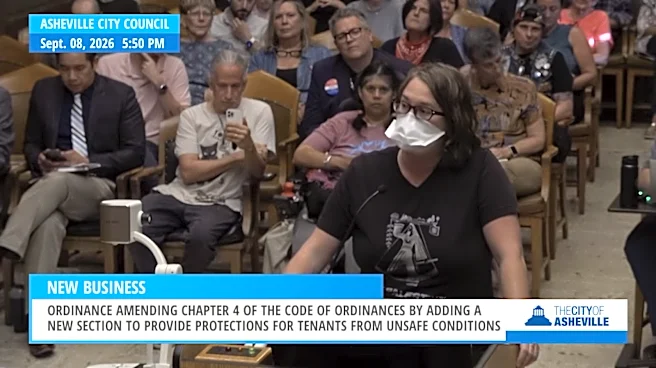









In the clunky argot of local government, the language that Asheville City Council passed on Sept. 8 was Section 4-209(c) of the city Code of Ordinances. Local advocates had a much catchier name for it: “No Rent for Slumlords.”
The new rule, unanimously supported by Council members, makes it illegal to collect rent on a property that Asheville has deemed unsafe. City ordinances list 18 different criteria — such as lack of hot water, a heating system, or smoke detectors — that would qualify a building as “unfit for human occupancy.”
Council considered the change at the behest of the Asheville Area Tenants Union, a branch of the North Carolina Tenants Union established in 2025. While city employees helped craft the legal language for consideration,
according to a staff report, they did not provide an opinion on whether to pass the change.
During public comment on the matter, several AATU members said the rule would help them hold their landlords accountable for what they characterized as dire circumstances.

Tenant union member Rachel Wyse shared her own experiences as a tenant at Evergreen Ridge Apartments in East Asheville. She alleged that her neighbors often lacked functional heating and air conditioning, and that elderly residents with limited mobility were “functionally trapped” in overheated apartments over the summer due to inoperable elevators. Older people are especially vulnerable to heat stroke, which can be fatal if not treated quickly.
“It is past time for landlords, like those who own Evergreen Ridge, to be reminded that they too have legal obligations.” Wyse declared. “There are consequences for choosing to put people’s lives and dignity and safety at risk for their own personal profits.”
Real estate representatives and property managers who spoke at Council generally supported the ordinance, but they stressed that the city needed to avoid harming responsible landlords. They also questioned the speed with which Asheville was adopting the change, noting that the rule had skipped the usual step of a Council committee discussion.

Mayor Esther Manheimer assured those property owners that the new language would not change Asheville's existing process for addressing resident complaints. Tenants must still file a complaint with the city’s code enforcement officers, which triggers a notice and hearing process that can take up to 30 days.
Only after a formal finding that a dwelling is unsafe, Manheimer said, would the new ordinance’s rent restrictions go into effect. And while the city’s language would prevent those landlords from charging rent, she noted, state law says tenants cannot “unilaterally withhold rent” due to landlord negligence.
By passing “No Rent for Slumlords,” Asheville joins a handful of other North Carolina cities. The most recent to approve the measure was Durham in October. Others include Charlotte, Pineville, and Pittsboro.

Jen Hampton, staff organizer for the AATU, told the Citizen Times that her group next hopes to tackle mold regulation. Although Asheville residences increasingly have issues with mold — especially following Tropical Storm Helene, as previously reported by Blue Ridge Public Radio and Grist — neither city nor state rules explicitly mention it as an unsafe condition.
Hampton said Asheville activists had already begun drafting a mold policy together with the state-level tenant union and could start advocating for change as soon as next month.
City Council members also seemed eager to make changes around mold, with both Sage Turner and Bo Hess expressing support at Tuesday’s meeting. City Attorney Brad Branham, however, said Asheville would have likely have little power to develop its own rules until North Carolina established legal standards for mold in its building code.
Daniel Walton is the City Government Watchdog Reporter for the Asheville Citizen Times. Email him at dwalton@gannett.com.
This article originally appeared on Asheville Citizen Times: Asheville targets slumlords with new rent rule